If you have ever asked, “What’s a synonym?”, you are already thinking like a smart writer, student, or ESL learner. This phrase is very common when people want to understand words better, improve vocabulary, or find a clearer way to say something.
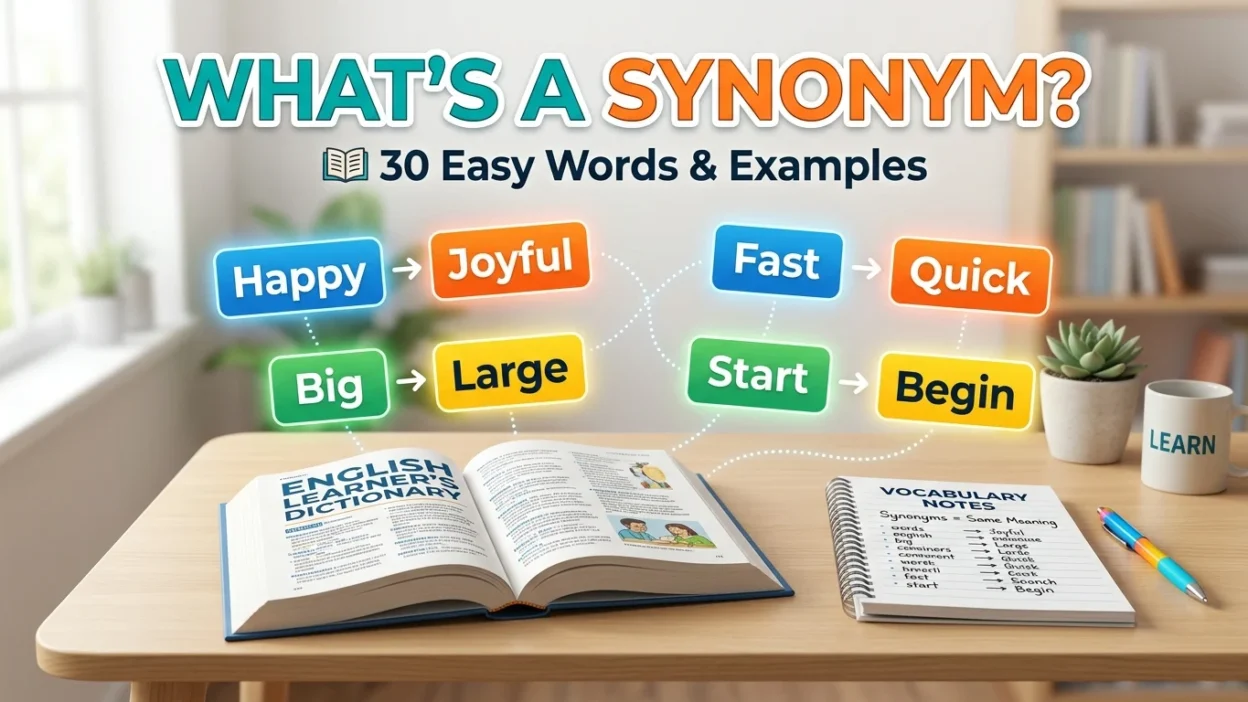
In simple English, a synonym is a word that has the same or very similar meaning as another word. For example, “happy” and “joyful” are synonyms. Learning synonyms helps you write better, speak more clearly, and understand English in a deeper way.
This guide explains what’s a synonym in easy language and gives you 30 useful related phrases and alternatives. It is designed for students, writers, content creators, and anyone who wants to improve vocabulary in a simple, friendly way.
What Does “What’s a Synonym” Mean?
The phrase “what’s a synonym” is a question people ask when they want to know another word with the same or a similar meaning.
For example:
- What’s a synonym for big?
- What’s a synonym for help?
- What’s a synonym for smart?
This phrase is very useful in school, writing, reading, and daily conversation. It helps you find better words, avoid repeating the same word again and again, and make your English sound more natural.
30 Helpful Synonyms and Related Phrases
Below are 30 simple phrases that people may use instead of saying “what’s a synonym.” These are not all exact synonyms in the dictionary sense, but they are useful alternatives with similar meaning and purpose.
1. Similar word
Meaning: A word that has a close meaning.
Example sentence: Can you give me a similar word for “nice”?
Best usage context: Good for simple everyday English.
2. Same meaning word
Meaning: A word that means the same thing.
Example sentence: “Begin” is a same meaning word for “start.”
Best usage context: Best for learners who want very easy English.
3. Word with the same meaning
Meaning: A word that has the same meaning as another word.
Example sentence: I need a word with the same meaning as “fast.”
Best usage context: Useful in school and ESL writing.
4. Alternative word
Meaning: Another word you can use.
Example sentence: Try an alternative word to avoid repeating “good.”
Best usage context: Great for writers and editors.
5. Another way to say it
Meaning: A different expression with the same idea.
Example sentence: Another way to say “big” is “large.”
Best usage context: Very natural in speaking and teaching.
6. Related word
Meaning: A word connected in meaning.
Example sentence: “Run” is a related word in this sentence.
Best usage context: Useful when the meaning is close but not exact.
7. Equivalent word
Meaning: A word that matches in meaning.
Example sentence: “Tiny” is an equivalent word for “small” in many cases.
Best usage context: Good for formal or academic English.
8. Replacement word
Meaning: A word used instead of another.
Example sentence: “Joyful” can be a replacement word for “happy.”
Best usage context: Useful for writing and editing.
9. Matching word
Meaning: A word that fits the same meaning.
Example sentence: Find a matching word for “quick.”
Best usage context: Simple and easy for beginners.
10. Closest word
Meaning: The word nearest in meaning.
Example sentence: “Brave” is the closest word to “courageous.”
Best usage context: Good when no exact synonym exists.
11. Vocabulary alternative
Meaning: Another vocabulary choice.
Example sentence: I need a vocabulary alternative for “important.”
Best usage context: Helpful for learners building word variety.
12. Same meaning phrase
Meaning: A short group of words with the same meaning.
Example sentence: “A lot of” is a same meaning phrase for “many.”
Best usage context: Useful when one word is not enough.
13. Word substitute
Meaning: A word that replaces another one.
Example sentence: “Buy” is a word substitute for “purchase” in casual speech.
Best usage context: Good for general writing and speaking.
14. Better word choice
Meaning: A stronger or clearer word.
Example sentence: “Excellent” is a better word choice than “good” here.
Best usage context: Great for writers improving style.
15. Different expression
Meaning: A different set of words with the same idea.
Example sentence: “Take a break” is a different expression for “rest.”
Best usage context: Helpful in speaking and casual writing.
16. Word with similar meaning
Meaning: A word that means almost the same thing.
Example sentence: Give me a word with similar meaning to “angry.”
Best usage context: Very common in ESL learning.
17. Meaning match
Meaning: A word that matches the meaning.
Example sentence: “Silent” is a meaning match for “quiet.”
Best usage context: Easy for beginners to understand.
18. Same idea word
Meaning: A word that gives the same idea.
Example sentence: “Child” is a same idea word for “kid.”
Best usage context: Good for simple conversation.
19. Word option
Meaning: One possible word choice.
Example sentence: “Rapid” is a word option for “fast.”
Best usage context: Useful when comparing several choices.
20. Language alternative
Meaning: Another choice in language.
Example sentence: “Calm” is a language alternative to “peaceful.”
Best usage context: Helpful in writing and classroom work.
21. Synonym suggestion
Meaning: A recommended word with similar meaning.
Example sentence: The teacher gave me a synonym suggestion for “hard.”
Best usage context: Common in learning and editing.
22. Word comparison
Meaning: A way to compare two words with similar meanings.
Example sentence: This lesson gives a word comparison for “big” and “large.”
Best usage context: Useful for study guides.
23. Meaning based word
Meaning: A word chosen because of its meaning.
Example sentence: “Small” is a meaning based word for this sentence.
Best usage context: Good for academic explanation.
24. Same sense word
Meaning: A word that carries the same sense.
Example sentence: “Glad” is a same sense word for “happy.”
Best usage context: Simple and useful in learning English.
25. Close match
Meaning: Something that is almost the same in meaning.
Example sentence: “Huge” is a close match for “very big.”
Best usage context: Best when exact meaning is not needed.
26. Word replacement
Meaning: A word used to replace another word.
Example sentence: Try a word replacement for “said” in your story.
Best usage context: Useful in creative writing.
27. Better phrasing
Meaning: A clearer or stronger way to say something.
Example sentence: “Raise your hand” is better phrasing than “put up your hand” in some contexts.
Best usage context: Good for improving sentences.
28. Meaning swap
Meaning: A word or phrase that swaps one meaning for a similar one.
Example sentence: “Begin” is a meaning swap for “start.”
Best usage context: Easy for casual explanation.
29. Word with close meaning
Meaning: A word that is very similar in meaning.
Example sentence: “Tiny” is a word with close meaning to “small.”
Best usage context: Helpful for dictionaries and lessons.
30. Similar expression
Meaning: A phrase that says nearly the same thing.
Example sentence: “At once” is a similar expression to “immediately.”
Best usage context: Good when looking for phrases, not just single words.
Quick Guide: When to Use Each Type of Synonym
| Type | Best Use | Example |
| Exact synonym | When the meaning is almost the same | happy → joyful |
| Near synonym | When the meaning is close, not perfect | big → large |
| Formal synonym | For academic or professional writing | help → assist |
| Casual synonym | For everyday speech | buy → get |
| Phrase alternative | When one word is not enough | start → begin to do |
This simple guide helps you choose the right word for the right situation. Not every synonym works in every sentence. Tone, formality, and context matter a lot.
How to Choose the Right Synonym
Choosing the right synonym is not only about meaning. It is also about style, tone, and purpose.
1. Choose based on meaning.
First, make sure the word means what you want. Some words look similar but are used differently.
2. Choose based on tone.
Some words sound formal, while others sound casual. For example, “assist” sounds more formal than “help.”
3. Choose based on context.
A word may work in one sentence but not another. Always check how it fits with the full sentence.
4. Choose based on your audience.
If you are writing for students, simple words are often best. If you are writing a report, stronger or more formal words may be better.
5. Choose based on clarity.
The best synonym is the one that makes your meaning easy to understand.
Why Learning Synonyms Is Important
Learning synonyms helps in many ways. It improves your vocabulary, makes your writing more interesting, and helps you avoid repeating the same word too often. It also helps you understand reading material better because you can recognize different words with similar meanings.
For ESL learners, synonyms are especially helpful because they build confidence in speaking and writing. For writers and content creators, synonyms add variety, style, and fluency.
Conclusion
So, what’s a synonym? In simple English, it is a word that has the same or very similar meaning as another word. Learning synonyms makes English easier, clearer, and more flexible.
The 30 alternatives in this guide can help you understand language better and choose stronger words in your writing. Whether you are a student, ESL learner, writer, or content creator, synonym knowledge is a powerful tool for better communication.
Keep practicing, keep reading, and keep exploring new words. The more synonyms you learn, the more natural your English will become.

Logan Hayes is a professional editor and language researcher passionate about improving English skills. He creates informative articles that encourage confident writing, stronger vocabulary, and effective everyday communication.