
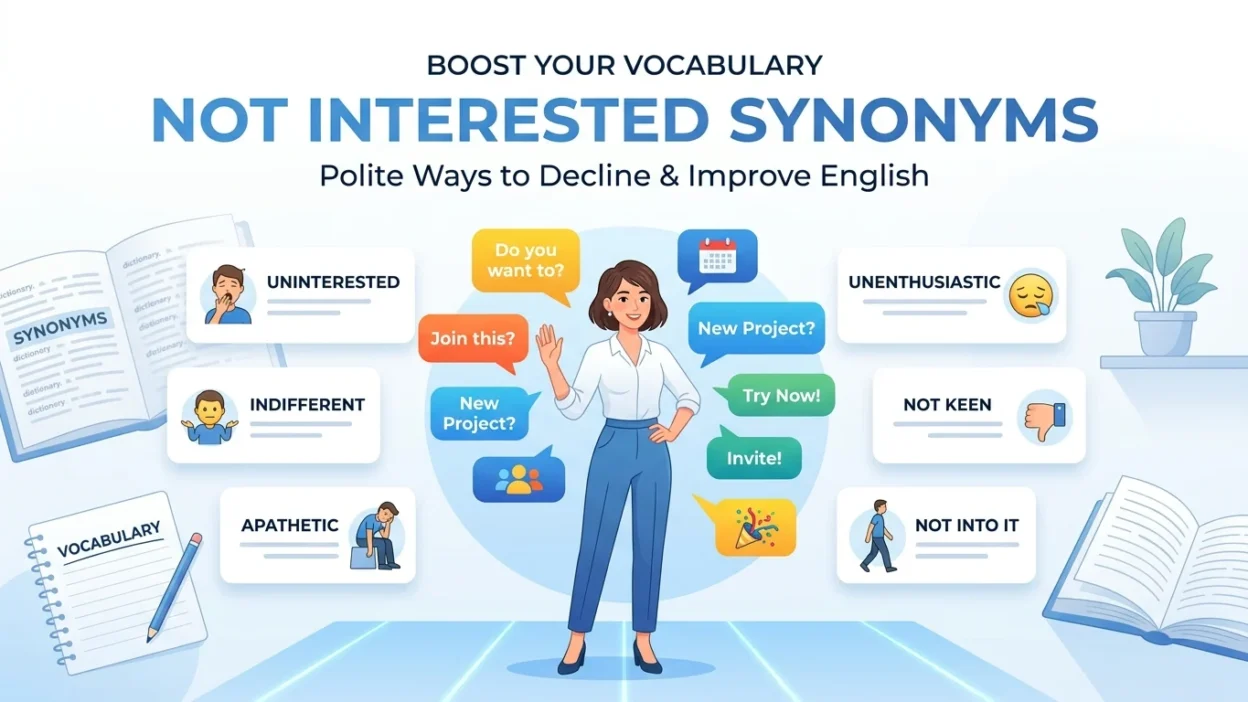
Understanding not interested synonyms can help you speak and write more clearly. Sometimes you want to say you are not interested in a polite way. Other times you need a stronger, more direct phrase. That is why having different options is useful.
This topic matters for students, ESL learners, writers, and content creators because the same idea can sound very different depending on the word you choose. For example, “not interested” can sound casual, formal, polite, cold, or even rude, depending on the context. Learning the right synonym helps you express your meaning with more confidence.
In simple English, “not interested” means you do not want something, do not feel attracted to something, or do not want to pay attention to it. You may use it when talking about a topic, an offer, a person, an idea, a hobby, or an activity. The tone can change based on how you say it. For example, “I am not interested” sounds clear and direct, while “I am not really into it” sounds softer and more casual.
What Does “Focus Keyword” Mean?
A focus keyword is the main phrase an article is built around. In this article, the focus keyword is not interested synonyms. Writers use a focus keyword to guide the topic, help search engines understand the page, and make the content easier for readers to find.
In simple terms, the focus keyword tells the reader and Google what the article is about. If people search for “not interested synonyms,” they want words or phrases that mean the same thing or sound close in meaning. This article gives those options in a clear and beginner friendly way.
30 Not Interested Synonyms
1. Uninterested
Meaning: Not wanting to pay attention to something or not caring about it.
Example sentence: She looked uninterested during the lecture.
Best usage context: Good for general writing and everyday conversation.
2. Indifferent
Meaning: Not showing much feeling or concern about something.
Example sentence: He seemed indifferent to the final result.
Best usage context: Useful in formal writing and emotional situations.
3. Apathetic
Meaning: Showing no interest, energy, or emotion.
Example sentence: The students were apathetic about the class project.
Best usage context: Best for formal or academic writing.
4. Unconcerned
Meaning: Not worried, not involved, or not interested.
Example sentence: She was unconcerned with the gossip around her.
Best usage context: Good when someone is calm or detached.
5. Disinterested
Meaning: Not personally interested; sometimes also means fair or unbiased.
Example sentence: He stayed disinterested in the argument.
Best usage context: Use carefully, especially in formal English.
6. Not keen
Meaning: Not excited or not eager about something.
Example sentence: I am not keen on going out tonight.
Best usage context: Common in British English and casual speech.
7. Not into it
Meaning: Not liking something or not wanting to take part.
Example sentence: She is not into it, so we should choose something else.
Best usage context: Very casual and natural in spoken English.
8. Not bothered
Meaning: Not caring enough to worry about it.
Example sentence: He was not bothered by the noise outside.
Best usage context: Casual English, especially in everyday conversation.
9. Detached
Meaning: Emotionally separated or not involved.
Example sentence: She spoke in a detached tone.
Best usage context: Good for formal and descriptive writing.
10. Bored
Meaning: Not interested because something is dull or unexciting.
Example sentence: He got bored during the long meeting.
Best usage context: Common when the lack of interest comes from boredom.
11. Distant
Meaning: Emotionally far away or not engaged.
Example sentence: Her distant reply showed little interest.
Best usage context: Useful when describing mood or behavior.
12. Cold
Meaning: Showing little warmth, feeling, or interest.
Example sentence: His cold response made the situation awkward.
Best usage context: Stronger tone; use carefully in writing.
13. Aloof
Meaning: Not friendly or not involved with others.
Example sentence: He stayed aloof from the discussion.
Best usage context: Best for formal descriptions of personality.
14. Unresponsive
Meaning: Not reacting or not showing interest.
Example sentence: The audience was unresponsive to the speaker.
Best usage context: Good for reports, reviews, and formal language.
15. Inactive
Meaning: Not taking part or not doing anything.
Example sentence: She remained inactive during the group activity.
Best usage context: Useful when someone is not participating.
16. Unenthusiastic
Meaning: Not excited or not showing strong interest.
Example sentence: He gave an unenthusiastic answer.
Best usage context: Great for polite, neutral writing.
17. Half hearted
Meaning: Done with little effort or little real interest.
Example sentence: She gave a half hearted attempt to join the team.
Best usage context: Good when interest is weak, not absent.
18. Lukewarm
Meaning: Only mildly interested or not strongly supportive.
Example sentence: The audience gave a lukewarm response.
Best usage context: Often used for reactions, opinions, or support.
19. Resistant
Meaning: Not willing to accept or support something.
Example sentence: He was resistant to the new plan.
Best usage context: Best when someone actively avoids or rejects an idea.
20. Unmoved
Meaning: Not emotionally affected or not impressed.
Example sentence: She remained unmoved by the speech.
Best usage context: Good for formal or emotional writing.
21. Unimpressed
Meaning: Not feeling approval or excitement.
Example sentence: The manager was unimpressed by the report.
Best usage context: Very useful in reviews and opinions.
22. Withdrawn
Meaning: Quiet, reserved, or not taking part much.
Example sentence: He became withdrawn after the meeting.
Best usage context: Good for describing social behavior.
23. Avoidant
Meaning: Tending to stay away from something.
Example sentence: She was avoidant when the topic came up.
Best usage context: Useful in psychology or formal discussion.
24. Resistant to
Meaning: Not accepting or wanting something.
Example sentence: The group was resistant to change.
Best usage context: Strong and formal, good for opinions or change.
25. Dispassionate
Meaning: Calm and not emotionally involved.
Example sentence: He gave a dispassionate view of the issue.
Best usage context: Best for formal, academic, or professional writing.
26. Tuned out
Meaning: Stopped paying attention.
Example sentence: I tuned out during the long presentation.
Best usage context: Casual spoken English.
27. Checked out
Meaning: Not paying attention or mentally absent.
Example sentence: She checked out halfway through the conversation.
Best usage context: Informal and conversational.
28. Not engaged
Meaning: Not involved or not mentally focused.
Example sentence: The class seemed not engaged in the lesson.
Best usage context: Good for teaching, business, and reports.
29. Unswayed
Meaning: Not affected or not convinced.
Example sentence: He stayed unswayed by the offer.
Best usage context: Useful when someone does not change their mind.
30. Apathetic to it
Meaning: Not caring about something at all.
Example sentence: She was apathetic to the whole debate.
Best usage context: Stronger expression for formal or serious writing.
Comparison Guide: When to Use Different Not Interested Synonyms
| Word or Phrase | Tone | Best For | Strength |
| Uninterested | Neutral | Daily writing | Medium |
| Indifferent | Formal | Feelings, opinions | Medium |
| Not keen | Casual | Speaking, messages | Soft |
| Not into it | Very casual | Friendly conversation | Soft |
| Apathetic | Formal | Academic or serious writing | Strong |
| Unenthusiastic | Neutral | Work, school, general writing | Medium |
| Unimpressed | Direct | Reactions and opinions | Strong |
| Aloof | Formal | Personality description | Strong |
| Bored | Simple | Everyday speech | Medium |
| Resistant | Formal | Decisions, change, ideas | Strong |
How to Choose the Right Synonym
Choosing the right synonym depends on tone, situation, and meaning.
Use casual phrases like “not into it,” “not keen,” or “not bothered” when you are speaking with friends or writing informally. These sound natural and soft.
Use formal words like “indifferent,” “apathetic,” “dispassionate,” or “unconcerned” when you are writing essays, articles, reports, or professional content. These words sound more serious and polished.
Use stronger words like “unimpressed,” “resistant,” “aloof,” or “cold” when you want to show a stronger emotional distance. These words can sound negative, so use them carefully.
Use simple words like “bored,” “uninterested,” or “not engaged” when you want your meaning to be easy to understand. These are often the best choices for ESL learners and general readers.
Simple Tips for ESL Learners
If you are learning English, start with the easiest phrases first. Good beginner choices are uninterested, bored, not keen, not into it, and unimpressed.
Try to remember this rule: some words mean lack of interest, while others mean lack of emotion or lack of involvement. That small difference can change the whole sentence.
Also, be careful with disinterested. In some contexts, it means “not interested,” but in formal English it can also mean “fair” or “unbiased.” That is why many writers choose simpler words instead.
Conclusion
The phrase not interested has many useful synonyms, and each one gives a slightly different tone. Some sound casual, some sound formal, and some sound stronger or more emotional. Learning these differences helps you write better and speak more naturally.
If you want clear and confident English, focus on the context first, then choose the synonym that matches your tone. With practice, these words will become easy to use in school, work, and everyday conversation.

Ethan Cross is a language enthusiast and content writer who creates practical vocabulary guides. He enjoys helping readers improve communication through clear explanations, engaging examples, and easy-to-understand educational resources.