
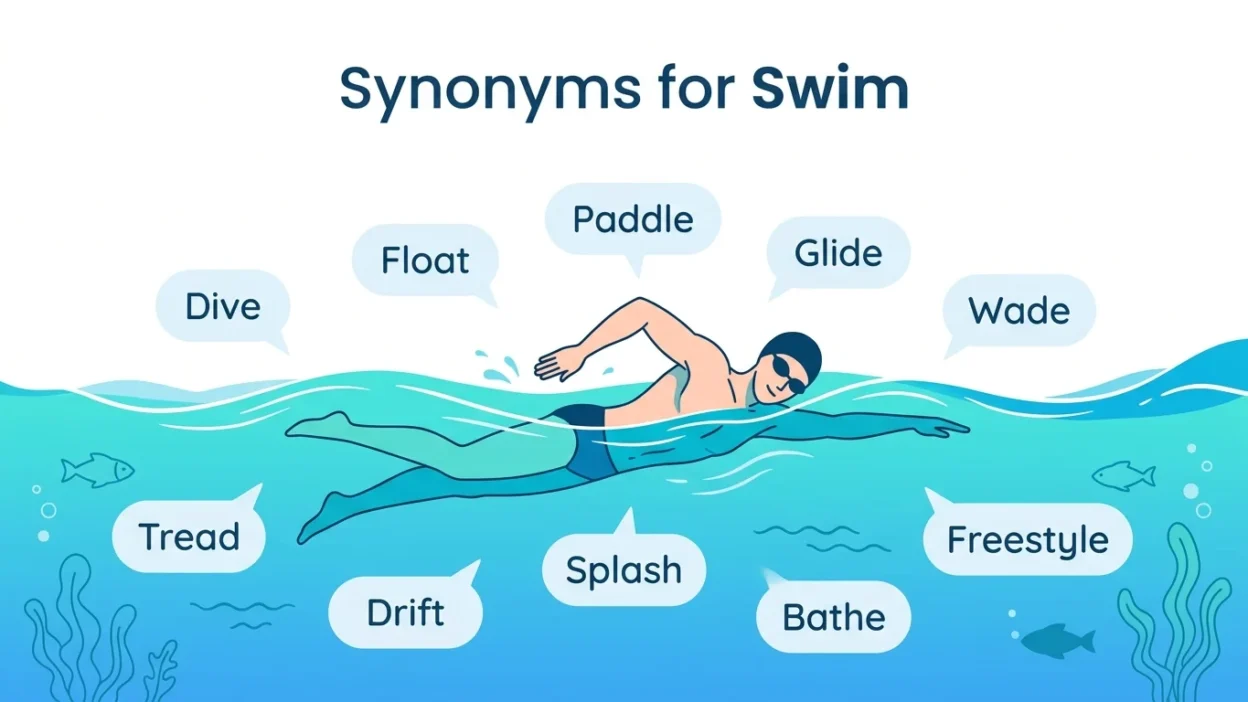
Learning synonyms for swim helps students, ESL learners, writers, and content creators speak and write with more variety. The word swim is simple, but it can show many actions and ideas depending on the context. Sometimes it means moving through water. Sometimes it can suggest floating, gliding, bathing, or even moving smoothly through a space.
Using different words makes your writing sound more natural and less repetitive. It also helps you choose the right tone. For example, one word may fit a child learning in a pool, while another may fit a fish in the ocean, a boat on waves, or a person moving through a crowd. That is why understanding synonyms for swim is useful for both everyday English and stronger writing.
Important note: The word demure is not a synonym for swim. It means shy, quiet, modest, or reserved. It is often used to describe a person’s behavior, style, or expression. For example, “She gave a demure smile.” This word has a soft, calm tone and is used in polite or descriptive writing.
Synonyms for Swim With Simple Meanings and Examples
1. Swim
Meaning: To move through water using your arms and legs.
Example sentence: I can swim across the pool.
Best usage context: General use for any water movement.
2. Dive
Meaning: To jump into water headfirst or move quickly down into water.
Example sentence: He dove into the lake from the boat.
Best usage context: Entering water in a fast or active way.
3. Float
Meaning: To stay on top of water without sinking.
Example sentence: The leaf floated on the pond.
Best usage context: Soft, calm movement on water.
4. Paddle
Meaning: To move through water with small, gentle arm or hand movements.
Example sentence: The child paddled in the shallow water.
Best usage context: Light, easy swimming, often for beginners.
5. Splash
Meaning: To move water around with force or play in water noisily.
Example sentence: The kids splashed in the pool.
Best usage context: Playful or lively water action.
6. Glide
Meaning: To move smoothly and quietly through water.
Example sentence: The swan glided across the lake.
Best usage context: Smooth, graceful motion.
7. Stroke
Meaning: A swimming movement made with the arms and legs.
Example sentence: Her stroke looked strong and steady.
Best usage context: Swimming technique and sports writing.
8. Tread
Meaning: To keep yourself above water by moving your hands and feet.
Example sentence: She had to tread water until help arrived.
Best usage context: Staying afloat in one place.
9. Bathe
Meaning: To wash yourself in water or spend time in water.
Example sentence: We bathed in the river after the long walk.
Best usage context: Older, literary, or formal writing.
10. Wade
Meaning: To walk through shallow water.
Example sentence: They waded across the stream.
Best usage context: Shallow water, slow movement.
11. Drift
Meaning: To move slowly with water or current.
Example sentence: The boat drifted near the shore.
Best usage context: Slow, natural movement without control.
12. Skim
Meaning: To move lightly across the top of water.
Example sentence: The stone skimmed across the pond.
Best usage context: Fast, light movement on the surface.
13. Sail
Meaning: To travel on water in a boat, or to move smoothly like a boat.
Example sentence: We sailed across the calm sea.
Best usage context: Boats, sea travel, smooth motion.
14. Move through water
Meaning: A simple phrase for going through water.
Example sentence: Fish move through water very easily.
Best usage context: Easy, plain English for beginners.
15. Bob
Meaning: To move up and down on water.
Example sentence: The ball bobbed on the waves.
Best usage context: Small objects or light movement on water.
16. Submerge
Meaning: To go completely under water.
Example sentence: He submerged himself in the pool.
Best usage context: Formal writing or deep water action.
17. Immerse
Meaning: To put something fully into water.
Example sentence: She immersed the cloth in warm water.
Best usage context: Cleaning, science, and formal English.
18. Sink
Meaning: To go down below the surface of water.
Example sentence: The heavy rock sank quickly.
Best usage context: Going down into water, often unintentionally.
19. Flounder
Meaning: To move awkwardly in water or struggle to swim.
Example sentence: The puppy floundered in the shallow pond.
Best usage context: Weak, messy, or difficult movement.
20. Splash about
Meaning: To play noisily in water.
Example sentence: The children splashed about in the fountain.
Best usage context: Playful children or casual writing.
21. Dog paddle
Meaning: A simple swimming style with short arm and leg movements.
Example sentence: He learned to dog paddle before proper swimming.
Best usage context: Beginners and informal speech.
22. Backstroke
Meaning: A swimming style done on the back.
Example sentence: She won the race with a fast backstroke.
Best usage context: Swimming sports and technique.
23. Front crawl
Meaning: A fast swimming style on the stomach.
Example sentence: The coach taught us the front crawl.
Best usage context: Training and competitive swimming.
24. Freestyle
Meaning: A race style where swimmers can choose their stroke, often front crawl.
Example sentence: He is very strong in freestyle events.
Best usage context: Sports and swimming competitions.
25. Breaststroke
Meaning: A swimming style with arm circles and frog like leg movement.
Example sentence: Breaststroke is slower but easy to control.
Best usage context: Technique, lessons, and competition.
26. Butterfly stroke
Meaning: A strong swimming style using both arms together.
Example sentence: Butterfly stroke needs a lot of power.
Best usage context: Advanced swimming and sports writing.
27. Crawl
Meaning: To move forward close to the water surface using a swimming style.
Example sentence: She crawled through the water with perfect rhythm.
Best usage context: Informal and sports related writing.
28. Navigate
Meaning: To move carefully through water or around it.
Example sentence: The boat navigated the river with care.
Best usage context: Boats, travel, and careful movement.
29. Flow
Meaning: To move smoothly like water, or to move with water.
Example sentence: The swimmer seemed to flow through the pool.
Best usage context: Smooth, natural, graceful movement.
30. Traverse
Meaning: To cross an area, including water or a body of water.
Example sentence: The team traversed the river in a small boat.
Best usage context: Formal writing, travel, and crossing.
Comparison Guide: When to Use Different Synonyms
| Word | Best for | Tone |
| Swim | General water movement | Neutral |
| Paddle | Beginners or gentle movement | Simple |
| Dive | Entering water fast | Active |
| Float | Staying on top of water | Calm |
| Wade | Walking through shallow water | Easy |
| Tread | Staying in place in water | Practical |
| Glide | Smooth and graceful movement | Elegant |
| Flounder | Struggling in water | Negative |
| Backstroke / Breaststroke / Freestyle | Swimming styles | Technical |
| Sail / Navigate / Traverse | Travel across water | Formal |
How to Choose the Right Synonym
Choose the word based on purpose, tone, and context.
Use simple words like paddle, float, wade, or splash when you are writing for beginners, children, or casual readers. These words are easy to understand and feel natural in daily English.
Use sport or technique words like freestyle, backstroke, or breaststroke when you are talking about swimming lessons, races, or fitness. These are the best words for structured or athletic writing.
Use formal or literary words like glide, drift, submerge, or traverse when you want a more polished style. These words work well in essays, stories, and descriptive content.
Use negative or struggle words like flounder or sink only when the meaning is about difficulty, not normal swimming.
Conclusion
The phrase synonyms for swim includes many useful words, but each one has its own meaning and style. Some words describe smooth movement, some describe playful water activity, and others describe swimming techniques or formal travel across water. Learning these differences helps you write more clearly and choose the best word for each situation.
If you are a student, ESL learner, writer, or content creator, these words can improve your vocabulary and make your English sound more natural. The more you practice them in real sentences, the easier it becomes to use them correctly and confidently.

Logan Hayes is a professional editor and language researcher passionate about improving English skills. He creates informative articles that encourage confident writing, stronger vocabulary, and effective everyday communication.