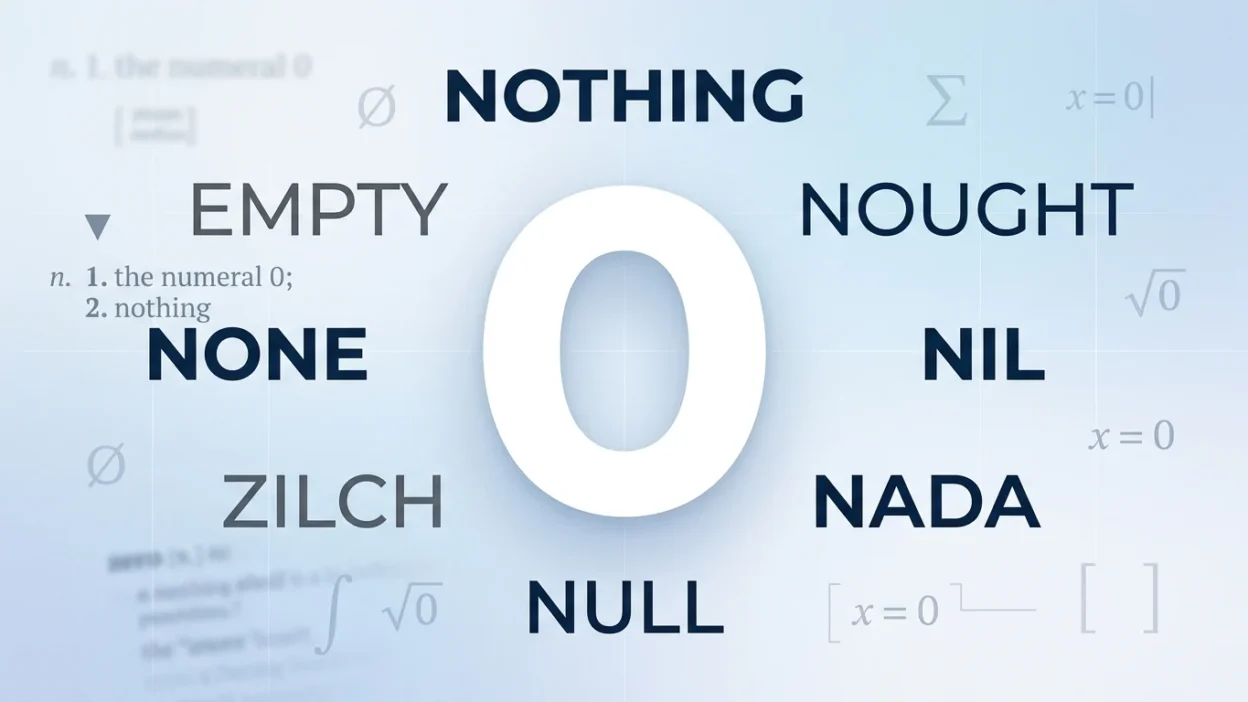
When you want to say zero, you do not always have to use the same word. Depending on the situation, different words can express the ideas of nothing, no amount, an empty amount, a complete lack, or a score of zero.
Learning the synonyms of zero can help students, ESL learners, writers, and content creators make their language more accurate and interesting. However, not every synonym works in every situation. Some words are formal, some are casual, and others are used only in specific contexts.
In this guide, we will explore 30 useful alternatives to zero with simple meanings, example sentences, and the best context for each word.
Note: A synonym is a word with the same or a very similar meaning as another word. For zero, the best synonym depends on whether you mean “nothing,” “no amount,” “a score of 0,” or “complete absence.”
30 Synonyms of Zero
1. Nothing
Meaning: Not anything; no amount or thing.
Example sentence: There was nothing in the empty box.
Best usage context: Everyday English and general situations.
2. Nought
Meaning: The number zero.
Example sentence: The temperature dropped to nought degrees.
Best usage context: British English, mathematics, and formal writing.
3. Nil
Meaning: Zero, especially in scores or results.
Example sentence: The final football score was three nil.
Best usage context: Sports, scores, and British English.
4. O
Meaning: The spoken form of the number zero.
Example sentence: The code was seven O four.
Best usage context: Telephone numbers, codes, and spoken numbers.
5. Nada
Meaning: Nothing at all.
Example sentence: I searched the drawer, but found nada.
Best usage context: Informal and conversational English.
6. Zilch
Meaning: Absolutely nothing.
Example sentence: He knew zilch about computer programming.
Best usage context: Informal speech and casual writing.
7. Zip
Meaning: Nothing or zero.
Example sentence: I had zip energy after the long journey.
Best usage context: Informal American English.
8. Naught
Meaning: Nothing or zero.
Example sentence: His efforts came to naught.
Best usage context: Formal, literary, or traditional English.
9. Null
Meaning: No value or no amount.
Example sentence: The system returned a null result.
Best usage context: Computing, mathematics, science, and technical writing.
10. Void
Meaning: An empty space or complete absence of something.
Example sentence: The room was void of furniture.
Best usage context: Formal, legal, literary, and descriptive writing.
11. Absence
Meaning: The state of something not being present.
Example sentence: The absence of evidence made the case difficult.
Best usage context: Formal writing and academic contexts.
12. Lack
Meaning: Not having enough or not having any of something.
Example sentence: The project failed because of a lack of funding.
Best usage context: Everyday, academic, and professional writing.
13. None
Meaning: Not any; no amount or number.
Example sentence: None of the students missed the lesson.
Best usage context: General English and everyday communication.
14. Naughtiness? No — Nought
Meaning: Zero or nothing.
Example sentence: The score was nought at the beginning of the match.
Best usage context: British English and traditional usage.
Tip: “Naughtiness” is not a synonym for zero. The correct word here is nought.
15. Blank
Meaning: Empty or containing no information.
Example sentence: The answer box was left blank.
Best usage context: Forms, tests, screens, and empty spaces.
16. Empty
Meaning: Containing nothing.
Example sentence: The bottle was completely empty.
Best usage context: Physical objects, spaces, and general descriptions.
17. Vacant
Meaning: Empty or not occupied.
Example sentence: There were zero people in the vacant building.
Best usage context: Rooms, buildings, positions, and spaces.
18. Devoid
Meaning: Completely without something.
Example sentence: The speech was devoid of useful information.
Best usage context: Formal and descriptive writing.
19. Scarcity
Meaning: A situation where something is available in very small amounts.
Example sentence: Water scarcity affected the entire region.
Best usage context: Economics, environment, and academic writing.
20. Absence of
Meaning: The complete lack of something.
Example sentence: The absence of rainfall caused serious problems.
Best usage context: Formal and academic writing.
21. No amount
Meaning: Zero quantity of something.
Example sentence: No amount of pressure could change her decision.
Best usage context: Quantity, emphasis, and general writing.
22. No one
Meaning: Zero people.
Example sentence: No one answered the phone.
Best usage context: Referring to people.
23. Not any
Meaning: Zero amount or zero number.
Example sentence: There was not any milk left.
Best usage context: Everyday English.
24. Absolute nothing
Meaning: Complete lack of anything.
Example sentence: There was absolutely nothing inside the box.
Best usage context: Strong emphasis in informal and general writing.
25. Ground zero
Meaning: A starting point or a central point, depending on context.
Example sentence: The team returned to ground zero and started again.
Best usage context: Figurative, technical, historical, and informal contexts.
Important: “Ground zero” does not always mean the number zero.
26. Zero point
Meaning: A point representing zero or the starting point of a scale.
Example sentence: The temperature reached the zero point.
Best usage context: Science, mathematics, and measurement.
27. No score
Meaning: A score of zero.
Example sentence: The player finished the round with no score.
Best usage context: Games, tests, and competitions.
28. Scoreless
Meaning: Having no points or goals.
Example sentence: The match remained scoreless until half time.
Best usage context: Sports and competitions.
29. Nonexistent
Meaning: Not existing at all.
Example sentence: The chance of success was almost nonexistent.
Best usage context: Formal, academic, and descriptive writing.
30. Complete lack
Meaning: A total absence of something.
Example sentence: There was a complete lack of communication between the teams.
Best usage context: Formal, professional, and academic writing.
Comparison Guide: Which Synonym of Zero Should You Use?
| Word or Phrase | Main Meaning | Best Context |
| Nothing | Not anything | Everyday English |
| Nought | The number zero | British English and maths |
| Nil | Zero score | Sports |
| Nada | Nothing | Informal speech |
| Zilch | Absolutely nothing | Casual English |
| Null | No value | Computing and technical writing |
| Void | Empty or absent | Formal writing |
| None | Not any | General English |
| Blank | Empty space | Forms and tests |
| Devoid | Completely without | Formal writing |
| Scoreless | No points | Sports |
| Nonexistent | Not existing | Academic and formal writing |
How to Choose the Right Synonym of Zero
For everyday conversation
Use:
- Nothing
- None
- Nada
- Zilch
- Not any
Example:
“I have nothing to say.”
These words sound natural in normal conversations.
For mathematics and numbers
Use:
- Nought
- Zero point
- O
Example:
“The answer is nought.”
These words are useful when discussing numbers, measurements, or calculations.
For sports and scores
Use:
- Nil
- Scoreless
- No score
Example:
“The match ended nil nil.”
These words are especially common when discussing football and other sports.
For formal or academic writing
Use:
- Absence
- Lack
- Devoid
- Complete lack
- Nonexistent
Example:
“The study found a complete lack of reliable evidence.”
These alternatives sound more professional than casual words such as “zilch” or “nada.”
For technology and computing
Use:
- Null
- Zero value
- Empty
Example:
“The database returned a null value.”
In technical writing, null often has a specific meaning and should not always be treated as exactly the same as the number zero.
Zero vs. Nothing: What Is the Difference?
Although zero and nothing can sometimes have similar meanings, they are not always interchangeable.
Zero usually refers to a number or measurable amount:
The temperature is zero degrees.
Nothing means not anything:
There is nothing in the box.
Similarly, nil is often used for scores:
The team lost two nil.
Choosing the correct word depends on the exact meaning and context.
Are “Nil” and “Nought” the Same as Zero?
Yes, in many situations, nil and nought can mean zero. However, their usage is different.
- Nought is common in British English and mathematical contexts.
- Nil is especially common for sports scores.
- Zero is the standard word used in most general situations.
For example:
- The score was nil nil.
- The answer is nought.
- The temperature is zero degrees.
Final Thoughts on the Synonyms of Zero
The best synonyms of zero depend on the situation. Use nothing, none, or not any for everyday English. Choose nought for British English and mathematical contexts, while nil and scoreless are useful for sports. Words such as null, void, devoid, and nonexistent work better in technical or formal writing.
Understanding these differences helps you communicate more clearly and naturally. Instead of using “zero” every time, choose a synonym that matches your meaning, tone, and audience.

Mason Blake specializes in educational writing, focusing on vocabulary, grammar, and language improvement. His articles simplify complex topics, making learning enjoyable for students, writers, and English learners everywhere.