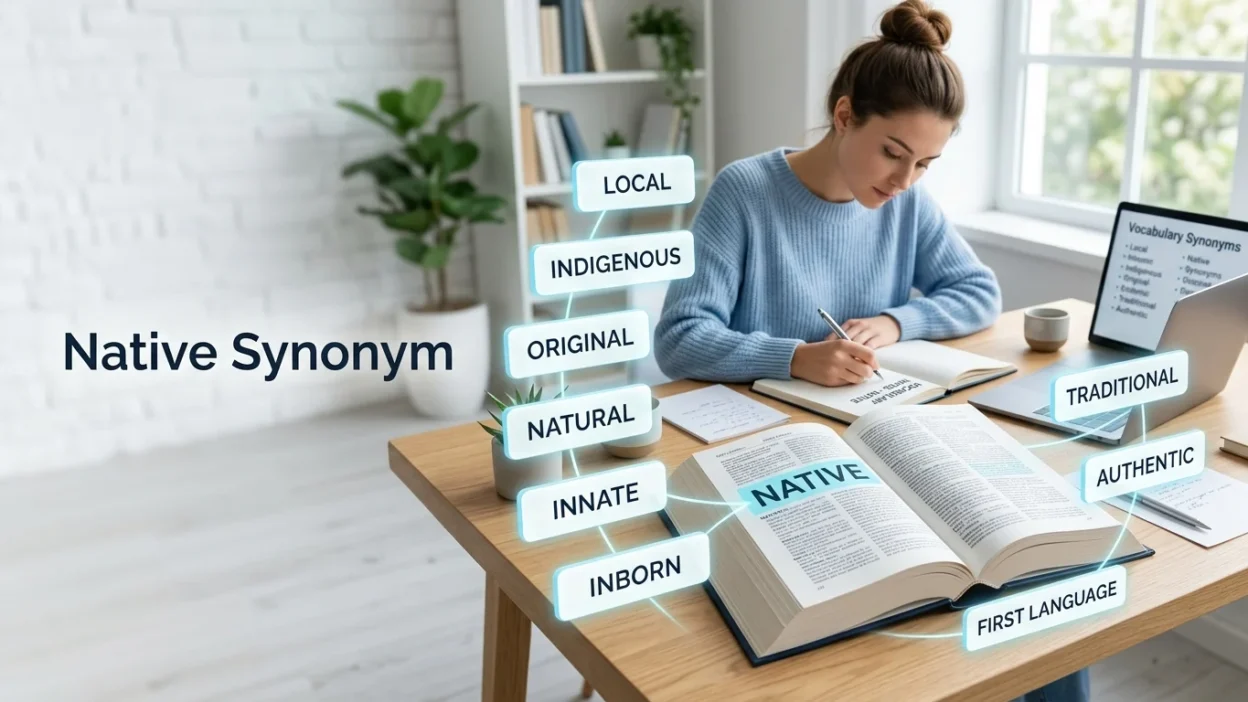
When people search for a native synonym, they usually want words that can replace native in writing or speaking without changing the meaning too much. The word native can mean “born in a place,” “original to a place,” or “natural to something.” Because of that, the best synonym depends on the sentence.
This guide is made for students, ESL learners, writers, and content creators. It explains the meaning of native in simple English, then gives you 30 useful synonyms with clear examples. You will also learn when each word works best, so you can choose the right one with confidence.
What Does “Native” Mean in Simple English?
In simple English, native means something that belongs naturally to a place, person, or environment.
For example, a person can be a native of a country. A plant can be native to a region. A language can be someone’s native language. The word is common in books, school work, travel writing, and formal English.
The best native synonym changes with context. In some sentences, local works well. In others, indigenous, original, innate, or first language may be better. That is why understanding meaning and usage matters more than choosing a word only by sound.
30 Native Synonyms With Meanings and Examples
1. Local
Meaning: From the nearby area or place
Example sentence: She knows the local customs very well.
Best usage context: Everyday writing, travel, and community topics
2. Indigenous
Meaning: Naturally from a place; originally from that land
Example sentence: The indigenous plants grow well in dry weather.
Best usage context: Nature, culture, history, and formal writing
3. Original
Meaning: First from a place or the first version
Example sentence: This is the original design of the village house.
Best usage context: When talking about first form, source, or beginning
4. Natural
Meaning: Not artificial; comes from nature
Example sentence: The island has many natural trees and flowers.
Best usage context: Nature, environment, and simple descriptions
5. Inborn
Meaning: Present from birth
Example sentence: She has an inborn sense of rhythm.
Best usage context: Personality, ability, and human traits
6. Innate
Meaning: Natural and built into a person or thing
Example sentence: He has an innate talent for music.
Best usage context: Skills, behavior, and personal qualities
7. Homegrown
Meaning: Made or grown in one’s own country or area
Example sentence: The store sells homegrown vegetables.
Best usage context: Food, business, and informal writing
8. Native born
Meaning: Born in a certain place
Example sentence: She is a native born citizen of Canada.
Best usage context: Formal identity, nationality, and records
9. Born
Meaning: Brought into life in a place
Example sentence: He was born in Karachi.
Best usage context: Basic personal information and simple writing
10. Resident
Meaning: A person who lives in a place
Example sentence: She is a long time resident of the city.
Best usage context: People, housing, and official information
11. Citizen
Meaning: A legal member of a country
Example sentence: He is a citizen of Pakistan.
Best usage context: Law, nationality, and formal documents
12. Domestic
Meaning: Related to one’s own country or home
Example sentence: The company focuses on domestic travel.
Best usage context: Business, trade, and formal language
13. Regional
Meaning: Belonging to a particular region
Example sentence: The dish is a regional favorite.
Best usage context: Food, culture, geography, and comparison
14. Endemic
Meaning: Naturally found in one area only
Example sentence: This flower is endemic to the mountain region.
Best usage context: Biology, plants, animals, and science
15. Autochthonous
Meaning: Native to a place; originally from that land
Example sentence: The museum explained the autochthonous culture of the area.
Best usage context: Academic, scientific, or very formal writing
16. Aboriginal
Meaning: Present in a place from the earliest times
Example sentence: The book studies aboriginal art and history.
Best usage context: History, anthropology, and formal discussion
17. Ancestral
Meaning: Related to ancestors or family origin
Example sentence: They returned to their ancestral village.
Best usage context: Family history, heritage, and identity
18. Hereditary
Meaning: Passed from parents to children
Example sentence: Eye color can be hereditary.
Best usage context: Biology, genetics, and medical writing
19. Congenital
Meaning: Present from birth
Example sentence: The baby was diagnosed with a congenital condition.
Best usage context: Medical and scientific writing only
20. Built in
Meaning: Included naturally or already part of something
Example sentence: The phone has a built in camera.
Best usage context: Technology, features, and informal explanation
21. Inherent
Meaning: Naturally part of something
Example sentence: Risk is inherent in every investment.
Best usage context: Formal writing, analysis, and abstract ideas
22. Characteristic
Meaning: Typical of a person, place, or thing
Example sentence: Honesty is a characteristic trait of her writing.
Best usage context: Descriptions, style, and general writing
23. Customary
Meaning: Usual in a place or group
Example sentence: It is customary to greet elders first.
Best usage context: Culture, habits, and social rules
24. Traditional
Meaning: Passed down from the past
Example sentence: The restaurant serves traditional food.
Best usage context: Culture, customs, and heritage
25. Authentic
Meaning: Real, true, and not fake
Example sentence: This is an authentic village recipe.
Best usage context: Food, culture, products, and trust
26. Tribal
Meaning: Related to a group or tribal community
Example sentence: The region is known for tribal music.
Best usage context: Culture, history, and community studies
27. Country born
Meaning: Born in a particular country
Example sentence: He is country born and proud of his roots.
Best usage context: Simple, descriptive writing about origin
28. Place born
Meaning: Born in a certain place
Example sentence: She is place born in a small coastal town.
Best usage context: Creative or descriptive writing
29. Native speaking
Meaning: Speaking a language from early life
Example sentence: He is a native speaking English teacher.
Best usage context: Language learning, teaching, and profiles
30. First language
Meaning: The first language a person learns
Example sentence: Urdu is her first language, so English takes practice.
Best usage context: ESL, language learning, and education
Quick Comparison Guide: Which Native Synonym Should You Use?
| Synonym | Best for | Tone | Notes |
| Local | Nearby area or community | Simple | Very common in daily English |
| Indigenous | People, plants, land, history | Formal | Strong and precise |
| Innate | Skills or qualities | Formal | Good for personality and ability |
| Native born | Birthplace and identity | Formal | Often used in official writing |
| Endemic | Plants, animals, science | Academic | Used in biology and geography |
| Inherent | Natural part of something | Formal | Good for abstract ideas |
| Traditional | Customs and heritage | Neutral | Focuses on long held practice |
| Authentic | Real and original | Positive | Good for food, culture, and products |
| First language | Language learning | Clear and modern | Best for ESL content |
How to Choose the Right Synonym
Choose your native synonym based on the meaning you want to show.
Use local when you mean someone or something from the nearby area.
Use indigenous when you mean originally from a land or region.
Use innate or inborn when you mean a natural human quality.
Use endemic when writing about plants, animals, or science.
Use first language when talking about language learning.
Also think about tone. Some words are simple and common, like local and born. Some are formal, like indigenous, inherent, and congenital. Some are best for ESL or beginner writing, like native born, resident, and first language.
Conclusion
A good native synonym depends on context. There is no single perfect replacement for every sentence. If you are talking about a place, local or indigenous may work best. If you are talking about a person, native born, born, or resident may fit better. If you are talking about language, first language is often the clearest choice.
The more you practice, the easier it becomes to match the right word to the right meaning. That is the key to stronger vocabulary, better writing, and more natural English.

Logan Hayes is a professional editor and language researcher passionate about improving English skills. He creates informative articles that encourage confident writing, stronger vocabulary, and effective everyday communication.