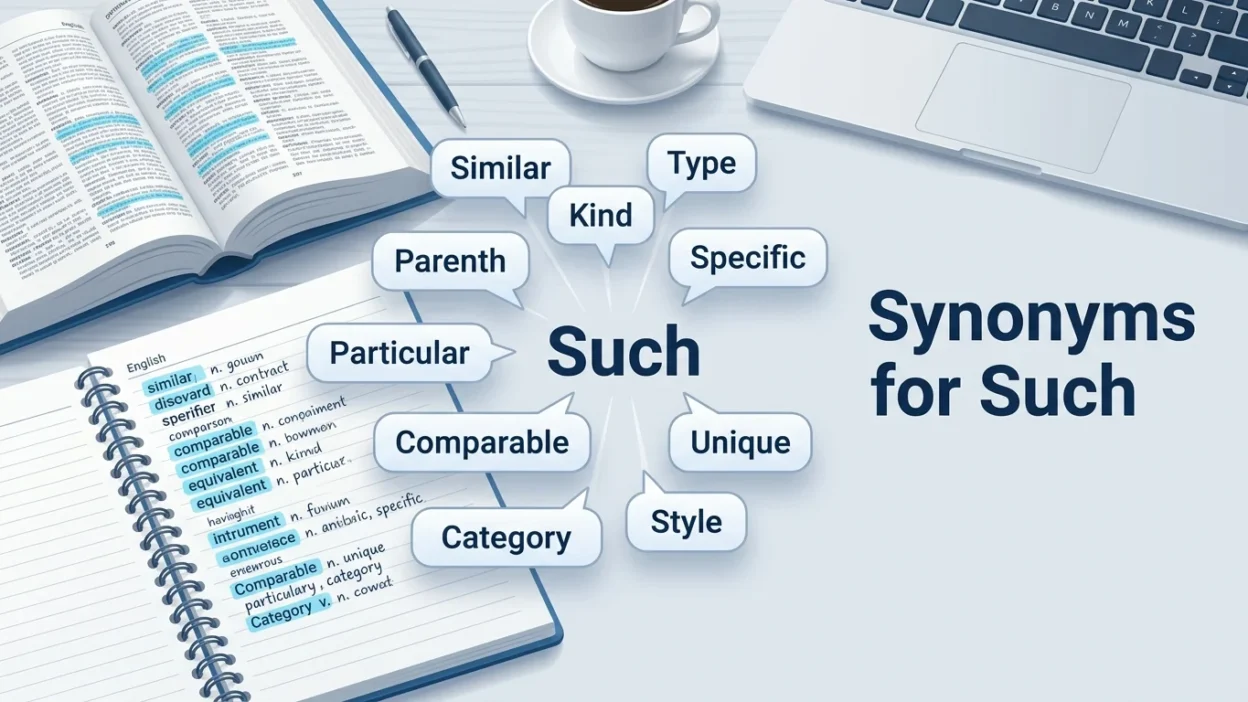
If you are searching for synonyms for such, you probably want simple ways to sound clearer, more natural, and more varied in English. The word such is very common, but it can feel tricky because it changes meaning depending on the sentence.
In many cases, such is used to describe a type, degree, or kind of something. It can show emphasis, comparison, or similarity. That is why learners often ask for alternatives. Some words work better in formal writing. Others sound more natural in speech. Knowing the difference helps you choose the right word every time.
This guide gives you 30 easy alternatives, clear meanings, example sentences, and usage notes. It is written in simple English so you can learn quickly and use the words with confidence.
What Does the Focus Keyword Mean?
The focus keyword synonyms for such means other words or phrases that can replace such in some situations.
In simple English, such often means:
- of this kind
- like this
- so great
- very
- particular
Because it has more than one use, not every synonym works in every sentence. Some replacements are for meaning, while others are for tone or style. This is why context matters.
30 Synonyms for Such
1. Like this
Meaning: Similar to this thing or example.
Example sentence: I have never seen a design like this before.
Best usage context: Everyday speech and simple writing.
2. This kind of
Meaning: A type similar to the one being discussed.
Example sentence: I enjoy this kind of music.
Best usage context: Casual and clear explanations.
3. That kind of
Meaning: A type like that one.
Example sentence: That kind of behavior is not acceptable.
Best usage context: Spoken English and informal writing.
4. Of this kind
Meaning: Belonging to this type or category.
Example sentence: Problems of this kind need a quick solution.
Best usage context: Formal and academic writing.
5. Of that kind
Meaning: Belonging to that type or category.
Example sentence: I do not usually buy items of that kind.
Best usage context: Neutral or formal English.
6. Similar
Meaning: Almost the same in some way.
Example sentence: Their ideas are similar to ours.
Best usage context: General writing and comparison.
7. Comparable
Meaning: Able to be compared because they are alike in some way.
Example sentence: The two results are comparable.
Best usage context: Formal or academic writing.
8. Equivalent
Meaning: Equal in value, meaning, or effect.
Example sentence: There is no equivalent word in my language.
Best usage context: Formal writing and explanation.
9. Kind
Meaning: A group or type of something.
Example sentence: What kind of food do you like?
Best usage context: Everyday questions and simple English.
10. Type
Meaning: A category or class of something.
Example sentence: This type of phone is very popular.
Best usage context: General English and product descriptions.
11. Sort
Meaning: A category or group.
Example sentence: I like this sort of story.
Best usage context: Informal speech and writing.
12. Variety
Meaning: A different form or type.
Example sentence: We offer a variety of services.
Best usage context: Marketing, blogs, and general writing.
13. Category
Meaning: A group with similar things inside it.
Example sentence: This book fits into the mystery category.
Best usage context: Academic, business, and organizational writing.
14. Genre
Meaning: A specific type, especially in books, films, or music.
Example sentence: Horror is my favorite genre.
Best usage context: Media, entertainment, and creative writing.
15. Style
Meaning: A special way something is done or looks.
Example sentence: I like her writing style.
Best usage context: Design, fashion, writing, and art.
16. Form
Meaning: A shape, version, or type of something.
Example sentence: This form of exercise is very effective.
Best usage context: Formal and general English.
17. Version
Meaning: A different form of the same thing.
Example sentence: I prefer the newer version of the app.
Best usage context: Technology, product writing, and comparison.
18. Example
Meaning: A case that shows what you mean.
Example sentence: This is a good example of teamwork.
Best usage context: Teaching, explanation, and learning.
19. Instance
Meaning: A single example of something.
Example sentence: In one instance, the machine stopped working.
Best usage context: Formal writing and reports.
20. Case
Meaning: A particular example or situation.
Example sentence: In this case, we need a different plan.
Best usage context: Business, discussion, and problem solving.
21. Certain
Meaning: Particular or specific.
Example sentence: Certain people prefer quiet places.
Best usage context: Neutral, formal, and descriptive writing.
22. Specific
Meaning: Clear and exact.
Example sentence: Please give me a specific answer.
Best usage context: Instructions, school writing, and business.
23. Particular
Meaning: One exact thing or one special kind.
Example sentence: I am looking for a particular book.
Best usage context: Formal and clear communication.
24. Exact
Meaning: Completely correct or fully the same.
Example sentence: That is the exact word I needed.
Best usage context: Precision in speech and writing.
25. Precise
Meaning: Very exact and careful.
Example sentence: She gave a precise explanation.
Best usage context: Academic, technical, and professional writing.
26. Unique
Meaning: One of a kind.
Example sentence: That painting has a unique style.
Best usage context: Creative writing, branding, and description.
27. Special
Meaning: Important, different, or not ordinary.
Example sentence: This is a special day for our family.
Best usage context: Everyday speech and emotional writing.
28. Exceptional
Meaning: Much better or different than usual.
Example sentence: He showed exceptional talent.
Best usage context: Formal praise, resumes, and reviews.
29. Remarkable
Meaning: Very noticeable or impressive.
Example sentence: She made remarkable progress.
Best usage context: Positive descriptions and formal writing.
30. Outstanding
Meaning: Very good or far above average.
Example sentence: The team did outstanding work.
Best usage context: Professional praise and strong positive writing.
Quick Guide: When to Use Different Synonyms
| Word | Best Tone | Best For |
| Like this | Casual | Everyday speech |
| This kind of | Simple | Basic explanation |
| Of this kind | Formal | Academic writing |
| Similar | Neutral | Comparison |
| Type / Sort | Everyday | General conversation |
| Category / Genre | Specific | Organization and media |
| Certain / Specific / Particular | Clear | Exact meaning |
| Unique / Special | Descriptive | Strong emphasis |
| Exceptional / Remarkable / Outstanding | Positive | Praise and evaluation |
How to Choose the Right Synonym
Choosing the right synonym depends on your purpose.
Use simple phrases like like this, this kind of, or that kind of when you want easy, natural English. These are good for students and everyday speaking.
Use formal words like specific, particular, category, instance, or equivalent when you are writing essays, reports, or professional content.
Use positive descriptive words like unique, special, remarkable, or outstanding when you want to show approval or highlight quality.
Use comparison words like similar, comparable, or equivalent when you want to show that two things are alike.
A good rule is this:
If the sentence is simple, choose a simple word.
If the sentence is formal, choose a formal word.
If the sentence needs strong emphasis, choose a stronger synonym.
Final Thoughts
The phrase synonyms for such is useful because the word such appears in many different sentence patterns. The best replacement depends on meaning, tone, and context. Some alternatives sound casual. Others sound formal. Some show similarity. Others show emphasis or category.
If you remember the difference between type words, comparison words, and emphasis words, you will choose better synonyms and write more naturally. Keep practicing with examples, and soon these words will feel easy to use in both speaking and writing.
Learning synonyms for such is not just about vocabulary. It is about making your English clearer, smarter, and more flexible.

Ethan Cross is a language enthusiast and content writer who creates practical vocabulary guides. He enjoys helping readers improve communication through clear explanations, engaging examples, and easy-to-understand educational resources.