
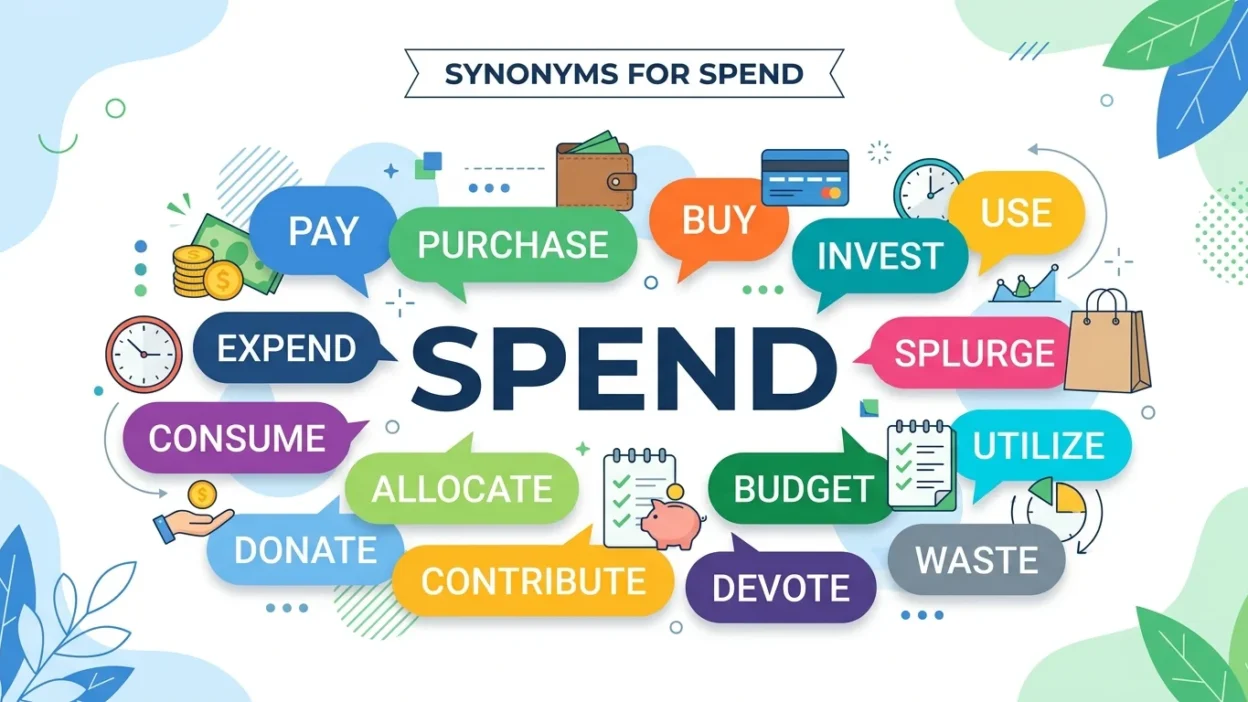
If you’re looking for the best synonyms for spend, you’ve come to the right place. The word “spend” is one of the most common English verbs, but using the same word repeatedly can make your writing sound repetitive. Learning different ways to say spend helps improve your vocabulary and makes your speaking and writing more natural.
Whether you’re a student, an ESL learner, a writer, or a content creator, understanding the subtle differences between these synonyms will help you choose the right word for every situation. Some words are perfect for talking about money, while others describe spending time, energy, or other resources.
Meaning of “Spend”
The word spend means to use money, time, energy, or other resources for a purpose. It is commonly used when talking about paying for something, using time doing an activity, or putting effort into achieving a goal.
Example:
- I spend too much money on coffee.
- She spends two hours studying every evening.
30 Synonyms for Spend
1. Pay
Meaning: Give money in exchange for something.
Example Sentence: I paid $20 for the book.
Best Usage Context: Buying goods or services.
2. Purchase
Meaning: Buy something using money.
Example Sentence: She purchased a new laptop yesterday.
Best Usage Context: Formal shopping or business writing.
3. Buy
Meaning: Get something by paying money.
Example Sentence: We bought fresh vegetables.
Best Usage Context: Everyday conversations.
4. Invest
Meaning: Use money, time, or effort expecting future benefits.
Example Sentence: He invested in a small business.
Best Usage Context: Finance, education, or personal growth.
5. Use
Meaning: Put something into action or service.
Example Sentence: We used all our savings.
Best Usage Context: General resource usage.
6. Consume
Meaning: Use up resources completely.
Example Sentence: The old car consumes a lot of fuel.
Best Usage Context: Energy, fuel, food, or resources.
7. Expend
Meaning: Use money, energy, or effort.
Example Sentence: They expended great effort on the project.
Best Usage Context: Formal writing.
8. Disburse
Meaning: Pay out money officially.
Example Sentence: The company disbursed employee bonuses.
Best Usage Context: Financial and legal documents.
9. Shell Out
Meaning: Spend money reluctantly.
Example Sentence: I had to shell out for car repairs.
Best Usage Context: Informal conversations.
10. Fork Out
Meaning: Pay money unwillingly.
Example Sentence: He forked out a lot for concert tickets.
Best Usage Context: Casual English.
11. Splurge
Meaning: Spend freely on luxury items.
Example Sentence: They splurged on a vacation.
Best Usage Context: Luxury purchases.
12. Waste
Meaning: Spend carelessly without value.
Example Sentence: Don’t waste your money.
Best Usage Context: Negative situations.
13. Squander
Meaning: Waste money or opportunities recklessly.
Example Sentence: He squandered his inheritance.
Best Usage Context: Serious financial discussions.
14. Lavish
Meaning: Give or spend generously.
Example Sentence: They lavished money on decorations.
Best Usage Context: Luxury or generosity.
15. Devote
Meaning: Spend time or effort on something important.
Example Sentence: She devoted her weekends to volunteering.
Best Usage Context: Time and effort.
16. Dedicate
Meaning: Commit time or energy to something.
Example Sentence: He dedicated years to research.
Best Usage Context: Professional or personal goals.
17. Allocate
Meaning: Set aside resources for a purpose.
Example Sentence: The budget allocated funds for education.
Best Usage Context: Planning and budgeting.
18. Budget
Meaning: Plan how money will be spent.
Example Sentence: We budget carefully each month.
Best Usage Context: Personal finance.
19. Outlay
Meaning: Spend a large amount of money.
Example Sentence: Building the house required a major outlay.
Best Usage Context: Business and investments.
20. Finance
Meaning: Provide money for something.
Example Sentence: The bank financed the project.
Best Usage Context: Loans and business.
21. Fund
Meaning: Supply money for a purpose.
Example Sentence: The charity funded the program.
Best Usage Context: Organizations and projects.
22. Cover
Meaning: Pay the cost of something.
Example Sentence: My employer covered my travel expenses.
Best Usage Context: Expenses and bills.
23. Foot the Bill
Meaning: Pay the entire cost.
Example Sentence: My parents footed the bill for dinner.
Best Usage Context: Informal English.
24. Chip In
Meaning: Contribute money with others.
Example Sentence: Everyone chipped in for the gift.
Best Usage Context: Group payments.
25. Donate
Meaning: Give money freely to help others.
Example Sentence: She donated to the local shelter.
Best Usage Context: Charity.
26. Contribute
Meaning: Give money or resources toward something.
Example Sentence: Employees contributed to the retirement fund.
Best Usage Context: Shared efforts.
27. Apply
Meaning: Use something for a particular purpose.
Example Sentence: They applied the funds wisely.
Best Usage Context: Formal writing.
28. Employ
Meaning: Make use of something.
Example Sentence: The company employed its resources efficiently.
Best Usage Context: Business or academic writing.
29. Utilize
Meaning: Use effectively.
Example Sentence: We utilized every available resource.
Best Usage Context: Professional writing.
30. Exhaust
Meaning: Use something completely.
Example Sentence: They exhausted their savings.
Best Usage Context: Resources being fully used.
Comparison Guide: When to Use Different Synonyms
| Synonym | Best For | Tone |
| Spend | General use | Neutral |
| Pay | Paying money | Neutral |
| Buy | Shopping | Casual |
| Purchase | Formal buying | Formal |
| Invest | Future benefits | Positive |
| Use | General resources | Neutral |
| Expend | Energy or money | Formal |
| Consume | Resources | Neutral |
| Shell Out | Unwanted expenses | Informal |
| Fork Out | Reluctant payment | Informal |
| Splurge | Luxury spending | Casual |
| Waste | Careless spending | Negative |
| Squander | Reckless spending | Negative |
| Lavish | Generous spending | Positive |
| Devote | Time and effort | Positive |
| Dedicate | Commitment | Positive |
| Allocate | Budget planning | Formal |
| Budget | Financial planning | Neutral |
| Outlay | Large expenses | Formal |
| Finance | Business funding | Formal |
| Fund | Projects and charities | Neutral |
| Cover | Paying expenses | Neutral |
| Foot the Bill | Paying all costs | Informal |
| Chip In | Shared payments | Casual |
| Donate | Charity | Positive |
| Contribute | Shared support | Neutral |
| Apply | Resources | Formal |
| Employ | Resources | Formal |
| Utilize | Efficient use | Formal |
| Exhaust | Complete usage | Neutral |
How to Choose the Right Synonym
Choosing the right synonym depends on what you are talking about and the tone you want.
For Everyday Spending
Use words like spend, pay, buy, or cover when talking about daily purchases.
For Formal Writing
Choose purchase, expend, allocate, finance, utilize, or employ in academic or business writing.
For Time and Effort
Use devote, dedicate, invest, or apply when discussing time, energy, or attention.
For Luxury Spending
Use splurge or lavish when describing generous or expensive purchases.
For Negative Spending
Choose waste or squander when money or resources are used carelessly.
For Shared Payments
Use chip in, contribute, or foot the bill when multiple people help pay or one person pays for everyone.
For Charity and Support
Use donate, fund, or finance when giving money to help a cause or project.
Conclusion
Learning different synonyms for spend helps you communicate more clearly and naturally. While spend works in most situations, using alternatives like pay, invest, purchase, splurge, allocate, or devote allows you to express more specific meanings and match the right tone.
As you continue building your English vocabulary, practice using these synonyms in everyday conversations and writing. Over time, you’ll become more confident in choosing the perfect word for every situation, making your communication more accurate, engaging, and professional.

Charles Cody is a talented author recognized for engaging storytelling, memorable characters, and imaginative plots. His books inspire readers through creativity, emotional depth, and meaningful literary experiences worldwide.