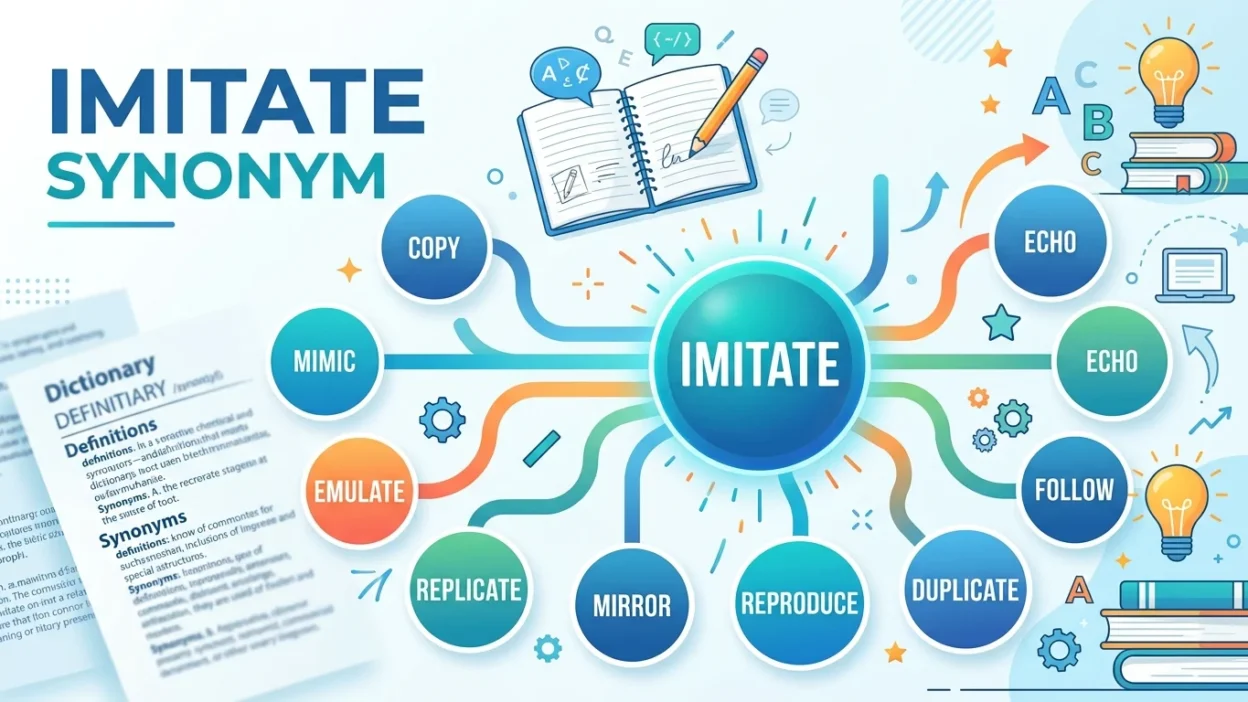
Have you ever wanted a better word than imitate? Whether you’re writing an essay, creating content, learning English, or improving your vocabulary, knowing the right imitate synonym can make your writing more natural and engaging.
The English language offers many words that express the idea of copying or following someone or something. However, each synonym has a slightly different meaning and works best in different situations. Understanding these differences helps you communicate more clearly and professionally.
In this guide, you’ll discover the meaning of imitate, explore 30 useful synonyms, learn when to use each one, and find examples that are easy to understand. This article is written in simple English, making it perfect for students, ESL learners, writers, and content creators.
What Does “Imitate” Mean?
Imitate means to copy someone’s actions, behavior, appearance, voice, style, or work. People imitate others to learn new skills, entertain others, practice, or sometimes make fun of someone.
The word is usually neutral, but its meaning depends on the situation. Sometimes imitation is a compliment because it shows admiration. Other times, it may suggest copying without originality.
30 Best Imitate Synonyms
1. Copy
Meaning: To make something exactly like the original.
Example Sentence: She copied her teacher’s notes carefully.
Best Usage Context: Schoolwork, documents, designs, or general copying.
2. Mimic
Meaning: To copy someone’s behavior, voice, or expressions.
Example Sentence: The comedian could mimic famous actors perfectly.
Best Usage Context: Entertainment, acting, humor.
3. Emulate
Meaning: To copy someone because you admire them and want similar success.
Example Sentence: Young athletes often emulate professional players.
Best Usage Context: Success, education, career growth.
4. Mirror
Meaning: To reflect or closely match something.
Example Sentence: His actions mirrored those of his mentor.
Best Usage Context: Behavior, leadership, communication.
5. Replicate
Meaning: To create an exact copy.
Example Sentence: Scientists replicated the experiment successfully.
Best Usage Context: Science, research, manufacturing.
6. Reproduce
Meaning: To create another version of something.
Example Sentence: The artist reproduced the painting beautifully.
Best Usage Context: Art, research, publishing.
7. Duplicate
Meaning: To make an identical copy.
Example Sentence: Please duplicate these files.
Best Usage Context: Office work, documents.
8. Follow
Meaning: To act according to someone’s example.
Example Sentence: Many children follow their parents’ habits.
Best Usage Context: Advice, examples, role models.
9. Echo
Meaning: To repeat or reflect someone’s words or ideas.
Example Sentence: Her speech echoed the president’s message.
Best Usage Context: Ideas, opinions, writing.
10. Shadow
Meaning: To closely follow someone.
Example Sentence: The trainee shadowed the senior engineer.
Best Usage Context: Learning, job training.
11. Pattern After
Meaning: To design or behave like another person or thing.
Example Sentence: The school was patterned after a famous university.
Best Usage Context: Design, planning.
12. Model
Meaning: To use someone as an example.
Example Sentence: He modeled his business after a successful company.
Best Usage Context: Business, education.
13. Simulate
Meaning: To imitate a real situation.
Example Sentence: Pilots simulate emergency landings during training.
Best Usage Context: Training, technology.
14. Personate
Meaning: To act as another person.
Example Sentence: The actor personated a historical leader.
Best Usage Context: Acting, theater.
15. Impersonate
Meaning: To pretend to be someone else.
Example Sentence: It is illegal to impersonate a police officer.
Best Usage Context: Entertainment, legal situations.
16. Ape
Meaning: To copy someone in an obvious or foolish way.
Example Sentence: He tried to ape his older brother.
Best Usage Context: Informal writing.
17. Borrow
Meaning: To take inspiration from something.
Example Sentence: The designer borrowed ideas from nature.
Best Usage Context: Creative work.
18. Reflect
Meaning: To show similar qualities.
Example Sentence: The painting reflects traditional culture.
Best Usage Context: Art, personality.
19. Resemble
Meaning: To look or seem similar.
Example Sentence: The twins resemble each other closely.
Best Usage Context: Appearance, comparison.
20. Match
Meaning: To be similar or equal.
Example Sentence: His performance matched the champion’s level.
Best Usage Context: Comparisons.
21. Parallel
Meaning: To develop in a similar way.
Example Sentence: Their careers parallel each other.
Best Usage Context: Writing, history.
22. Echo Back
Meaning: To repeat something that was said.
Example Sentence: The student echoed back the instructions.
Best Usage Context: Communication.
23. Clone
Meaning: To make an identical version.
Example Sentence: The software cloned the hard drive.
Best Usage Context: Technology.
24. Reenact
Meaning: To perform an event again.
Example Sentence: Students reenacted the historical battle.
Best Usage Context: History, education.
25. Trace
Meaning: To copy by following the outline.
Example Sentence: She traced the picture carefully.
Best Usage Context: Drawing, art.
26. Adapt
Meaning: To copy while making changes.
Example Sentence: The movie adapted the novel successfully.
Best Usage Context: Literature, film.
27. Follow Suit
Meaning: To do what others are doing.
Example Sentence: Other companies soon followed suit.
Best Usage Context: Business, trends.
28. Recreate
Meaning: To make something again.
Example Sentence: They recreated the ancient village.
Best Usage Context: History, design.
29. Take After
Meaning: To be similar to a family member.
Example Sentence: She takes after her mother.
Best Usage Context: Family resemblance.
30. Echo Someone
Meaning: To express the same thoughts or opinions.
Example Sentence: Many voters echoed her concerns.
Best Usage Context: Discussions, politics, opinions.
Comparison Guide: When to Use Different Imitate Synonyms
| Synonym | Best Used For | Tone |
| Copy | General copying | Neutral |
| Mimic | Voice or behavior | Informal |
| Emulate | Admiring success | Positive |
| Replicate | Science and research | Formal |
| Duplicate | Exact copies | Technical |
| Mirror | Similar actions | Professional |
| Simulate | Training and testing | Technical |
| Impersonate | Acting or pretending | Neutral |
| Adapt | Modified copying | Creative |
| Clone | Technology | Technical |
How to Choose the Right Synonym
Choosing the best imitate synonym depends on your purpose.
When You Mean Exact Copying
Use:
- Copy
- Duplicate
- Replicate
- Clone
- Reproduce
When You Mean Learning from Someone
Use:
- Emulate
- Follow
- Model
- Shadow
When Talking About Acting or Entertainment
Use:
- Mimic
- Impersonate
- Personate
- Reenact
When Referring to Creative Inspiration
Use:
- Adapt
- Borrow
- Mirror
- Reflect
When Comparing Similarities
Use:
- Match
- Parallel
- Resemble
- Echo
Why Learning Imitate Synonyms Matters
Expanding your vocabulary makes your writing stronger and more interesting. Instead of repeating the word imitate, you can choose a synonym that better matches your meaning. This improves essays, blog posts, emails, stories, and everyday conversations.
For ESL learners, using different synonyms also helps build confidence and improve reading comprehension. Writers and content creators benefit because varied vocabulary keeps readers engaged and supports better SEO performance.
Conclusion
Understanding the right imitate synonym helps you communicate with greater accuracy and style. While every synonym relates to copying in some way, each has its own unique meaning and best usage. Words like emulate express admiration, mimic suits entertainment, replicate fits scientific contexts, and adapt works well for creative projects.
By learning these 30 synonyms, their meanings, example sentences, and best usage contexts, you’ll improve your vocabulary, write more naturally, and choose the perfect word for every situation.

Carter Brooks writes educational content that helps readers understand word meanings, synonyms, and writing techniques. He believes simple explanations inspire lifelong learning and stronger communication skills for everyone.