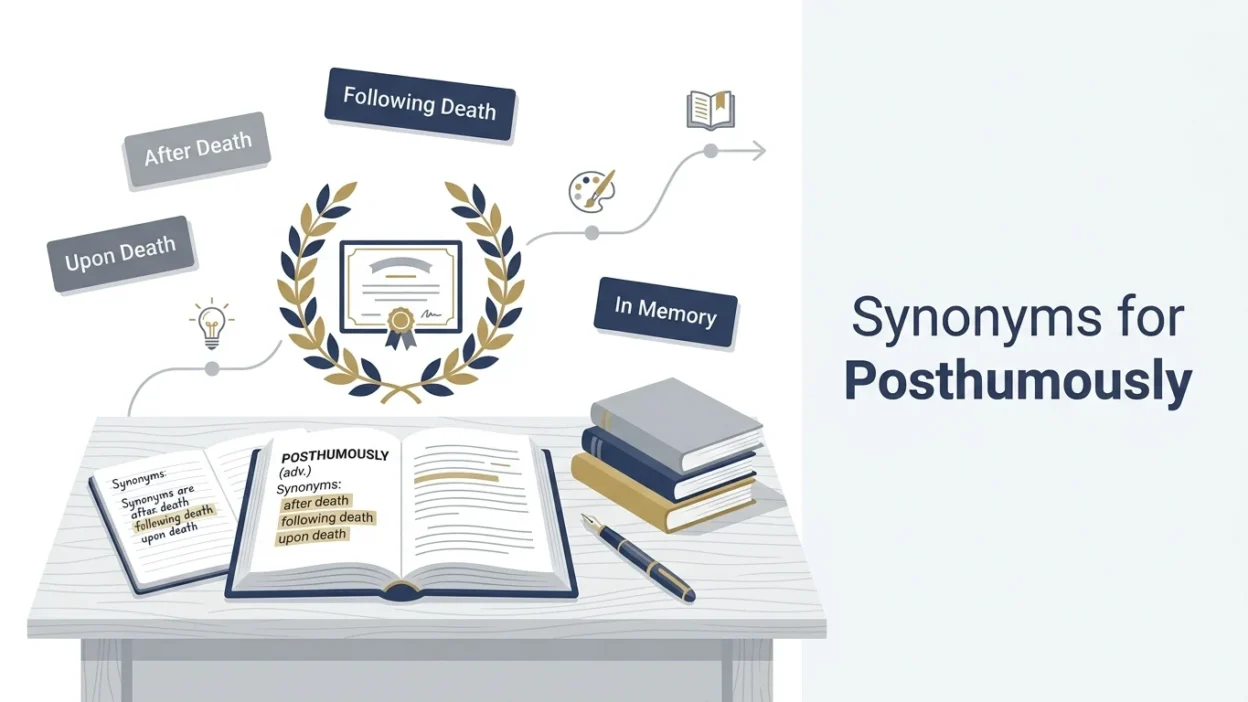
The phrase synonyms for posthumously is useful for students, ESL learners, writers, and content creators who want to speak and write with more precision. The word posthumously means after a person has died. It is often used in formal writing, biographies, news reports, awards, and academic content.
Understanding this keyword helps you choose the right tone. Sometimes you need a formal word like after death or following death. Other times, a softer or more natural phrase works better. This guide gives you simple, beginner friendly options so you can use the right expression in the right place.
A quick note for clarity: demure is a different word. It means quiet, modest, reserved, or shy in a polite way. People often use it to describe a calm tone, gentle behavior, or a modest style. It does not mean posthumously, but it is a useful vocabulary word for learners, so it is explained here as requested.
Synonym Guide: Meaning, Example, and Best Usage
1. After death
Meaning: A simple phrase meaning something happens once a person has died.
Example sentence: The award was given after death.
Best usage context: Clear, simple, everyday writing.
2. Following death
Meaning: Something happens after a person dies.
Example sentence: Following death, the family released a statement.
Best usage context: Formal and respectful writing.
3. After passing away
Meaning: A gentle phrase for after someone dies.
Example sentence: The book was published after passing away.
Best usage context: Soft, polite, human friendly tone.
4. Upon death
Meaning: At the time of death or immediately after death.
Example sentence: Upon death, the property went to his children.
Best usage context: Legal or formal contexts.
5. After someone dies
Meaning: A very easy phrase for learners.
Example sentence: The message was shared after someone dies.
Best usage context: Beginner friendly explanations.
6. After the person’s death
Meaning: Something occurs after a specific person has died.
Example sentence: The honor came after the person’s death.
Best usage context: News, articles, and biographies.
7. Once deceased
Meaning: After a person is no longer alive.
Example sentence: Once deceased, his collection was donated to a museum.
Best usage context: Formal or literary writing.
8. After demise
Meaning: After death; “demise” is a formal word for dying.
Example sentence: The property was transferred after demise.
Best usage context: Formal documents and legal style.
9. Post mortem
Meaning: After death; also used for an examination of a body.
Example sentence: The report was completed post mortem.
Best usage context: Medical or technical writing.
10. Post death
Meaning: Happening after death.
Example sentence: The artist’s post death fame grew quickly.
Best usage context: General formal writing.
11. In death
Meaning: Related to the period after death.
Example sentence: In death, the writer became even more famous.
Best usage context: Literary or reflective writing.
12. After life ends
Meaning: After a person’s life is over.
Example sentence: The legacy continued after life ends.
Best usage context: Simple, emotional writing.
13. When no longer alive
Meaning: After a person has died.
Example sentence: The story became popular when no longer alive.
Best usage context: ESL friendly explanation.
14. After the passing
Meaning: After someone has passed away.
Example sentence: The ceremony was held after the passing of the author.
Best usage context: Respectful and gentle tone.
15. On death
Meaning: At the time of death.
Example sentence: On death, the title went to his brother.
Best usage context: Legal, official, or formal writing.
16. After the loss
Meaning: After someone is lost through death.
Example sentence: The family received support after the loss.
Best usage context: Sympathy and emotional writing.
17. After departure from life
Meaning: A very formal way to say after death.
Example sentence: The tribute was written after departure from life.
Best usage context: Literary or ceremonial language.
18. After the individual died
Meaning: A direct and clear phrase meaning after a person’s death.
Example sentence: The document was released after the individual died.
Best usage context: Plain formal writing.
19. After the deceased passed
Meaning: After the dead person passed away.
Example sentence: The donation was made after the deceased passed.
Best usage context: Obituaries and respectful reports.
20. In a posthumous manner
Meaning: Done after someone has died.
Example sentence: The story was published in a posthumous manner.
Best usage context: Academic or formal prose.
21. After mortal life
Meaning: After human life has ended.
Example sentence: Their influence remained after mortal life.
Best usage context: Philosophical or literary writing.
22. After final breath
Meaning: After the last moment of life.
Example sentence: The tribute appeared after final breath.
Best usage context: Poetic or emotional language.
23. After the end of life
Meaning: After death.
Example sentence: The award was announced after the end of life.
Best usage context: Clear, readable general writing.
24. After burial
Meaning: After the person has been buried.
Example sentence: The family met after burial to thank supporters.
Best usage context: Funeral related context.
25. After cremation
Meaning: After the body has been cremated.
Example sentence: The memorial service was held after cremation.
Best usage context: Funeral and memorial writing.
26. After the body’s death
Meaning: After the physical death of a person.
Example sentence: The examination happened after the body’s death.
Best usage context: Medical or forensic context.
27. After being deceased
Meaning: After the person has died.
Example sentence: His work became more respected after being deceased.
Best usage context: Simple formal English.
28. In memory of the dead
Meaning: Done to honor someone after death.
Example sentence: The event was held in memory of the dead.
Best usage context: Memorials and tributes.
29. After the person had died
Meaning: A direct phrase for after death.
Example sentence: The letter was discovered after the person had died.
Best usage context: Clear storytelling and reports.
30. After life had ended
Meaning: A simple, descriptive phrase for after death.
Example sentence: The family shared the news after life had ended.
Best usage context: Easy to understand writing.
Comparison Guide: Which Synonym Should You Use?
| Use case | Best choices | Tone |
| Simple everyday English | after death, after someone dies, after the person’s death | Clear, direct |
| Formal writing | following death, upon death, once deceased, after demise | Professional |
| Gentle or respectful tone | after passing away, after the passing, after the loss | Soft, polite |
| Medical or technical use | post mortem, after the body’s death | Technical |
| Literary or poetic writing | in death, after final breath, after mortal life | Artistic |
| Funeral or memorial context | after burial, after cremation, in memory of the dead | Emotional, respectful |
How to Choose the Right Synonym
Choose your wording based on tone, audience, and purpose.
For students and ESL learners, the best choices are simple phrases like after death, after someone dies, and after the person’s death. These are easy to understand and work well in general writing.
For formal articles, reports, or legal content, use phrases like following death, upon death, or once deceased. These sound more polished and official.
For sympathetic or respectful writing, choose softer expressions such as after passing away, after the passing, or after the loss. These feel more human and gentle.
For medical, forensic, or technical writing, post mortem and after the body’s death are more suitable. They sound precise and specific.
For creative writing, phrases like in death, after final breath, or after mortal life can add emotion and style.
What Does Demure Mean?
Demure means quiet, modest, shy, or reserved in a polite way.
Example sentence: She gave a demure smile and spoke softly.
Best usage context: Describing a calm personality, gentle behavior, or modest style.
Conclusion
The keyword synonyms for posthumously covers many useful phrases that all point to the same general idea: something happening after death. Some expressions are simple, while others are formal, poetic, or technical. The best choice depends on your audience and your tone.
If you want clear English, use after death or after the person’s death. If you want a softer tone, use after passing away. If you need formal writing, try following death or upon death. With these 30 options, you can write more naturally, sound more precise, and understand the word posthumously with confidence.

Mason Blake specializes in educational writing, focusing on vocabulary, grammar, and language improvement. His articles simplify complex topics, making learning enjoyable for students, writers, and English learners everywhere.