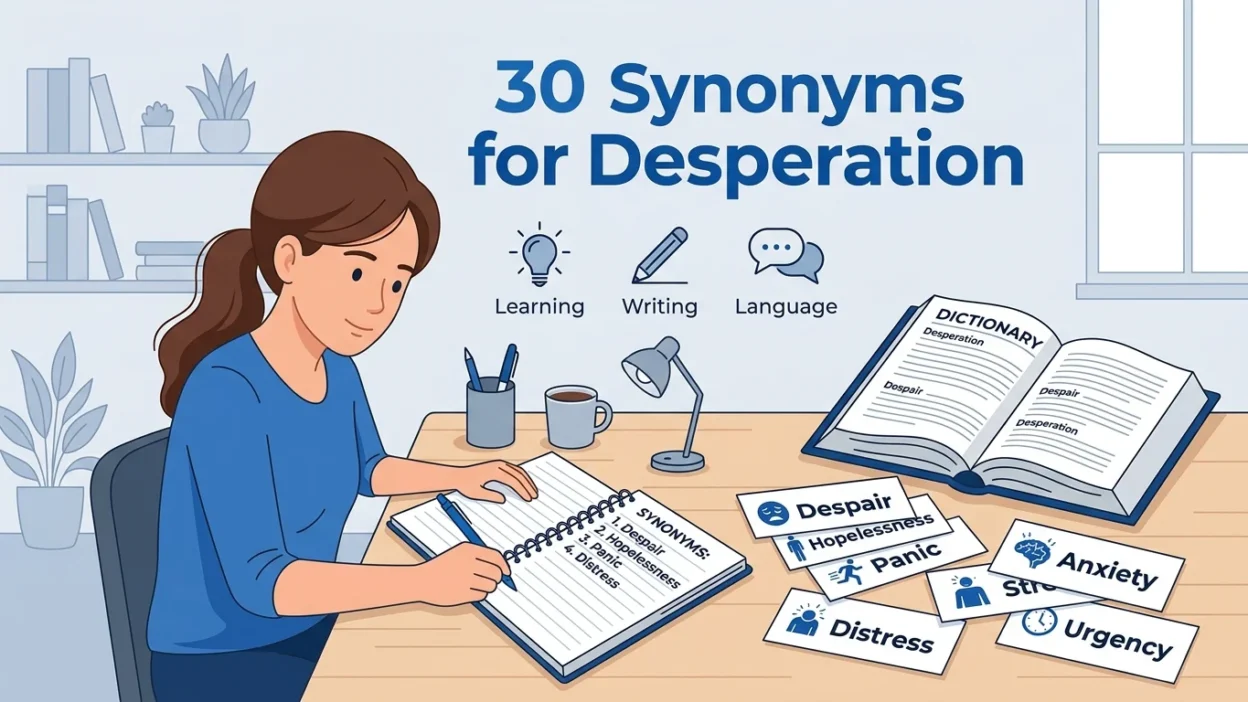
Desperation is a strong feeling of hopelessness, extreme need, or panic. People feel desperate when they believe they have very few choices left, or when a situation feels urgent and difficult to control. Because this emotion can appear in writing, speech, schoolwork, and daily life, it is useful to know different ways to express it.
Learning synonyms for desperation helps students, ESL learners, writers, and content creators choose more accurate words. Some words sound emotional, some sound formal, and some work better in storytelling or academic writing. Knowing the difference makes your vocabulary stronger and your writing more natural.
This guide gives you 30 beginner friendly related words and phrases, along with simple meanings, examples, and best use notes. It is designed as a dictionary style and blog style resource you can read quickly and use immediately.
What does “demure” mean?
“Demure” is a different word from desperation. It means quiet, modest, shy, or well behaved in a calm way. It is often used to describe a person, especially someone who appears reserved or polite.
Example: She gave a demure smile and looked down.
Tone and usage context: Demure has a soft, gentle tone. It is used in descriptions of people, manners, fashion, or behavior. It is not used for strong emotions like desperation.
30 Synonyms for Desperation
1. Despair
Meaning: A deep feeling that things will not get better.
Example sentence: After many failed attempts, he felt despair.
Best usage context: Emotional writing, stories, and serious situations.
2. Hopelessness
Meaning: The feeling that there is no hope or positive result.
Example sentence: The team was filled with hopelessness after the loss.
Best usage context: Simple explanation of a very negative mood.
3. Panic
Meaning: A sudden strong fear that makes a person act quickly.
Example sentence: She felt panic when she could not find her phone.
Best usage context: Fast, urgent, or frightening moments.
4. Distress
Meaning: A strong feeling of suffering, worry, or pain.
Example sentence: The family was in distress after hearing the news.
Best usage context: Formal writing, news, and general emotional situations.
5. Anxiety
Meaning: A worried, uneasy feeling about what may happen.
Example sentence: He felt anxiety before the exam.
Best usage context: Everyday use, school, work, and health related writing.
6. Agony
Meaning: Very strong emotional or physical pain.
Example sentence: She was in agony after the bad news.
Best usage context: Dramatic writing and strong emotional expression.
7. Anguish
Meaning: Deep mental suffering or emotional pain.
Example sentence: The mother spoke with anguish about her missing child.
Best usage context: Serious, literary, or emotional writing.
8. Desperateness
Meaning: The state of feeling desperate or needing something badly.
Example sentence: His desperateness was clear when he begged for help.
Best usage context: Informal to semi formal writing, though “desperation” is usually more natural.
9. Neediness
Meaning: A strong emotional or practical need for help, attention, or support.
Example sentence: Her neediness made it hard for her to work alone.
Best usage context: Personality descriptions and relationship writing.
10. Urgency
Meaning: A feeling that something must be done very quickly.
Example sentence: The message created urgency in the office.
Best usage context: Work, business, safety, and action based writing.
11. Alarm
Meaning: A feeling of worry caused by danger or a serious problem.
Example sentence: The sudden silence caused alarm in the room.
Best usage context: News, safety, and formal communication.
12. Fear
Meaning: A strong feeling that something bad may happen.
Example sentence: He spoke with fear in his voice.
Best usage context: Simple, common, and easy to understand writing.
13. Worry
Meaning: A feeling of concern about a problem or future event.
Example sentence: She had worry about paying the rent.
Best usage context: Daily conversation and ESL friendly writing.
14. Frustration
Meaning: A feeling of anger or sadness because something is difficult or blocked.
Example sentence: He showed frustration after waiting for hours.
Best usage context: Daily life, work problems, and school situations.
15. Helplessness
Meaning: The feeling that you cannot control the situation or fix it.
Example sentence: Her helplessness was painful to watch.
Best usage context: Emotional stories and serious personal situations.
16. Restlessness
Meaning: A feeling of being unable to relax or stay calm.
Example sentence: He felt restlessness while waiting for the results.
Best usage context: Personal feelings, anxiety, and quiet tension.
17. Tension
Meaning: A nervous or stressed feeling in a situation.
Example sentence: There was tension in the room before the announcement.
Best usage context: Conflict, meetings, and dramatic scenes.
18. Dread
Meaning: A strong fear that something unpleasant is coming.
Example sentence: She felt dread before opening the exam results.
Best usage context: Emotional writing and situations with fear of the future.
19. Misery
Meaning: A very unhappy state with a lot of pain or suffering.
Example sentence: The cold weather added to their misery.
Best usage context: Strong emotional or physical suffering.
20. Suffering
Meaning: Pain, hardship, or a very difficult experience.
Example sentence: Many people were suffering after the storm.
Best usage context: Formal writing, humanitarian topics, and serious discussion.
21. Struggle
Meaning: A difficult effort to survive, solve, or continue.
Example sentence: The student’s struggle to pass the course was real.
Best usage context: Work, school, recovery, and personal growth stories.
22. Craving
Meaning: A very strong desire or need for something.
Example sentence: He had a craving for help and reassurance.
Best usage context: Food, emotions, habits, or strong personal desire.
23. Yearning
Meaning: A deep, strong wish for something.
Example sentence: She felt yearning for a peaceful life.
Best usage context: Literary writing, emotional scenes, and soft expression.
24. Longing
Meaning: A strong feeling of wanting something or someone.
Example sentence: He felt longing for home.
Best usage context: Emotional, reflective, and storytelling writing.
25. Pleading
Meaning: Asking for help in a strong, emotional way.
Example sentence: She gave him a pleading look.
Best usage context: Dialogue, scenes of request, and emotional interactions.
26. Urgency driven need
Meaning: A need that feels immediate and cannot wait.
Example sentence: The urgency driven need for water was clear after the hike.
Best usage context: Clear explanation in instructional or formal writing.
27. Crisis
Meaning: A very serious or dangerous situation that needs action now.
Example sentence: The company entered a crisis after losing its main client.
Best usage context: Business, news, health, and emergency writing.
28. Meltdown
Meaning: A sudden emotional breakdown or loss of control.
Example sentence: He had a meltdown after days of pressure.
Best usage context: Informal writing, conversations, and emotional descriptions.
29. Impatience
Meaning: A feeling of not wanting to wait.
Example sentence: Her impatience grew as the minutes passed.
Best usage context: Everyday situations, waiting, and frustration based scenes.
30. Dire need
Meaning: An extremely serious and urgent need.
Example sentence: The village was in dire need of clean water.
Best usage context: Formal writing, charity, news, and serious appeals.
Comparison Guide: When to Use Different Synonyms
Not every synonym for desperation has the same tone. Some words are emotional, some are formal, and some focus more on urgency than sadness.
| Word | Main feeling | Tone | Best use |
| Despair | No hope | Strong and emotional | Stories, essays, dramatic writing |
| Hopelessness | No hope | Simple and clear | Basic explanation, ESL writing |
| Panic | Sudden fear | Fast and intense | Emergencies, real time reactions |
| Distress | Pain or worry | Formal and flexible | News, reports, serious situations |
| Anxiety | Ongoing worry | Common and modern | Daily life, school, health topics |
| Helplessness | No control | Emotional and clear | Personal struggles, reflective writing |
| Urgency | Need to act now | Neutral and practical | Work, business, safety |
| Dread | Fear of future harm | Emotional and literary | Storytelling, inner feelings |
| Misery | Deep unhappiness | Strong and negative | Serious emotional scenes |
| Dire need | Extreme need | Formal and strong | Charity, crisis, support requests |
How to Choose the Right Synonym
The best synonym depends on the exact feeling you want to express.
Use emotional words like despair, anguish, misery, and helplessness when you want to show deep suffering. These words work well in stories, personal writing, and strong emotional descriptions.
Use fear based words like panic, dread, and alarm when the situation feels dangerous or sudden. These words are useful when something urgent is happening.
Use practical words like urgency, crisis, and dire need when the focus is on action, timing, or problem solving. These are good for reports, business writing, and formal communication.
Use simple everyday words like worry, frustration, and anxiety when you want language that feels natural and easy to understand. These are often the best choice for ESL learners.
Use literary words like yearning, longing, and pleading when you want a softer or more expressive tone. These words add depth to creative writing.
Quick Usage Tips for Writers and ESL Learners
If you want to sound clear and natural, choose the word that matches the situation, not just the meaning.
For example, panic is stronger than worry. Despair is stronger than frustration. Urgency is more practical than anguish. These small differences matter in good writing.
Also, remember that some words are close in meaning but not perfect replacements. That is why studying synonyms for desperation is helpful: it teaches you tone, feeling, and context together.
Conclusion
Synonyms for desperation help you express emotion more accurately and make your writing more powerful. Some words show hopelessness, some show fear, and some show urgent need. By learning the difference, you can choose the best word for essays, stories, conversations, and content writing.
If you remember only one thing, remember this: the right synonym depends on tone, intensity, and context. That is what turns simple vocabulary into strong communication.

Mason Blake specializes in educational writing, focusing on vocabulary, grammar, and language improvement. His articles simplify complex topics, making learning enjoyable for students, writers, and English learners everywhere.