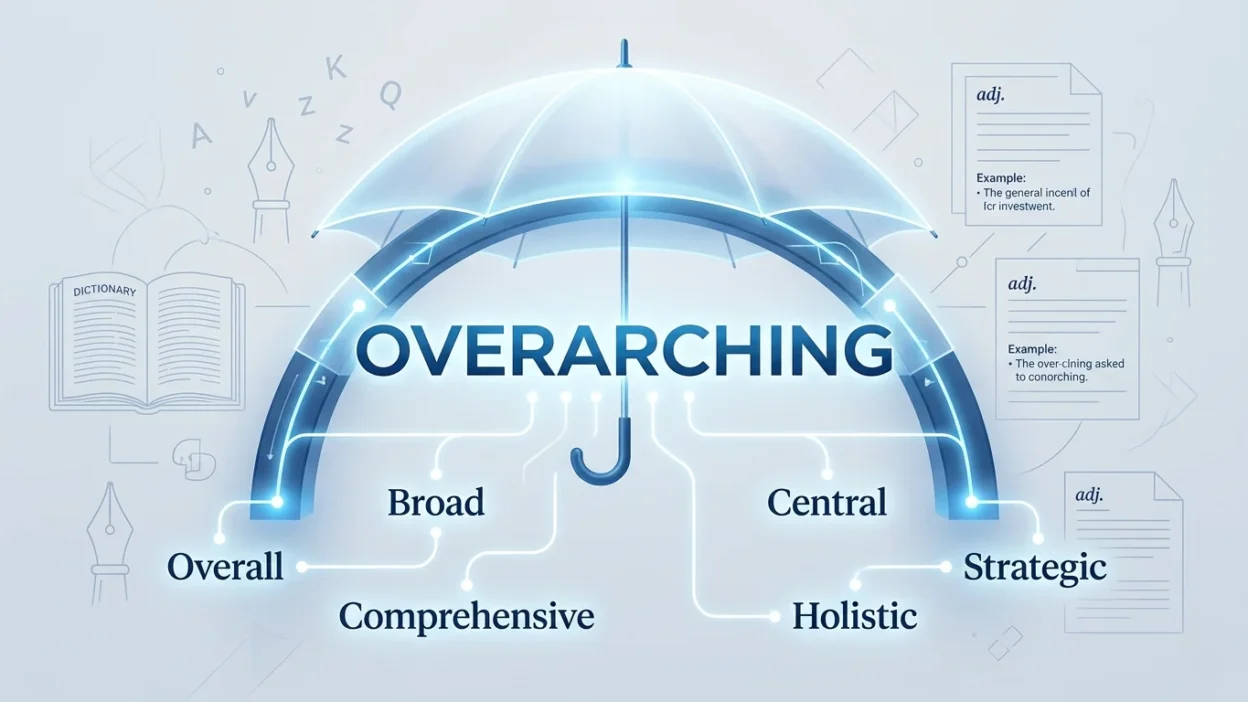
Finding the right word can make your writing clearer, more professional, and more natural. The word overarching is useful when you want to describe something broad, important, or connected to many smaller parts. However, using the same word repeatedly can make your writing feel limited.
This guide explores synonyms for overarching and explains how each alternative differs in meaning, tone, and usage. These words can help students, ESL learners, writers, bloggers, and content creators express broad ideas more precisely.
Whether you are writing an essay, business report, article, presentation, or academic paper, understanding these alternatives can help you choose the word that best matches your intended meaning.
What Does “Overarching” Mean?
In simple English, overarching means covering, connecting, or affecting many different things at once. It is often used for a main idea, goal, principle, theme, or strategy that includes several smaller elements.
For example:
Example:
“The overarching goal of the project is to improve student performance.”
Here, overarching means the main or broad goal that includes several smaller objectives.
The word often has a formal, academic, professional, or analytical tone. It is especially common in essays, research papers, business writing, government documents, and strategic discussions.
30 Synonyms for Overarching
Below are 30 useful alternatives. Some are close synonyms, while others work best in specific contexts where the meaning of “overarching” changes slightly.
1. Overall
Meaning: Describes something that considers the whole situation rather than just one part.
Example sentence:
“The overall purpose of the program is to support new learners.”
Best usage context:
Everyday, academic, business, and general writing.
2. Comprehensive
Meaning: Including all or most important parts of something.
Example sentence:
“The school developed a comprehensive plan for improving education.”
Best usage context:
Academic, professional, research, and formal writing.
3. Broad
Meaning: Covering a large range of subjects, ideas, or areas.
Example sentence:
“The course provides a broad understanding of modern technology.”
Best usage context:
General, academic, and educational writing.
4. All Encompassing
Meaning: Including almost everything connected with a particular subject.
Example sentence:
“The organization created an all encompassing strategy for employee development.”
Best usage context:
Formal writing when emphasizing wide coverage.
5. Inclusive
Meaning: Including many different people, ideas, areas, or elements.
Example sentence:
“The company needs an inclusive approach to workplace development.”
Best usage context:
Education, social topics, business, and organizational writing.
6. Wide Ranging
Meaning: Covering many different subjects, areas, or possibilities.
Example sentence:
“The researcher conducted a wide ranging investigation into climate change.”
Best usage context:
Research, journalism, academic writing, and reports.
7. Far Reaching
Meaning: Having an effect across many areas or producing important effects over a large range.
Example sentence:
“The new policy could have far reaching effects on small businesses.”
Best usage context:
Policies, decisions, consequences, and major changes.
8. All Inclusive
Meaning: Including everything important within a particular group or subject.
Example sentence:
“The guide offers an all inclusive overview of digital marketing.”
Best usage context:
Guides, programs, plans, services, and informational content.
9. Holistic
Meaning: Considering something as a complete system rather than focusing on individual parts.
Example sentence:
“The school takes a holistic approach to student development.”
Best usage context:
Education, health, business, personal development, and systems thinking.
10. General
Meaning: Relating to the whole subject rather than one specific detail.
Example sentence:
“The report gives a general overview of the company’s performance.”
Best usage context:
Simple, everyday, academic, and explanatory writing.
11. Central
Meaning: Most important or closely connected to the main subject.
Example sentence:
“Trust is a central principle of effective teamwork.”
Best usage context:
When emphasizing importance rather than broad coverage.
12. Main
Meaning: The most important or primary part of something.
Example sentence:
“Our main objective is to improve customer satisfaction.”
Best usage context:
Simple English, business, education, and everyday writing.
13. Principal
Meaning: Most important or primary.
Example sentence:
“The principal aim of the research is to identify better learning methods.”
Best usage context:
Formal, academic, and professional writing.
14. Dominant
Meaning: More important, powerful, or influential than other elements.
Example sentence:
“Technology has become a dominant factor in modern education.”
Best usage context:
When describing influence, power, or importance.
15. Unifying
Meaning: Bringing separate parts together around one common idea or purpose.
Example sentence:
“The project has a unifying goal that connects all departments.”
Best usage context:
Teams, organizations, movements, ideas, and strategies.
16. Guiding
Meaning: Providing direction or helping determine how something should be done.
Example sentence:
“Respect remains the guiding principle of the organization.”
Best usage context:
Principles, values, strategies, policies, and leadership.
17. Governing
Meaning: Controlling, directing, or establishing how something operates.
Example sentence:
“Several governing principles shape the company’s decision making process.”
Best usage context:
Rules, principles, policies, systems, and institutions.
18. Underlying
Meaning: Existing beneath the surface and supporting or influencing something.
Example sentence:
“The underlying idea is that every student deserves equal opportunities.”
Best usage context:
Ideas, causes, principles, assumptions, and problems.
19. Fundamental
Meaning: Basic and extremely important to something.
Example sentence:
“Communication is a fundamental part of successful teamwork.”
Best usage context:
Academic, educational, professional, and explanatory writing.
20. Unifying
Meaning: Connecting different elements through a shared purpose or idea.
Example sentence:
“A unifying theme appears throughout the entire novel.”
Best usage context:
Literature, projects, organizations, themes, and creative writing.
21. Sweeping
Meaning: Very broad and affecting many people, areas, or subjects.
Example sentence:
“The government introduced sweeping changes to the education system.”
Best usage context:
Major reforms, changes, policies, and social developments.
22. Global
Meaning: Relating to the whole system, world, or a very large area.
Example sentence:
“The company needs a global strategy for entering new markets.”
Best usage context:
International business, world issues, technology, and large scale subjects.
23. Extensive
Meaning: Covering a large amount or range.
Example sentence:
“The study provides extensive information about language learning.”
Best usage context:
Research, reports, studies, resources, and investigations.
24. Broad Based
Meaning: Supported by or involving many different groups, areas, or aspects.
Example sentence:
“The organization needs a broad based approach to community development.”
Best usage context:
Policy, social issues, organizations, education, and development.
25. Cross Cutting
Meaning: Affecting or connecting several different areas or subjects.
Example sentence:
“Digital literacy is a cross cutting issue across modern education.”
Best usage context:
Academic research, policy, government, development, and professional writing.
26. Umbrella
Meaning: Describes something that includes several related ideas, categories, or activities.
Example sentence:
“Sustainability is an umbrella concept covering environmental and social concerns.”
Best usage context:
Categories, concepts, organizations, fields, and groups of related ideas.
27. Big Picture
Meaning: Focused on the complete situation instead of small details.
Example sentence:
“Managers need to understand the big picture goals before making decisions.”
Best usage context:
Business, education, planning, presentations, and informal professional writing.
28. Macro Level
Meaning: Related to a large system or broad situation rather than individual details.
Example sentence:
“The study examines the issue at a macro level.”
Best usage context:
Economics, sociology, business, research, and academic writing.
29. Strategic
Meaning: Related to a carefully planned approach designed to achieve a larger goal.
Example sentence:
“The company adopted a strategic plan for long term growth.”
Best usage context:
Business, leadership, management, planning, and organizational writing.
30. Panoramic
Meaning: Giving a broad or complete view of a subject.
Example sentence:
“The book offers a panoramic view of American history.”
Best usage context:
Literature, history, journalism, essays, and descriptive writing.
Quick Comparison of Synonyms for Overarching
| Synonym | Main Idea | Tone | Best Use |
| Overall | Whole situation | Neutral | General writing |
| Comprehensive | Covers many parts | Formal | Academic/research |
| Broad | Large range | Neutral | General/academic |
| All encompassing | Includes almost everything | Formal | Strategies/plans |
| Holistic | Complete system | Professional | Education/business |
| Central | Most important | Neutral/Formal | Ideas/principles |
| Main | Primary importance | Simple | Everyday writing |
| Principal | Primary importance | Formal | Academic writing |
| Unifying | Connects different parts | Formal | Themes/projects |
| Guiding | Provides direction | Professional | Principles/values |
| Governing | Controls or directs | Formal | Rules/policies |
| Underlying | Hidden supporting idea | Analytical | Causes/ideas |
| Fundamental | Basic and essential | Formal | Principles/education |
| Sweeping | Very broad and significant | Strong | Changes/reforms |
| Global | Very large scale | Formal | International topics |
| Extensive | Large in range | Formal | Research/reports |
| Cross cutting | Affects several areas | Technical | Policy/research |
| Umbrella | Covers related categories | Neutral/Formal | Concepts/categories |
| Big picture | Complete view | Informal | Planning/business |
| Strategic | Connected to larger goals | Professional | Business/planning |
How to Choose the Right Synonym
Choosing the best synonym depends on what you mean by overarching. Not every alternative works in every sentence.
For General and Simple Writing
Choose:
- Overall
- Broad
- General
- Main
These are easy for most readers to understand.
Example:
“The overall goal is to improve student performance.”
This sounds natural and straightforward.
For Academic Writing
Choose:
- Comprehensive
- Principal
- Fundamental
- Extensive
- Broad based
- Underlying
These words can make academic writing more precise without unnecessarily complicated language.
Example:
“The study provides a comprehensive analysis of online education.”
For Business and Professional Writing
Choose:
- Strategic
- Guiding
- Central
- Governing
- Macro level
These alternatives work well when discussing organizational goals, strategies, principles, or decision making.
Example:
“Customer satisfaction is a central objective of the business.”
When You Mean “Covering Many Areas”
Choose:
- Comprehensive
- All encompassing
- All inclusive
- Wide ranging
- Extensive
These words emphasize the amount or range of coverage.
Example:
“The report provides a comprehensive review of the industry.”
When You Mean “Connecting Different Parts”
Choose:
- Unifying
- Cross cutting
- Umbrella
- Guiding
- Central
These are better when one idea connects multiple smaller ideas or areas.
Example:
“Environmental protection is a cross cutting issue affecting several government departments.”
When You Mean “Very Important”
Choose:
- Central
- Main
- Principal
- Fundamental
- Dominant
These focus more on importance than on broad coverage.
Example:
“Communication is a fundamental part of effective leadership.”
Overarching vs. Overall
Overarching and overall are closely related, but they are not always interchangeable.
Overall usually means considering the whole situation.
Example:
“The overall result was positive.”
Overarching usually describes a major idea, goal, theme, or principle that covers several smaller elements.
Example:
“The overarching goal was to improve access to education.”
A simple way to remember the difference is:
Overall = the whole picture
Overarching = the big idea connecting the parts
Overarching vs. Comprehensive
These words are also similar but have different focuses.
Comprehensive emphasizes completeness.
Example:
“The report provides a comprehensive analysis of the issue.”
This suggests that the report covers many or all important aspects.
Overarching emphasizes a higher level idea or purpose.
Example:
“The overarching purpose of the research is to improve public education.”
Therefore, use comprehensive when you want to emphasize complete coverage and overarching when you want to emphasize a broad central idea.
Overarching vs. Broad
Broad is a simple and flexible synonym.
Example:
“She has a broad understanding of history.”
Overarching is usually more specific when discussing a major idea, theme, objective, or principle.
Example:
“The overarching theme of the book is personal freedom.”
For ESL learners, broad is usually easier and more natural in everyday writing, while overarching can sound more formal and analytical.
Common Collocations With Overarching
Learning common word combinations can make your English sound more natural.
Some common expressions include:
- overarching goal
- overarching objective
- overarching theme
- overarching principle
- overarching strategy
- overarching purpose
- overarching framework
- overarching vision
- overarching concern
- overarching idea
- overarching message
- overarching argument
- overarching concept
- overarching approach
Example Sentences
Overarching goal:
“The overarching goal is to create a better learning environment.”
Overarching theme:
“Freedom is an overarching theme throughout the novel.”
Overarching principle:
“Equality is an overarching principle of the organization.”
Overarching strategy:
“The company developed an overarching strategy for sustainable growth.”
Why Use Synonyms for Overarching?
Using synonyms is not simply about avoiding repetition. The right synonym can make your writing more accurate.
For example, these sentences have slightly different meanings:
- “The overall result was positive.”
- “The comprehensive report covered every major issue.”
- “The central idea was easy to understand.”
- “The unifying theme connected the different chapters.”
- “The strategic objective focused on long term growth.”
- “The underlying principle influenced the entire project.”
All of these words can relate to a broad idea, but each emphasizes something different.
For students and writers, this distinction is important because strong vocabulary is not about using the most complicated word. It is about choosing the most accurate word for the situation.
Tips for Using Overarching Synonyms Naturally
1. Consider the Meaning
Ask yourself what you want to emphasize.
Do you mean:
- the whole situation?
- the main idea?
- complete coverage?
- a connecting theme?
- a long term strategy?
- an important principle?
Your answer will help you choose the right synonym.
2. Consider Your Audience
For beginners and general readers, words such as overall, main, and broad are easy to understand.
For academic or professional audiences, comprehensive, fundamental, cross cutting, and strategic may be more appropriate.
3. Avoid Forced Vocabulary
Do not replace overarching with a complicated word just to sound intelligent.
For example:
“The overall purpose of this article is to explain vocabulary.”
This is often better than:
“The macro level purpose of this article is to explain vocabulary.”
The first sentence is simpler and more natural.
4. Match the Word With the Noun
Some synonyms naturally work better with certain nouns.
For example:
- overall result
- comprehensive analysis
- central idea
- guiding principle
- strategic objective
- underlying cause
- unifying theme
- far reaching consequences
Learning these combinations can improve both vocabulary and sentence quality.
Final Takeaway
The word overarching describes something broad, central, or influential that covers or connects several smaller elements. It is especially useful when talking about goals, themes, principles, strategies, ideas, and objectives.
The best synonym depends on the exact meaning you want to express. Use overall for the whole situation, comprehensive for complete coverage, central for importance, unifying for connection, strategic for long term planning, and underlying for a deeper supporting idea.
For ESL learners and writers, the most important lesson is simple: good vocabulary is about precision, not complexity. Understanding these synonyms for overarching will help you write clearer essays, stronger articles, more professional reports, and more natural English.

Carter Brooks writes educational content that helps readers understand word meanings, synonyms, and writing techniques. He believes simple explanations inspire lifelong learning and stronger communication skills for everyone.