
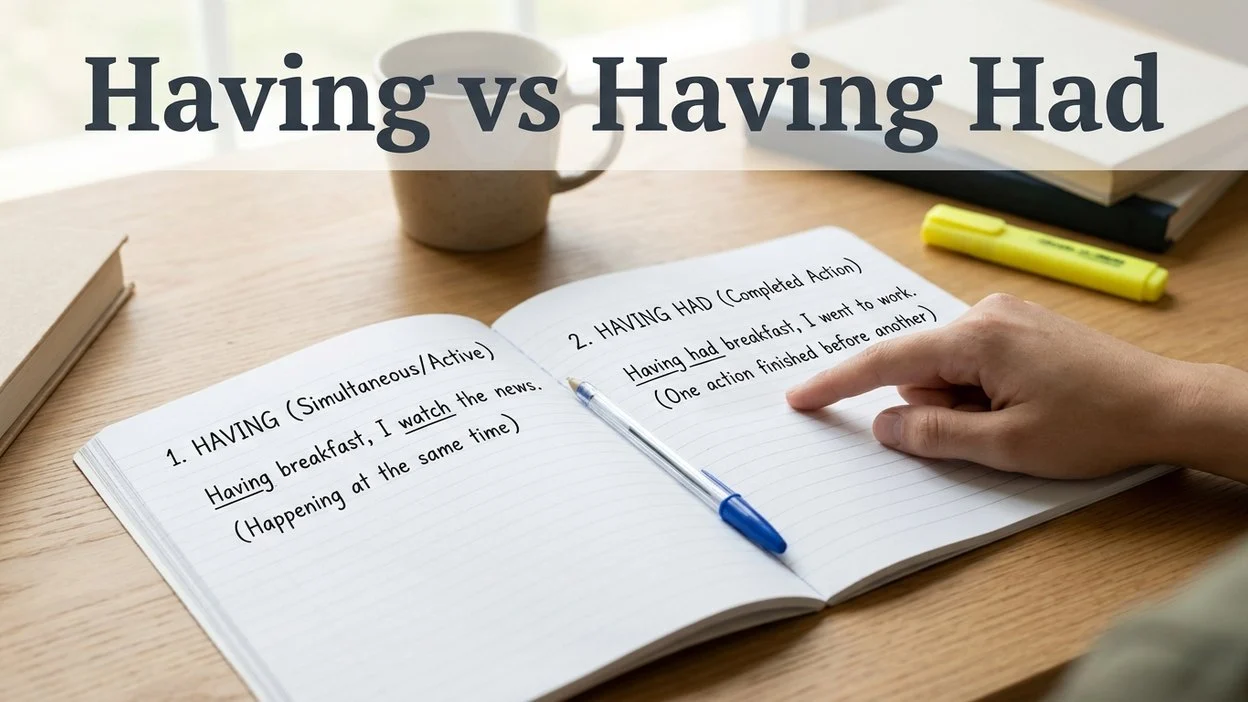
“Having” and “having had” are both correct English expressions, but they have different meanings and uses. The main difference is that “having” usually refers to an experience, action, or situation in progress or connected to another action, while “having had” emphasizes an earlier experience or situation that happened before another point in time. The correct choice depends on the sentence and the meaning you want to express.
For example, “Having a car makes life easier” describes owning a car as a general situation. In contrast, “Having had a car before, I knew how to maintain it” explains that someone owned a car in the past and gained experience from that situation. Both expressions are grammatically valid, but they cannot always replace each other. In this guide, you will learn their meanings, grammatical structures, differences, and everyday uses through simple explanations and practical examples. You will also discover common mistakes and easy ways to remember when to use each expression.
Quick Answer
“Having” is the present participle of “have” and can describe possession, experiences, or ongoing activities. “Having had” combines “having” with the past participle “had” to refer to an earlier experience or situation. Use “having” for the relevant present or general context and “having had” when emphasizing something that happened before another event.
Why Do People Confuse “Having” and “Having Had”?
People confuse these expressions because both contain the verb “have.” They also appear in sentences that describe experiences, situations, and actions.
The confusion becomes easier to understand when you look at their grammatical structures:
- Having: have + -ing form.
- Having had: having + past participle “had.”
The word “having” can describe an activity or situation, as in “having lunch” or “having a good time.” It can also appear before another clause to explain a reason or circumstance.
“Having had” usually looks back at an experience or situation that was already completed before another event.
Compare these sentences:
- Having a headache, I decided to rest. (My headache is the reason I decided to rest.)
- Having had a headache earlier, I decided to rest again. (The headache happened earlier, although the exact timing depends on the context.)
The important point is that the surrounding sentence determines the precise meaning.
What Does “Having” Mean?
“Having” is the -ing form of the verb “have.” Depending on the context, it can describe possession, an experience, an activity, or a circumstance.
1. Having to describe possession
Use “having” when talking about owning or possessing something.
Examples:
- Having a reliable computer helps me study.
- Having enough money makes traveling easier.
- Having a small garden gives us fresh vegetables.
In these sentences, “having” introduces a situation or condition.
2. Having to describe experiences or activities
“Having” is also common when talking about activities, meals, conversations, or experiences.
Examples:
- We are having dinner.
- She is having a great time.
- They are having a meeting.
Here, “having” forms part of the present continuous tense: am, is, or are + having.
3. Having at the beginning of a sentence
“Having” can introduce a circumstance that explains another action.
Examples:
- Having finished my homework, I went outside.
- Having no other choice, we waited.
- Having enough time, she decided to help us.
Notice that “having” does not always mean that something is happening right now. In “Having finished my homework,” the word “having” introduces an action completed before the main action.
What Does “Having Had” Mean?
“Having had” is a grammatical construction formed with the present participle “having” followed by the past participle “had.”
It often emphasizes that an experience or situation occurred before another action or event.
The structure is:
Having had + noun or object, + main clause
For example:
“Having had breakfast, I went to work.”
This means I ate breakfast before I went to work.
1. Having had to describe a past experience
Use “having had” when an earlier experience helps explain the present situation or a later action.
Examples:
- Having had a similar problem before, I knew what to do.
- Having had experience with children, she felt confident teaching them.
- Having had several opportunities, he finally chose one.
Each example connects an earlier experience with a later situation.
2. Having had to describe something completed earlier
The construction can also refer to an activity or event that was completed before the main clause.
Examples:
- Having had lunch, we returned to the office.
- Having had enough rest, she started working again.
- Having had the opportunity to travel, he appreciated different cultures.
In these examples, the earlier activity or experience provides context for what happened next.
3. Having had with possession or a condition
“Having had” can refer to something someone possessed or experienced in the past.
Examples:
- Having had a car before, I understood the maintenance costs.
- Having had a difficult childhood, he valued stability.
- Having had several jobs, she knew what kind of work suited her.
The phrase does not necessarily mean the situation is permanently over. It simply presents the earlier experience in relation to another event or point in time.
Having vs. Having Had: Comparison Table
| Feature | Having | Having Had |
|---|---|---|
| Grammatical form | Have + -ing | Having + past participle |
| Basic use | Activities, possession, experiences, or circumstances | Earlier experiences or situations |
| Time reference | Depends on the sentence | Usually looks back to an earlier event |
| Example | Having a dog is rewarding. | Having had a dog, I understand the responsibility. |
| Completed earlier action | Can introduce a completed action with another verb, as in “having finished” | Can describe a completed earlier experience with “have” |
| Common context | Ongoing activities and general situations | Background, previous experience, or a prior event |
| Can both be correct? | Yes, depending on meaning | Yes, depending on meaning |
Remember: “Having” does not always refer to the present, and “having had” does not automatically mean the situation is completely finished forever. The full sentence determines the meaning.
When Should You Use Each Expression?
Choose the expression that matches the relationship between the two ideas in your sentence.
Use “having” when:
- You are talking about an activity happening now: “We are having dinner.”
- You are describing a general situation: “Having good friends is important.”
- You are introducing a reason or circumstance: “Having no money, he walked home.”
- You are describing a completed action before another action using a different verb: “Having finished the report, she went home.”
Use “having had” when:
- You want to describe an earlier experience: “Having had similar problems, I understood.”
- You want to explain what happened before a later action: “Having had lunch, we continued our journey.”
- You are referring to previous possession: “Having had a bicycle as a child, I learned to ride early.”
- You want to connect a past situation with a later result: “Having had enough practice, he performed confidently.”
A simple question can help: Are you referring to an earlier experience of having something or experiencing something? If so, “having had” may be the appropriate choice.
However, if you mean an activity, a general situation, or a circumstance, “having” may be better.
12 Examples of “Having” vs. “Having Had”
These examples show how both expressions work in everyday English.
Examples of “Having”
1. Having a pet teaches children responsibility.
“Having” describes owning or caring for a pet as a general experience.
2. We are having dinner at eight tonight.
“Having” is part of the present continuous tense and describes a planned activity.
3. Having no umbrella, I got wet in the rain.
“Having no umbrella” explains the circumstance that contributed to getting wet.
4. Having enough sleep improves concentration.
“Having” refers to a general condition.
5. She is having a difficult day.
“Having” describes her current experience.
6. Having finished the book, I returned it to the library.
Here, “having” introduces a completed action. The verb “finished,” rather than “had,” expresses what was completed.
Examples of “Having Had”
7. Having had breakfast, I left for school.
Breakfast happened before the speaker left.
8. Having had similar experiences, we understood each other.
Both people had experienced similar situations before.
9. Having had a car for years, he knew how to maintain it.
His earlier experience of owning a car gave him useful knowledge.
10. Having had enough rest, she returned to work.
The sentence presents rest as an earlier experience or condition.
11. Having had several chances to improve, he finally succeeded.
The opportunities came before his eventual success.
12. Having had a conversation with the manager, I understood the new policy.
The conversation occurred before the speaker understood the policy.
Can Changing One Word Change the Meaning?
Yes. Compare these two sentences:
- Having a dog, I enjoy walking every morning.
- Having had a dog, I understand how much care pets need.
The first sentence describes a current or general situation: the speaker has a dog. The second refers to a previous experience of owning a dog. It does not necessarily mean the speaker owns a dog now.
Common Mistakes to Avoid
Even advanced English learners sometimes confuse these expressions. Here are several mistakes worth avoiding.
Mistake 1: Using “having had” for every past event
Incorrect for the intended meaning: “Having had went to school, I learned English.”
Correct: “Having gone to school, I learned English.”
Why? The past participle of “go” is “gone,” so “having gone” is the correct construction. “Had” is used only when it belongs to the verb or structure being expressed.
Mistake 2: Confusing “having had” with “had had”
These forms are different.
- “Having had breakfast, I left.” — The participial construction introduces an earlier action.
- “I had had breakfast before I left.” — The past perfect tense describes the earlier action in a complete main clause.
Both sentences can express the same sequence of events, but their grammatical structures differ.
Mistake 3: Assuming “having” always means right now
Incorrect assumption: “Having finished the test” means the person is still taking the test.
Actually, “Having finished the test, she left the room” means the test was completed before she left.
The -ing form alone does not establish the time reference.
Mistake 4: Forgetting the main clause
A sentence beginning with “having” or “having had” usually needs a main clause to complete its meaning.
Incomplete: “Having had enough time.”
Complete: “Having had enough time, we completed the project.”
Mistake 5: Using “having had” when a simpler phrase is clearer
Sometimes the simple past is more natural.
Wordy: “Having had a meal, we went outside.”
Simpler: “After eating, we went outside.”
Both can be correct. Choose the construction that makes your meaning clear and fits the tone of your writing.
Memory Trick: How to Remember the Difference
Use this simple memory trick:
- Having = the situation, activity, or circumstance.
- Having had = an earlier experience of having or experiencing something.
Imagine that you are talking about a car.
- “Having a car makes travel easier.” You are describing the general situation of owning a car.
- “Having had a car before, I knew the costs.” You are referring to earlier experience with car ownership.
You can also remember the difference by looking at the words that follow “having.”
- Having + noun: “Having a phone is useful.”
- Having + past participle: “Having finished the work, I went home.”
- Having had + noun or object: “Having had a phone before, I knew how to use it.”
Quick test: If you can replace the idea with “after experiencing” or “after having experienced,” the “having had” construction may fit. Always check the full sentence to make sure the meaning remains accurate.
Is There a Difference Between American and British English?
There is no significant grammatical difference between American and British English in the use of “having” and “having had.”
Both varieties use these constructions in the same basic ways.
Examples in American English:
- Having had breakfast, I drove to work.
- Having enough time, we visited the museum.
Examples in British English:
- Having had breakfast, I drove to work.
- Having enough time, we visited the museum.
The expressions are standard in both varieties. Differences may occur in vocabulary, preferred phrasing, or conversational style, but neither expression belongs exclusively to American or British English.
Similar Words and Expressions
Several other expressions are related to “having” and “having had.” Understanding them can help you choose more natural wording.
| Expression | Meaning | Example |
|---|---|---|
| Having | Describes an activity, experience, or situation | Having friends is important. |
| Having had | Refers to an earlier experience or situation | Having had experience, she felt ready. |
| Had | Past tense or past participle of “have” | I had a bicycle. |
| Had had | Past perfect form of “have” | I had had breakfast before noon. |
| Have had | Present perfect form of “have” | I have had this phone for years. |
| Having been | Often introduces an earlier state or experience | Having been warned, he was careful. |
| After having | Emphasizes an action or experience that came before another | After having lunch, we left. |
| After experiencing | Expresses an earlier experience in simpler wording | After experiencing the problem, I understood. |
These expressions are related, but they are not interchangeable in every sentence. Pay attention to the verb form and the intended time relationship.
Final Verdict: Having or Having Had?
Both “having” and “having had” are correct English expressions. The best choice depends on what you want to communicate.
Use “having” to describe an activity, a general situation, possession, or a circumstance. It can also introduce a completed action when followed by an appropriate past participle, as in “Having finished the work, I went home.”
Use “having had” when you want to refer to an earlier experience, possession, or situation that provides context for another event.
For example, “Having a car is convenient” describes a general situation, while “Having had a car before, I understood the expenses” refers to previous experience.
The key is not simply to memorize which expression is present or past. Instead, understand how each expression connects to the rest of the sentence.
Frequently Asked Questions
1. Is “having had” grammatically correct?
Yes. “Having had” is a standard English construction. It often introduces a previous experience or completed situation, as in “Having had breakfast, I went to work.”
2. What is the difference between “having” and “having had”?
“Having” can describe an activity, possession, or circumstance. “Having had” usually refers to an earlier experience or situation. For example, “Having a car is useful” describes a general situation, while “Having had a car, I understand the costs” refers to past experience.
3. Can I start a sentence with “having had”?
Yes. You can begin a sentence with “having had” to introduce background information before the main clause.
Example: “Having had enough practice, she performed confidently.”
The opening phrase explains the circumstances behind the main action.
4. Is “having had” the same as “had had”?
No. “Having had” is a participial construction, while “had had” is the past perfect form of the verb “have.”
Example: “Having had lunch, I left” uses a participial phrase. “I had had lunch before I left” uses the past perfect tense.
5. Can “having” refer to the past?
Yes. “Having” can introduce a completed action when it is followed by a past participle.
Example: “Having completed the assignment, he went home.”
The assignment was completed before he went home.
6. Is “having had” used in everyday English?
Yes, although some sentences sound more formal when they begin with “having had.” In casual conversation, people may prefer simpler expressions such as “After eating, we left” instead of “Having had dinner, we left.”
7. Which is correct: “having experience” or “having had experience”?
Both can be correct, depending on the meaning.
- “Having experience makes this job easier” describes experience as a general advantage.
- “Having had experience with similar projects, I knew what to expect” refers to previous experience that informed a later situation.
Remember This
- Having can describe possession, activities, general situations, and circumstances.
- Having had usually emphasizes a previous experience or situation.
- Having finished and having had are different constructions because they use different verbs.
- Had had is the past perfect form, while having had is a participial construction.
- American and British English use both expressions in essentially the same way.
Conclusion
Understanding “having” vs. “having had” becomes much easier when you focus on the meaning of the entire sentence. “Having” is useful for describing activities, general situations, and circumstances. “Having had” helps connect an earlier experience or situation to a later event. Both expressions are grammatically correct when used in the right context.
To improve your English, practice writing your own examples using both forms. Try describing a general situation with “having,” then rewrite the idea to refer to an earlier experience with “having had.” Over time, you will recognize the difference more naturally and use both expressions with greater confidence.

Mason Blake specializes in educational writing, focusing on vocabulary, grammar, and language improvement. His articles simplify complex topics, making learning enjoyable for students, writers, and English learners everywhere.