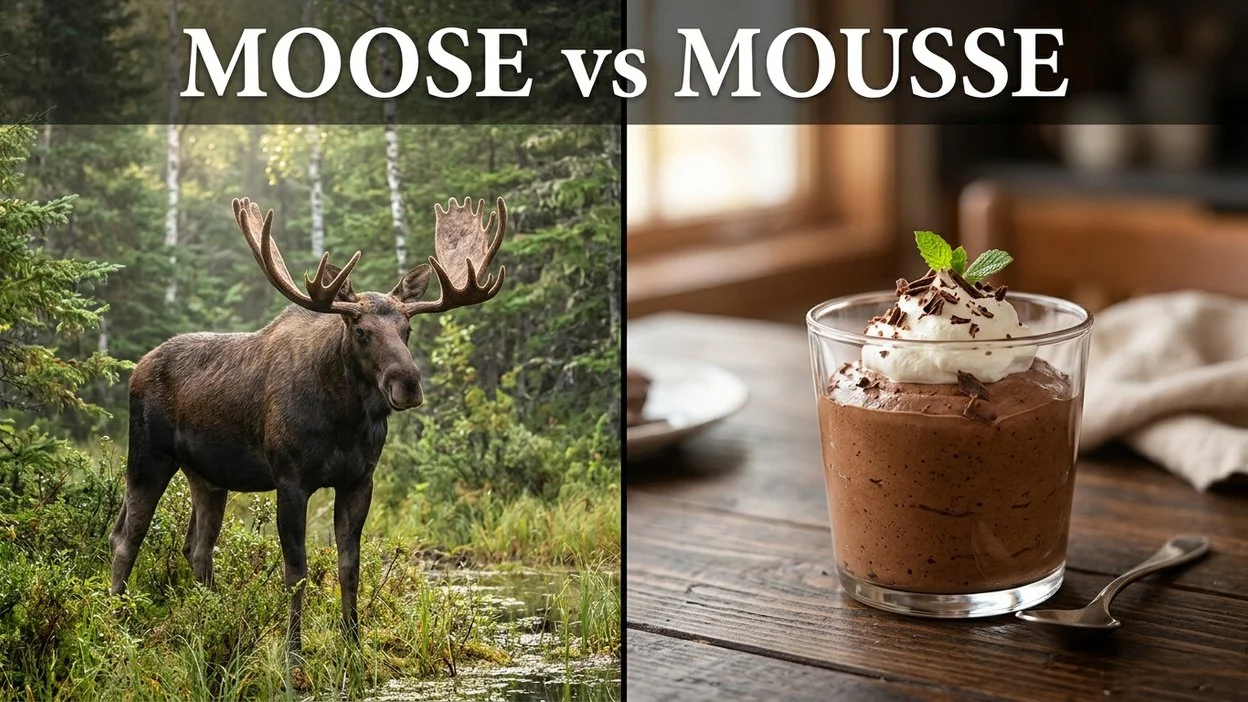
The words moose vs mousse sound almost identical, but they have completely different meanings. A moose is a large wild animal with long legs, a broad nose, and impressive antlers. A mousse is a light, fluffy food or hair-styling product. Although their pronunciation is nearly the same, their spelling, meanings, and uses are different.
Understanding the difference between moose and mousse can help you avoid spelling mistakes and use both words correctly. Whether you are learning English, improving your vocabulary, or simply wondering which word to use in a sentence, this guide explains everything in simple language. You will learn their definitions, pronunciation, common uses, examples, and an easy memory trick to remember the difference.
Quick Answer
Moose refers to a large deer-like animal commonly found in northern forests. Mousse refers to a light, airy food, such as chocolate mousse, or a foamy hair-styling product. Both words sound alike, but they describe completely different things.
Why Do People Confuse Moose and Mousse?
People often confuse these words because they have nearly identical pronunciations. Both are pronounced /muːs/, which sounds like “mooss.”
However, their spellings and meanings are different.
There are three main reasons for this confusion:
- Similar pronunciation: Both words sound the same in everyday English.
- Different spellings: Moose has five letters, while mousse has six.
- Different meanings: One describes an animal, while the other describes food or a beauty product.
These words are examples of homophones or near-identical-sounding words. In this case, they are homophones because they share the same pronunciation but have different meanings and spellings.
Moose Explained: Meaning, Definition, and Examples
What Is the Biggest Deer? Exploring the Largest Deer Species Ever – Know Animals
Moose is a noun that refers to a very large member of the deer family. It is known for its long legs, large body, broad nose, and impressive antlers.
Moose are commonly found in northern regions of North America, Europe, and Asia. They usually live in forests, wetlands, and areas near lakes and rivers.
What Does Moose Mean?
According to its dictionary meaning, a moose is a large deer-like mammal with broad, flattened antlers in males.
The plural form of moose is also moose, not mooses.
- One moose
- Two moose
- Five moose
Example Sentences with Moose
- We saw a moose standing near the lake.
- The moose had enormous antlers.
- A large moose crossed the road in front of our car.
- Moose often live in cold northern forests.
- The wildlife photographer captured a beautiful picture of a moose.
- My children were excited to see a moose at the national park.
Is Moose Singular or Plural?
Moose can be both singular and plural.
Unlike regular English nouns, which often add -s or -es to form plurals, moose does not change its spelling.
Correct: Three moose were walking through the forest.
Incorrect: Three mooses were walking through the forest.
Mousse Explained: Meaning, Definition, and Examples
Chocolate Mousse Recipe | Jernej Kitchen
Mousse is a noun that describes a light, soft, and airy preparation. It is most commonly associated with desserts and hair-styling products.
The word comes from French, where mousse means foam.
What Does Mousse Mean?
Mousse has two common meanings:
1. Food or Dessert
In cooking, mousse is a soft, fluffy dish made by incorporating air into ingredients. Chocolate mousse is one of the most popular examples.
Other varieties include:
- Chocolate mousse
- Strawberry mousse
- Lemon mousse
- Vanilla mousse
- Mango mousse
2. Hair-Styling Product
Mousse can also refer to a lightweight foamy product used to style hair.
Hair mousse helps add volume, shape, texture, and hold to different hairstyles.
Example Sentences with Mousse
- I ordered chocolate mousse for dessert.
- She prepared a delicious strawberry mousse.
- The restaurant serves vanilla mousse after dinner.
- He used hair mousse to give his hair more volume.
- This chocolate mousse tastes light and creamy.
- My sister bought a new mousse for styling her curly hair.
Moose vs Mousse: Comparison Table
| Feature | Moose | Mousse |
|---|---|---|
| Meaning | Large wild animal | Light, airy preparation or product |
| Word type | Noun | Noun |
| Pronunciation | /muːs/ | /muːs/ |
| Spelling | M-O-O-S-E | M-O-U-S-S-E |
| Origin | From an Indigenous North American language through English | French |
| Plural | Moose | Mousses |
| Common use | Wildlife and nature | Food and hair care |
| Example | A moose crossed the road. | I ate chocolate mousse. |
When Should You Use Moose or Mousse?
Choosing the correct word is easy when you understand the context.
Use Moose When Talking About an Animal
Use moose when discussing wildlife, forests, nature, or large deer-like animals.
Examples:
- We spotted a moose in the forest.
- The moose was drinking water from the river.
- A moose appeared near our campsite.
Use Mousse When Talking About Food or Hair Products
Use mousse when referring to a fluffy dessert or a foamy styling product.
Examples:
- I made chocolate mousse for my family.
- She applied mousse to her wet hair.
- The bakery sells fresh strawberry mousse.
Simple rule: If you are talking about an animal, write moose. If you are talking about dessert or hair styling, write mousse.
12 Examples of Moose vs Mousse in Sentences
Here are 12 examples to help you understand how these words work in everyday English.
| Moose | Mousse |
|---|---|
| We saw a moose in the forest. | I enjoyed chocolate mousse. |
| The moose had huge antlers. | She prepared strawberry mousse. |
| A moose walked across the road. | He applied mousse to his hair. |
| The moose was near the river. | The restaurant serves lemon mousse. |
| A baby moose followed its mother. | This mousse has a smooth texture. |
| The photographer spotted two moose. | She bought a bottle of hair mousse. |
More Examples in Everyday Conversations
Example 1: Talking About Wildlife
Person A: What did you see during your forest trip?
Person B: I saw a huge moose near the lake.
Example 2: Talking About Dessert
Person A: What did you order for dessert?
Person B: I ordered chocolate mousse.
Example 3: Talking About Hair Care
Person A: How did you get so much volume in your hair?
Person B: I used a little hair mousse.
Common Mistakes When Using Moose and Mousse
Even though these words are easy to understand, people sometimes use them incorrectly.
Here are some common mistakes to avoid.
1. Using Moose Instead of Mousse
Incorrect: I made chocolate moose for dinner.
Correct: I made chocolate mousse for dinner.
Chocolate mousse is a dessert, so the correct spelling is mousse.
2. Using Mousse Instead of Moose
Incorrect: We saw a large mousse in the forest.
Correct: We saw a large moose in the forest.
A wild animal is called a moose, not a mousse.
3. Writing Mooses as the Plural
Incorrect: Five mooses were standing near the trees.
Correct: Five moose were standing near the trees.
Moose has the same singular and plural form.
4. Forgetting the Extra Letters in Mousse
Incorrect: I love chocolate mouse.
Correct: I love chocolate mousse.
Remember that mousse contains two S letters and ends with E.
Memory Trick: How to Remember Moose vs Mousse
Here is a simple trick to remember both words without confusion.
- Moose = Animal: Think of a moose standing in a forest with large antlers.
- Mousse = Dessert: Think of a fluffy chocolate dessert served in a glass.
You can also remember the spelling:
- MOOSE has two O’s, just like the animal’s large round eyes (a playful memory association).
- MOUSSE has two S’s, just like the two S letters in its spelling.
Easy reminder: Moose walks through forests, while mousse sits on dessert menus and bathroom shelves.
American vs British English: Moose and Mousse
The meanings and spellings of moose and mousse are generally the same in American and British English.
There is no major spelling difference between the two varieties.
| Word | American English | British English |
|---|---|---|
| Moose | Moose | Moose |
| Mousse | Mousse | Mousse |
Both American and British speakers use:
- Moose for the large wild animal.
- Mousse for a light dessert or hair-styling product.
The pronunciation is also essentially the same in both varieties.
Similar Words to Moose and Mousse
Learning related words can help expand your English vocabulary.
Words Related to Moose
- Elk: A large member of the deer family.
- Deer: A hoofed mammal commonly found in forests and grasslands.
- Reindeer: A deer species known for its association with Arctic regions.
- Caribou: The North American name for reindeer populations.
- Antlers: Branched bony structures that grow on the heads of certain animals.
Words Related to Mousse
- Foam: A mass of small air bubbles in a liquid or substance.
- Froth: A collection of small bubbles on a liquid’s surface.
- Soufflé: A light, fluffy baked dish.
- Pudding: A soft dessert that can have different textures and ingredients.
- Whipped cream: Cream beaten until light and fluffy.
Final Verdict: Moose or Mousse?
Moose and mousse sound the same but have different meanings and spellings.
Use moose when talking about the large wild animal found in northern forests. Use mousse when referring to a light, airy dessert or a foamy hair-styling product.
The easiest way to remember the difference is to associate moose with wildlife and mousse with food or hair care.
Both spellings are correct English words. The right choice simply depends on what you want to describe.
Frequently Asked Questions
1. What is the main difference between moose and mousse?
Moose is a large wild animal belonging to the deer family. Mousse is a light, airy food preparation or a foamy hair-styling product. They sound the same but have different spellings and meanings.
2. Are moose and mousse pronounced the same?
Yes. Both words are pronounced /muːs/, which sounds like “mooss.” Their pronunciation is the same in standard American and British English, but their meanings are different.
3. Is mousse a type of animal?
No. Mousse is not an animal. It refers to a light, fluffy food preparation or a foamy hair product. A large wild animal with antlers is called a moose.
4. What is the plural of moose?
The plural of moose is also moose. You can say one moose, two moose, or several moose. The word does not normally take an additional S in its plural form.
5. What is the plural of mousse?
The plural of mousse is mousses. For example, “The restaurant offers three different chocolate mousses.”
6. Is chocolate moose or chocolate mousse correct?
Chocolate mousse is correct. It refers to a light, airy chocolate dessert. Chocolate moose is incorrect when you are referring to the dessert.
7. Is hair moose or hair mousse correct?
Hair mousse is correct. It is a foamy styling product used to add volume, texture, and hold to hair. Hair moose is an incorrect spelling for this product.
Remember This
- Moose means a large wild animal.
- Mousse means a light dessert or hair-styling product.
- Both words have the same pronunciation.
- Moose has the same singular and plural form.
- The plural of mousse is mousses.
- Context helps you choose the correct spelling.
Conclusion
Understanding the difference between moose and mousse is simple once you learn their meanings. Although both words sound alike, they describe entirely different things. Moose refers to a large animal, while mousse describes a fluffy dessert or a foamy hair product.
Remember the spelling by connecting moose with wildlife and mousse with chocolate desserts or hair care. With these definitions, examples, and memory tricks, you can confidently use both words in your everyday English writing and conversations.

Carter Brooks writes educational content that helps readers understand word meanings, synonyms, and writing techniques. He believes simple explanations inspire lifelong learning and stronger communication skills for everyone.