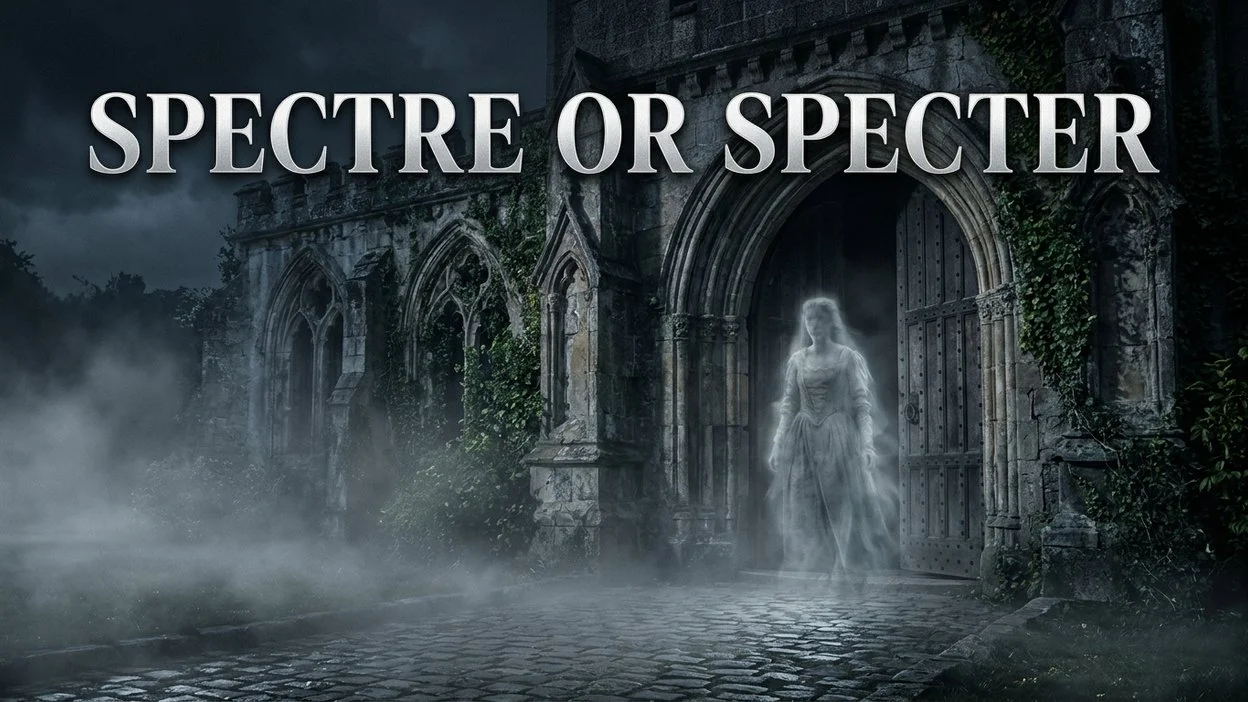
Have you ever wondered whether the correct spelling is spectre or specter? Both words are correct, and they have exactly the same meaning. They refer to a ghost, an apparition, or something frightening that seems to haunt a person or situation. The main difference is regional spelling: specter is the standard American English spelling, while spectre is the standard British English spelling.
Although these words look different, they are pronounced almost identically and can be used in the same contexts. For example, an American writer might describe a ghost as a specter, while a British writer would typically spell it spectre. Understanding this small spelling difference can help you write more naturally, avoid common spelling mistakes, and choose the right version for your audience. Let’s explore their meanings, examples, pronunciation, and usage.
Quick Answer: Spectre or Specter?
Both spectre and specter are correct spellings of the same noun. They mean a ghost, spirit, or frightening presence. The difference is regional: specter is preferred in American English, whereas spectre is preferred in British English. Choose the spelling that matches your audience and use it consistently.
Why Do People Confuse Spectre and Specter?
People often confuse these words because they have:
- The same meaning.
- Almost identical pronunciation.
- The same grammatical function.
- Different regional spelling conventions.
The main source of confusion is the final two letters.
American English commonly uses the shorter ending -er, as in specter. British English often retains the -re ending, as in spectre.
This difference also appears in other English words:
- Center (American) vs Centre (British)
- Theater (American) vs Theatre (British)
- Meter (American) vs Metre (British)
- Liter (American) vs Litre (British)
Therefore, neither spelling is incorrect. The choice simply depends on the variety of English you are using.
1. Specter: Meaning, Definition, and Usage
Specter is the standard American English spelling of a noun that means a ghost, spirit, or frightening apparition.
It can describe something supernatural that appears to haunt people. It can also refer to an unpleasant possibility, fear, or threat that makes someone worried.
Definition: A ghostly figure or something frightening that causes fear or anxiety.
Examples:
- A mysterious specter appeared in the abandoned house.
- The specter of failure made him nervous.
- People believed a specter haunted the old castle.
- The specter of war frightened the entire community.
How to use specter in a sentence:
Use specter when writing for an American audience or following American English spelling conventions.
For example:
“The villagers claimed they saw a strange specter walking through the cemetery.”
Here, specter refers to a ghostly figure.
Another example:
“The specter of unemployment worried many workers.”
In this sentence, the word describes the frightening possibility of losing a job rather than an actual ghost.
2. Spectre: Meaning, Definition, and Usage
Spectre is the standard British English spelling of the same noun. It refers to a ghost, spirit, apparition, or frightening possibility.
Its meaning and pronunciation are the same as those of specter. Only the spelling changes.
Definition: A ghostly appearance or an imagined threat that causes fear or concern.
Examples:
- A strange spectre appeared near the forest.
- The spectre of poverty worried the family.
- An old legend describes a mysterious spectre.
- The spectre of another war troubled the nation.
How to use spectre in a sentence:
Use spectre when writing for British English audiences or following British spelling conventions.
For example:
“A pale spectre appeared outside the ancient mansion.”
Here, spectre describes a ghostly appearance.
Another example:
“The spectre of economic uncertainty affected the country.”
In this sentence, it describes an unpleasant possibility that creates concern.
Spectre vs Specter: Comparison Table
The following table explains the main differences between these two spellings.
| Feature | Specter | Spectre |
|---|---|---|
| Meaning | Ghost or frightening presence | Ghost or frightening presence |
| Spelling | American English | British English |
| Pronunciation | /ˈspek.tər/ | /ˈspek.tə(r)/ |
| Part of speech | Noun | Noun |
| Usage | Common in the US | Common in the UK |
| Definition | Ghost or imagined threat | Ghost or imagined threat |
| Grammar | Singular noun | Singular noun |
| Plural | Specters | Spectres |
| Correctness | Correct | Correct |
| Main difference | Ends in -er | Ends in -re |
Important: Neither spelling changes the meaning, pronunciation, or grammatical role of the word.
When Should You Use Specter or Spectre?
Choosing between these spellings is simple once you know your target audience.
Use Specter When:
- Writing articles for American readers.
- Following American English spelling rules.
- Preparing school assignments in American English.
- Writing American publications or professional documents.
- Using American English dictionaries and style guides.
Example: “The specter of climate change continues to concern scientists.”
Use Spectre When:
- Writing articles for British readers.
- Following British English spelling conventions.
- Preparing assignments in British English.
- Writing for British publications.
- Using British English dictionaries and style guides.
Example: “The spectre of poverty remains a serious concern.”
What if you are writing for an international audience?
Either spelling is understandable. However, choose one version based on your preferred English style and use it consistently throughout your writing.
10+ Examples of Spectre and Specter in Sentences
Seeing both spellings in context makes the difference easier to understand.
| American English (Specter) | British English (Spectre) |
|---|---|
| A specter appeared in the old house. | A spectre appeared in the old house. |
| The specter frightened the children. | The spectre frightened the children. |
| A mysterious specter haunted the castle. | A mysterious spectre haunted the castle. |
| The specter of war worried everyone. | The spectre of war worried everyone. |
| He believed a specter followed him. | He believed a spectre followed him. |
| The specter disappeared into the darkness. | The spectre disappeared into the darkness. |
| The specter of failure affected her confidence. | The spectre of failure affected her confidence. |
| They reported seeing a ghostly specter. | They reported seeing a ghostly spectre. |
| The specter of poverty troubled the family. | The spectre of poverty troubled the family. |
| An eerie specter appeared near the cemetery. | An eerie spectre appeared near the cemetery. |
| The specter of uncertainty worried investors. | The spectre of uncertainty worried investors. |
Notice that the meaning remains exactly the same in every pair. Only the regional spelling changes.
Common Mistakes When Using Spectre and Specter
Although both spellings are correct, writers sometimes make mistakes when using them.
1. Thinking One Spelling Is Always Wrong
Some people believe spectre is incorrect because they are familiar with American English. Others assume specter is wrong because they follow British English.
Both assumptions are incorrect. Each spelling is accepted in its respective variety of English.
2. Mixing American and British Spellings
Using specter in one paragraph and spectre in another can make an article look inconsistent.
Choose one spelling style and maintain it throughout your writing.
3. Confusing the Word With a Physical Ghost Only
A specter does not always refer to a supernatural being.
It can also describe an unpleasant possibility or an imagined threat.
For example:
“The specter of financial problems worried the business owner.”
This sentence describes a potential problem, not a ghost.
4. Assuming the Words Have Different Pronunciations
Both words are pronounced almost identically. Their spelling difference does not create a meaningful pronunciation difference.
5. Using the Wrong Plural Form
The plural forms follow their respective spellings:
- One specter → Two specters.
- One spectre → Two spectres.
Memory Trick: How to Remember Spectre vs Specter
Here is a simple trick to remember which spelling to use.
Specter = American English
Remember the ending -er in specter. This is the standard American spelling.
Spectre = British English
Remember the ending -re in spectre. This follows the British spelling pattern found in words such as centre and theatre.
An even easier way to remember:
- US = Specter
- UK = Spectre
Think of the letter arrangement, and you will be less likely to confuse the two.
American vs British English: Spectre or Specter
The difference between spectre and specter is primarily a matter of regional spelling.
In American English, specter is the preferred spelling. American dictionaries and publications generally use this version.
In British English, spectre is the preferred spelling. It follows the traditional British pattern of ending certain words with -re rather than -er.
Here are a few similar spelling differences:
| American English | British English |
|---|---|
| Specter | Spectre |
| Center | Centre |
| Theater | Theatre |
| Meter | Metre |
| Liter | Litre |
| Fiber | Fibre |
| Caliber | Calibre |
Both spelling systems are correct. The important thing is to follow the conventions of your intended audience.
Similar Words to Spectre and Specter
Several English words have meanings similar to spectre and specter. However, their exact meanings and uses can differ.
- Ghost: The spirit or soul of a dead person, often imagined as appearing to living people.
- Phantom: A ghostly or imaginary figure that may appear mysterious or frightening.
- Apparition: A supernatural figure or unexpected ghostly appearance.
- Spirit: A supernatural being or the nonphysical part of a person.
- Wraith: A ghostly figure, traditionally associated with death or the spirit of a dead person.
- Haunting: The experience or appearance of a ghost or something that remains troubling in someone’s memory.
- Shadow: A dark shape produced when an object blocks light; it can also suggest something mysterious or threatening.
These words are related, but they are not always interchangeable.
For example, apparition usually emphasizes a sudden supernatural appearance, while specter can also describe an abstract fear or threat.
Final Verdict: Which Spelling Is Correct?
Both spectre and specter are correct English words with the same meaning. They refer to a ghost, supernatural appearance, or frightening possibility.
The only important difference is regional spelling:
- Specter: Use this spelling in American English.
- Spectre: Use this spelling in British English.
If you are writing for American readers, choose specter. If your audience follows British English, choose spectre.
Remember that neither word is universally better or more correct. Your choice should depend on your audience and writing style.
Frequently Asked Questions (FAQs)
1. Is it spectre or specter?
Both are correct. Specter is the preferred American English spelling, while spectre is the preferred British English spelling. Both words have the same meaning and pronunciation.
2. What does specter mean?
A specter is a ghost, spirit, or frightening apparition. The word can also describe an unpleasant possibility or threat that causes fear or anxiety.
3. Is spectre British or American?
Spectre is the standard British English spelling. It is commonly used in the United Kingdom and other regions that follow British spelling conventions.
4. Is specter American English?
Yes. Specter is the standard American English spelling. It is commonly used in American books, newspapers, articles, and everyday writing.
5. Do spectre and specter sound the same?
Yes. Both words are pronounced almost identically. The difference is in their spelling, not their meaning or normal pronunciation.
6. What is the plural of specter and spectre?
The plural of specter is specters, while the plural of spectre is spectres. Each spelling follows its respective regional convention.
7. Can specter describe something other than a ghost?
Yes. Specter can describe a frightening possibility or an unpleasant threat. For example, “The specter of war worried the entire community.” Here, it refers to the fear of a possible war.
Remember This
- Specter and spectre are both correct spellings.
- Specter is preferred in American English.
- Spectre is preferred in British English.
- Both words mean a ghost, apparition, or frightening possibility.
- Their pronunciation and meaning are essentially the same.
- Use one spelling consistently throughout your writing.
Conclusion
The difference between spectre and specter is simple: both words have the same meaning, but their spellings vary by region. American English generally prefers specter, while British English uses spectre. Neither spelling is incorrect, so you do not need to worry about choosing the wrong word when you understand your audience.
The easiest way to remember this difference is to associate specter with the United States and spectre with the United Kingdom. Whether you are writing an essay, an article, or an everyday message, choosing the appropriate regional spelling will make your writing more consistent and natural.

Ethan Cross is a language enthusiast and content writer who creates practical vocabulary guides. He enjoys helping readers improve communication through clear explanations, engaging examples, and easy-to-understand educational resources.