
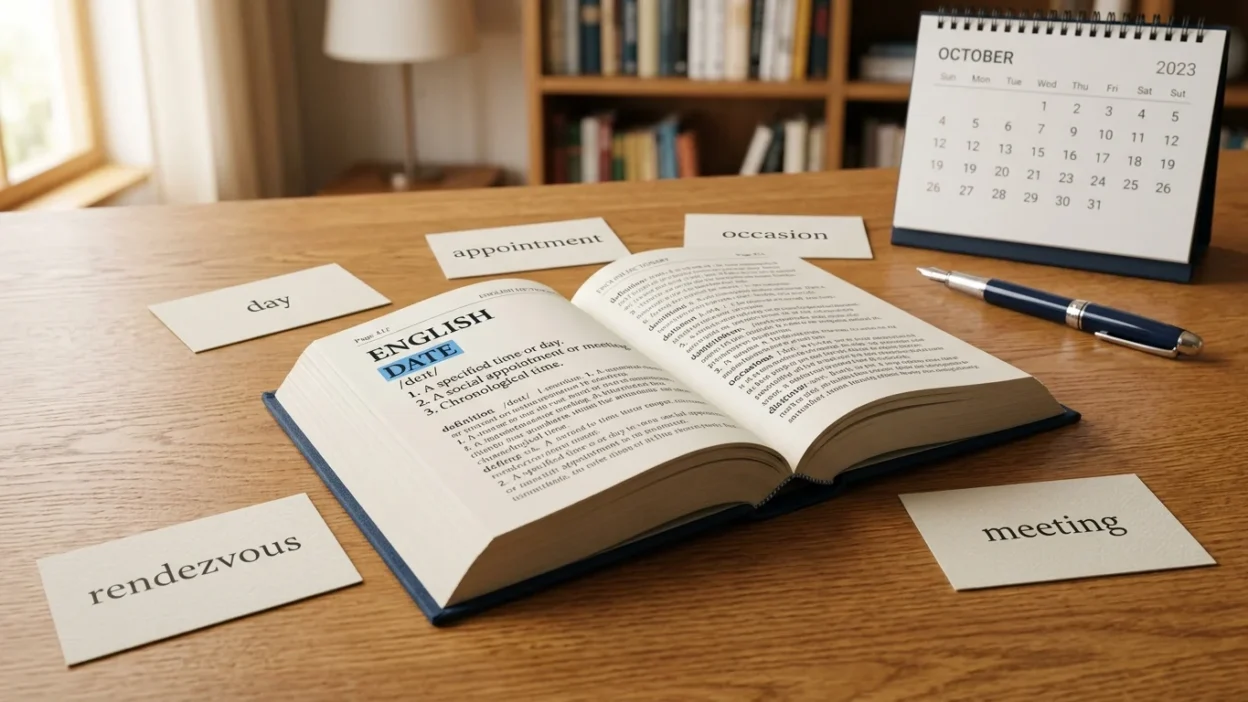
The word date is common in everyday English, but it can have several different meanings. It can refer to a particular day on the calendar, a planned meeting, a romantic meeting, or even a period in history. Because of these different meanings, choosing the right synonym depends strongly on the context.
Learning synonyms for date can help students, ESL learners, writers, and content creators express ideas more clearly. Instead of repeating the same word, you can choose a more precise alternative that matches your intended meaning, tone, and situation.
What Does “Date” Mean?
In simple English, date usually means a specific day, time, or planned occasion.
For example:
- Calendar meaning: “What is the date today?”
- Appointment meaning: “I have a date with the dentist.”
- Romantic meaning: “They went on a date.”
- Historical meaning: “The exact date of the building is unknown.”
- Fruit meaning: “She ate a sweet date.”
Because the meaning changes with context, there is no single synonym that works everywhere. The best alternative depends on how date is being used.
30 Synonyms for Date
Below are 30 useful alternatives and related words. Some are direct synonyms, while others are context specific alternatives that can replace date naturally in particular situations.
1. Day
Meaning: A particular period of 24 hours or a specific day on a calendar.
Example sentence: “What day is the meeting?”
Best usage context: Use this when “date” refers to a calendar day.
2. Time
Meaning: A particular point or period when something happens.
Example sentence: “We need to agree on a time for the interview.”
Best usage context: Useful when the exact day or moment is more important as a general schedule.
3. Occasion
Meaning: A particular event or time when something happens.
Example sentence: “Their wedding was a memorable occasion.”
Best usage context: Best for formal or special events.
4. Appointment
Meaning: An arranged meeting at a particular time.
Example sentence: “I have a doctor’s appointment tomorrow.”
Best usage context: Use it for professional, medical, or scheduled meetings.
5. Meeting
Meaning: An arranged time when people come together to talk or work.
Example sentence: “Our meeting is scheduled for Monday.”
Best usage context: Appropriate for business, education, and everyday plans.
6. Engagement
Meaning: A planned meeting or arrangement to meet someone.
Example sentence: “She has a business engagement this afternoon.”
Best usage context: Useful in formal English, especially for professional commitments.
7. Event
Meaning: Something planned or important that happens at a particular time.
Example sentence: “The event will take place on Saturday.”
Best usage context: Good for public, social, cultural, or organized activities.
8. Schedule
Meaning: A plan showing when activities or events will happen.
Example sentence: “Please check the schedule before choosing a date.”
Best usage context: Useful when discussing planned times rather than the date itself.
9. Deadline
Meaning: The final time or date by which something must be completed.
Example sentence: “The application deadline is September 15.”
Best usage context: Use this when “date” means a required completion date.
10. Appointment Time
Meaning: The specific time arranged for a meeting or service.
Example sentence: “Please arrive ten minutes before your appointment time.”
Best usage context: Useful when the focus is on a scheduled meeting.
11. Period
Meaning: A particular length or section of time.
Example sentence: “The castle was built during a difficult period.”
Best usage context: Best for historical or general discussions of time.
12. Era
Meaning: A long and distinct period in history.
Example sentence: “The invention changed the modern era.”
Best usage context: Use it for significant historical periods.
13. Age
Meaning: A historical period associated with particular events or characteristics.
Example sentence: “The discovery dates back to the Bronze Age.”
Best usage context: Useful in history, archaeology, and cultural writing.
14. Moment
Meaning: A specific and usually short point in time.
Example sentence: “That was an important moment in her career.”
Best usage context: Use it when referring to a particular point in time.
15. Point in Time
Meaning: A specific moment or stage in time.
Example sentence: “At that point in time, nobody knew the truth.”
Best usage context: Helpful in formal, academic, and analytical writing.
16. Rendezvous
Meaning: An arranged meeting, often between two people.
Example sentence: “The two travelers arranged a rendezvous in Paris.”
Best usage context: More literary, sophisticated, or romantic than “meeting.”
17. Outing
Meaning: A short trip or social activity outside the home.
Example sentence: “The couple planned a weekend outing.”
Best usage context: Useful when a romantic or social date involves going somewhere together.
18. Get Together
Meaning: An informal social meeting.
Example sentence: “We are having a small get together this evening.”
Best usage context: Best for casual social occasions.
19. Encounter
Meaning: A meeting or experience involving another person or situation.
Example sentence: “Their unexpected encounter changed both of their lives.”
Best usage context: Useful when a meeting is unexpected or significant.
20. Tryst
Meaning: A private meeting, especially between romantic partners.
Example sentence: “The novel describes a secret tryst between the two characters.”
Best usage context: Literary or romantic writing; it can suggest secrecy.
21. Romantic Meeting
Meaning: A meeting between people who are romantically interested in each other.
Example sentence: “Their first romantic meeting took place at a small café.”
Best usage context: Useful when you want to make the romantic meaning clear.
22. Social Engagement
Meaning: A planned social meeting or activity.
Example sentence: “He could not attend because of another social engagement.”
Best usage context: Good for polite and moderately formal English.
23. Appointment
Meaning: A previously arranged meeting at a particular time.
Example sentence: “I need to change my appointment to Friday.”
Best usage context: Especially common for doctors, offices, services, and professional meetings.
24. Booking
Meaning: An arrangement made in advance for a service, place, or activity.
Example sentence: “I made a booking for Saturday evening.”
Best usage context: Useful when a “date” involves reserving a service or place.
25. Deadline Day
Meaning: The particular day on which something must be finished or submitted.
Example sentence: “Friday is the deadline day for the project.”
Best usage context: Useful for assignments, applications, projects, and official requirements.
26. Anniversary
Meaning: The yearly return of a significant event or occasion.
Example sentence: “They celebrated their wedding anniversary.”
Best usage context: Use this when a date marks a recurring yearly event.
27. Birthday
Meaning: The yearly celebration of the day someone was born.
Example sentence: “Her birthday is on October 12.”
Best usage context: Use it when the date refers specifically to someone’s birth celebration.
28. Historical Period
Meaning: A defined period connected with past events.
Example sentence: “The painting comes from an important historical period.”
Best usage context: Appropriate for history, research, and academic writing.
29. Timeline
Meaning: A sequence showing when events happened.
Example sentence: “The timeline shows the dates of the major discoveries.”
Best usage context: Useful for history, projects, biographies, and chronological information.
30. Dating Meeting
Meaning: A meeting between people who are exploring a romantic relationship.
Example sentence: “Their first dating meeting was relaxed and informal.”
Best usage context: Use this phrase when you specifically need to explain the romantic meaning of “date.”
Quick Comparison of Synonyms for Date
| Word | Main Meaning | Tone | Best Context |
| Day | Calendar day | Neutral | Everyday English |
| Time | Point or period | Neutral | Scheduling |
| Appointment | Planned meeting | Neutral/Formal | Doctors and business |
| Meeting | People coming together | Neutral | Work and education |
| Occasion | Special event or time | Formal | Celebrations |
| Event | Planned happening | Neutral | Public and social activities |
| Deadline | Final required date | Formal | Work and school |
| Era | Historical period | Formal | History |
| Period | Section of time | Neutral/Formal | History and general writing |
| Rendezvous | Arranged meeting | Literary | Romantic or sophisticated writing |
| Outing | Social activity outside | Casual | Friends and couples |
| Get together | Informal gathering | Casual | Social situations |
| Tryst | Private romantic meeting | Literary | Romantic literature |
| Anniversary | Yearly remembered event | Neutral | Relationships and milestones |
| Timeline | Chronological sequence | Formal | Research and projects |
Date Synonyms by Meaning
One of the easiest ways to choose the correct synonym is to first identify which meaning of date you need.
When “Date” Means a Calendar Day
Use:
- Day
- Time
- Occasion
- Point in time
- Deadline
- Timeline
Example:
Original: “What is the date of the exam?”
Possible alternatives:
- “What day is the exam?”
- “When is the exam?”
- “What is the exam date?”
Here, day or when may sound more natural in casual English.
When “Date” Means an Appointment
Use:
- Appointment
- Meeting
- Engagement
- Booking
- Scheduled time
Example:
Original: “I need to change my date with the dentist.”
Better:
“I need to change my appointment with the dentist.”
In this situation, “appointment” is much more precise.
When “Date” Means a Romantic Meeting
Use:
- Romantic meeting
- Rendezvous
- Outing
- Tryst
- Social engagement
Example:
Original: “They went on a date.”
Possible alternatives:
“They went on a romantic outing.”
“They had a romantic meeting.”
The word date remains the most natural choice in ordinary conversation, while alternatives can create a particular tone.
When “Date” Means a Historical Time
Use:
- Era
- Age
- Period
- Historical period
- Point in time
- Timeline
Example:
Original: “The exact date of the artifact is unknown.”
Possible alternative:
“The exact period of the artifact is unknown.”
However, these words are not always interchangeable. A date can refer to one specific day or year, while a period usually refers to a broader stretch of time.
How to Choose the Right Synonym for Date
For Casual English
Choose words such as:
- Day
- Time
- Meeting
- Outing
- Get together
These words sound natural in everyday conversations.
For Formal English
Choose:
- Appointment
- Engagement
- Occasion
- Deadline
- Period
- Point in time
These alternatives are useful in academic, professional, and official writing.
For Historical Writing
Choose:
- Era
- Age
- Period
- Historical period
- Timeline
These words work well when discussing past civilizations, events, discoveries, or cultural changes.
For Romantic Writing
Choose:
- Rendezvous
- Tryst
- Romantic meeting
- Outing
These words can add variety or a more literary feeling. Remember that tryst often suggests a secret or private romantic meeting.
For School and Academic Writing
Choose precise words based on the meaning:
- Day for a calendar day
- Deadline for the final submission date
- Period for a broader span of time
- Era for a major historical period
- Point in time for a specific moment
Precision is more important than simply finding a different word.
Common Mistakes When Using Synonyms for Date
Not every synonym can replace date in every sentence.
For example:
Incorrect or unnatural: “What is the rendezvous of your exam?”
Natural: “What is the date of your exam?”
Similarly:
Less natural: “I have a day with my doctor.”
Natural: “I have an appointment with my doctor.”
This shows why understanding the meaning and context is essential. A synonym should preserve the meaning of the original sentence.
Date vs. Day
Date usually identifies a particular calendar number, such as August 27, while day can refer to the day of the week or a general 24 hour period.
Example:
- “What is the date?” → August 27.
- “What day is it?” → Thursday.
Both are related, but they are not always interchangeable.
Date vs. Appointment
An appointment is a planned meeting, while a date can have several meanings.
Example:
“I have a dentist appointment.”
This is clearer than saying:
“I have a dentist date.”
For professional or medical situations, appointment is the better word.
Date vs. Period
A date usually points to a specific point in time.
A period describes a wider stretch of time.
Example:
“The date of the battle was 1066.”
“The medieval period lasted for centuries.”
This distinction is especially important in academic and historical writing.
Date vs. Rendezvous
Both can describe a meeting, but their tones are different.
Date is common and natural.
Rendezvous sounds more sophisticated, literary, or romantic.
For everyday conversation, “date” is usually the better choice. For creative writing, “rendezvous” can add atmosphere.
Why Learning Synonyms for Date Matters
Learning different alternatives helps you communicate with greater precision.
For ESL learners, these distinctions can make English sound more natural. For students, they can improve academic writing. Writers can use them to avoid repetition, while content creators can choose vocabulary that better matches their audience.
The goal is not to replace date every time you use it. Instead, learn to recognize its different meanings and select the word that communicates your exact idea.
Frequently Asked Questions
What is the best synonym for date?
The best synonym depends on the meaning. Day works for a calendar date, appointment works for a scheduled meeting, and rendezvous can work for a romantic or literary meeting.
What is another word for a romantic date?
Possible alternatives include romantic meeting, rendezvous, outing, and tryst. However, each has a slightly different tone.
What is a formal synonym for date?
Depending on the context, formal alternatives include appointment, engagement, occasion, deadline, period, and point in time.
What is a synonym for date in history?
Useful alternatives include era, age, period, historical period, and point in time. The correct choice depends on whether you mean a specific date or a longer historical span.
Can “day” replace “date”?
Sometimes. If you are asking about the day on which something happens, day can often work. However, “date” may be more precise when you mean a specific calendar number.
Final Thoughts
The word date has several meanings, so its best synonym depends on context. When talking about a calendar, day or time may be appropriate. For scheduled meetings, appointment or engagement is often better. For historical contexts, era, age, or period can provide greater precision.
For romantic situations, words such as rendezvous, outing, and tryst can add variety, although their tones are different from the everyday word date.
The most important lesson is simple: do not choose a synonym only because it looks similar in a dictionary. Choose it because it fits the meaning, tone, and situation of your sentence. This approach will make your English clearer, more natural, and more effective.

Mason Blake specializes in educational writing, focusing on vocabulary, grammar, and language improvement. His articles simplify complex topics, making learning enjoyable for students, writers, and English learners everywhere.