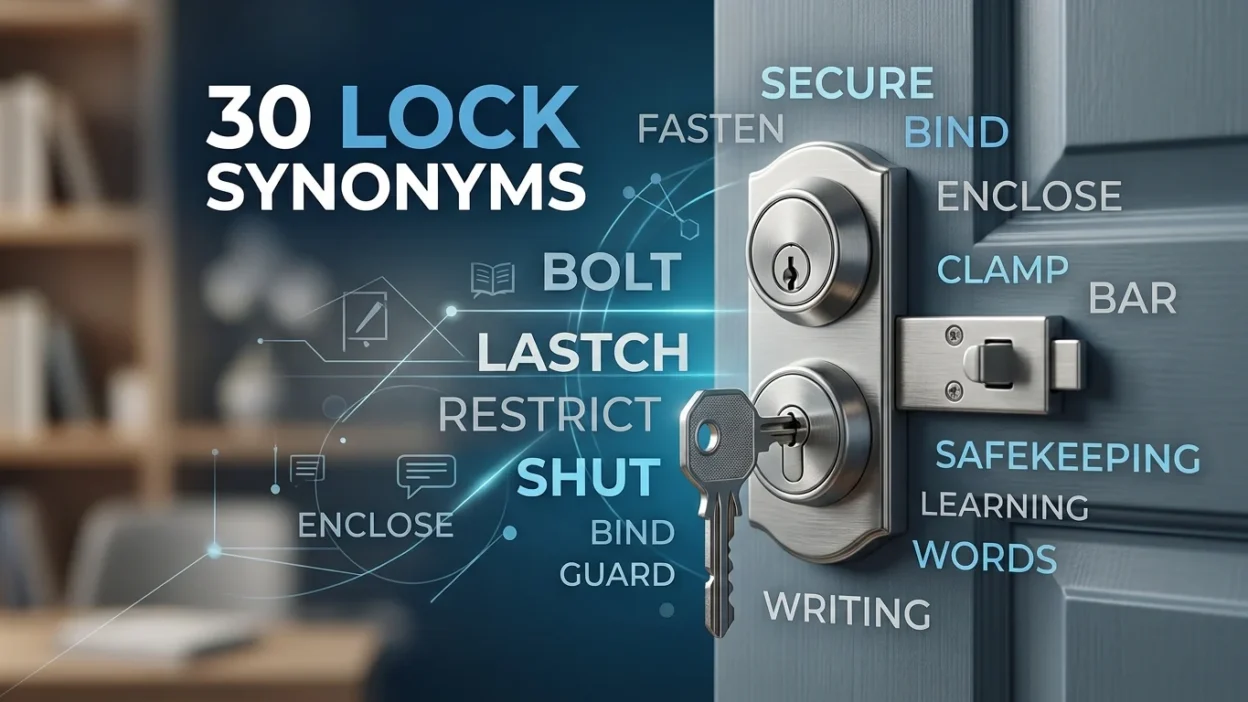
Finding the right lock synonyms can make your writing clearer, more natural, and more precise. The word “lock” has several meanings. It can describe securing a door, fastening something in place, preventing movement, restricting access, or even becoming stuck.
For students, ESL learners, writers, and content creators, learning alternatives to “lock” is useful because each synonym has a slightly different meaning and tone. For example, you might secure a building, fasten a strap, bolt a door, or restrict access to an area.
This guide explains 30 useful words related to “lock” in simple English. Each word includes its meaning, an example sentence, and the best situation for using it.
What Does “Lock” Mean?
In simple English, lock means to close or secure something so that it cannot be opened, moved, or used freely.
For example:
- “Please lock the door.”
- “She locked the window.”
- “The police locked the gate.”
- “The computer screen is locked.”
- “The wheels locked during braking.”
The exact meaning depends on the context. Some alternatives are direct synonyms, while others are closely related words that work better in specific situations.
30 Lock Synonyms
1. Secure
Meaning: To make something safe by protecting it from access, movement, or danger.
Example sentence: Please secure the back door before you leave.
Best usage context: Use “secure” when you want to emphasize safety or protection rather than the physical locking mechanism.
2. Fasten
Meaning: To attach or close something firmly so it stays in place.
Example sentence: Fasten the lock on the storage box before moving it.
Best usage context: Common for doors, straps, belts, containers, and objects that need to be held firmly.
3. Bolt
Meaning: To secure a door or gate using a bolt.
Example sentence: He bolted the front door before going to bed.
Best usage context: Best for doors and gates, especially when describing a strong physical method of securing them.
4. Latch
Meaning: To close something with a device that holds it shut.
Example sentence: Make sure you latch the garden gate.
Best usage context: Useful for gates, doors, cabinets, boxes, and similar objects.
5. Bar
Meaning: To block an entrance or prevent someone from entering.
Example sentence: The workers barred the entrance after the building became unsafe.
Best usage context: Use when the focus is on preventing entry rather than the locking mechanism itself.
6. Seal
Meaning: To close something completely so that it cannot easily be opened or entered.
Example sentence: The officials sealed the room after the inspection.
Best usage context: Useful for rooms, containers, packages, documents, and areas that need to remain closed.
7. Shut
Meaning: To close something.
Example sentence: She shut the door quietly.
Best usage context: A simple, everyday alternative when the emphasis is on closing rather than using a lock.
8. Close
Meaning: To move something into a position where it is no longer open.
Example sentence: Close the window before you leave.
Best usage context: A general and beginner friendly word for doors, windows, boxes, and other openings.
9. Fasten Down
Meaning: To hold something firmly in place so it cannot move easily.
Example sentence: The crew fastened down the equipment before the storm.
Best usage context: Best for objects, equipment, covers, and items that need to stay in position.
10. Immobilize
Meaning: To prevent something from moving.
Example sentence: The device immobilized the vehicle’s wheels.
Best usage context: Common in technical, mechanical, medical, and formal writing.
11. Restrain
Meaning: To prevent someone or something from moving freely.
Example sentence: The safety system restrained the machine during testing.
Best usage context: Useful for people, animals, machines, or actions when movement needs to be controlled.
12. Confine
Meaning: To keep someone or something inside a limited space.
Example sentence: The animal was confined to a secure enclosure.
Best usage context: More formal than “lock in” and often used for people, animals, or objects kept within boundaries.
13. Restrict
Meaning: To limit someone’s movement, access, or ability to do something.
Example sentence: The school restricted access to the laboratory.
Best usage context: Excellent for formal, academic, business, and policy writing.
14. Block
Meaning: To stop movement, entry, or progress.
Example sentence: A heavy gate blocked the entrance.
Best usage context: Use when something physically or figuratively prevents access or movement.
15. Securely Fasten
Meaning: To attach or close something firmly and safely.
Example sentence: Securely fasten the container before transporting it.
Best usage context: Helpful in instructions, safety guides, technical writing, and practical directions.
16. Pin
Meaning: To hold something in a fixed position with a pin or similar object.
Example sentence: The technician pinned the mechanism in place.
Best usage context: Common in mechanical, technical, craft, and physical contexts.
17. Clamp
Meaning: To hold something tightly between or with a device.
Example sentence: The mechanic clamped the pipe securely.
Best usage context: Best for tools, machinery, pipes, materials, and technical situations.
18. Jam
Meaning: To become stuck or prevent something from moving properly.
Example sentence: The door jammed and would not open.
Best usage context: Use when something becomes stuck, especially doors, windows, machines, or moving parts.
19. Freeze
Meaning: To stop something from changing, moving, or functioning temporarily.
Example sentence: The security system froze the account after several failed attempts.
Best usage context: Common with computers, accounts, financial activity, systems, and figurative situations.
20. Restrict Access
Meaning: To prevent or limit people from entering or using something.
Example sentence: The company restricted access to confidential files.
Best usage context: Particularly useful in technology, security, business, and formal writing.
21. Shut Off
Meaning: To stop the operation or flow of something.
Example sentence: The technician shut off the machine before repairing it.
Best usage context: Use with machines, electricity, water, gas, systems, and other operating functions.
22. Shut Down
Meaning: To stop a machine, computer, business, or system from operating.
Example sentence: The administrator shut down the computer after the update.
Best usage context: Common in technology, business, and everyday speech.
23. Disable
Meaning: To make something unable to work or operate.
Example sentence: The administrator disabled the account.
Best usage context: Very useful for technology, security systems, accounts, machines, and formal instructions.
24. Guard
Meaning: To protect a place, person, or object from unwanted access.
Example sentence: Security officers guarded the entrance throughout the night.
Best usage context: Use when protection is provided by a person, system, or security measure rather than a physical lock.
25. Protect
Meaning: To keep someone or something safe from harm, damage, or unwanted access.
Example sentence: Strong passwords protect your online accounts.
Best usage context: A broad synonym related word that works well in security and safety contexts.
26. Enclose
Meaning: To surround or close something within an area or boundary.
Example sentence: The fence enclosed the private garden.
Best usage context: Useful for physical spaces, buildings, gardens, packages, and formal descriptions.
27. Cage
Meaning: To put someone or something inside a confined structure.
Example sentence: The bird was safely caged during transportation.
Best usage context: Mainly used for animals and, in figurative language, for people or situations involving severe restriction.
28. Anchor
Meaning: To hold something firmly so it cannot move freely.
Example sentence: The heavy base anchored the equipment to the floor.
Best usage context: Useful for boats, equipment, structures, furniture, and other objects that must remain stable.
29. Hold
Meaning: To keep something in a particular position or prevent it from moving.
Example sentence: The mechanism holds the door in place.
Best usage context: A very broad and simple word that can describe physical or figurative restriction.
30. Barred
Meaning: Prevented from entering or accessing something.
Example sentence: Unauthorized visitors were barred from the restricted area.
Best usage context: Best in formal writing when describing denied access or entry.
Lock Synonyms Comparison Table
| Synonym | Main Meaning | Tone | Common Context |
| Secure | Make safe | Neutral/Formal | Security, doors, information |
| Fasten | Attach firmly | Neutral | Clothing, straps, objects |
| Bolt | Secure with a bolt | Neutral | Doors and gates |
| Latch | Close with a latch | Neutral | Doors, gates, boxes |
| Bar | Prevent entry | Formal/Neutral | Entrances, access |
| Seal | Close completely | Formal | Rooms, packages, documents |
| Shut | Close | Everyday | Doors, windows |
| Immobilize | Stop movement | Formal | Vehicles, machinery |
| Restrain | Limit movement | Formal | People, animals, systems |
| Confine | Keep within limits | Formal | People, animals, spaces |
| Restrict | Limit access or activity | Formal | Policies, websites, access |
| Block | Stop entry or movement | Neutral | Roads, doors, progress |
| Pin | Hold in place | Technical | Machinery, objects |
| Clamp | Hold tightly | Technical | Tools, pipes, machinery |
| Jam | Become stuck | Everyday | Doors, machines |
| Freeze | Stop temporarily | Neutral | Accounts, systems |
| Disable | Make inoperative | Formal/Technical | Computers, accounts |
| Enclose | Surround or contain | Formal | Areas, structures |
| Anchor | Hold firmly | Neutral/Technical | Equipment, structures |
Different Meanings of “Lock”
One reason lock synonyms can be confusing is that “lock” is used in several different ways.
Lock a Door
When you mean securing a door, the strongest alternatives are:
- Secure
- Bolt
- Latch
- Bar
- Seal
Example:
“Please lock the door.”
Possible alternatives:
“Please secure the door.”
“Please bolt the door.”
“Please latch the door.”
The best choice depends on the exact action.
Lock Something in Place
When something cannot move, consider:
- Immobilize
- Restrain
- Pin
- Clamp
- Anchor
- Hold
Example:
“The technician locked the machine in place.”
A more precise version could be:
“The technician immobilized the machine.”
Lock Someone Inside
When a person is kept within an area, useful alternatives include:
- Confine
- Restrain
- Enclose
- Cage
These words can sound stronger than “lock,” so choose them carefully.
Lock Access
When “lock” means preventing access, use:
- Restrict
- Block
- Bar
- Disable
- Guard
Example:
“The administrator locked access to the account.”
A more natural formal version might be:
“The administrator restricted access to the account.”
Lock a Computer or Account
For technology, useful alternatives include:
- Secure
- Disable
- Restrict
- Freeze
- Shut down
Example:
“The system locked my account.”
Depending on the meaning, you could say:
“The system restricted my account.”
“The administrator disabled my account.”
“The bank froze my account.”
These are not always interchangeable, so context matters.
Lock Synonyms for Different Tones
Everyday English
For casual conversations, choose:
- Shut
- Close
- Secure
- Fasten
- Bolt
- Latch
Example:
“Make sure you secure the door.”
This sounds natural in everyday English.
Formal English
For academic, professional, or official writing, consider:
- Restrict
- Confine
- Immobilize
- Disable
- Enclose
- Restrain
- Seal
Example:
“Access to the research facility was restricted.”
This sounds more formal than:
“The research facility was locked.”
Technical English
For machinery, engineering, and technical contexts, useful terms include:
- Clamp
- Pin
- Immobilize
- Anchor
- Disable
- Fasten
Example:
“The component was clamped securely during testing.”
Security Context
For security related writing, consider:
- Secure
- Restrict
- Bar
- Guard
- Seal
- Disable
Example:
“The administrator restricted access to sensitive information.”
How to Choose the Right Synonym
Choosing the right alternative depends on what kind of “lock” you mean.
If You Mean “Make Safe”
Choose:
Secure or protect
Example: “Secure the building before leaving.”
If You Mean “Close Firmly”
Choose:
Fasten, latch, bolt, or shut
Example: “Latch the gate after entering.”
If You Mean “Prevent Entry”
Choose:
Bar, block, or restrict
Example: “The authorities restricted access to the area.”
If You Mean “Stop Movement”
Choose:
Immobilize, restrain, clamp, pin, or anchor
Example: “The mechanic immobilized the vehicle.”
If You Mean “Keep Inside”
Choose:
Confine, enclose, or cage
Example: “The animal was confined to a safe enclosure.”
If You Mean “Stop a System”
Choose:
Disable, freeze, or shut down
Example: “The administrator disabled the compromised account.”
Lock Synonyms: Quick Word Guide
If you are unsure which word to choose, use this simple guide:
Lock a door → secure, bolt, latch, bar
Lock a gate → secure, latch, bolt, bar
Lock an account → disable, restrict, freeze
Lock access → restrict, block, bar
Lock something in position → immobilize, pin, clamp, anchor
Lock someone inside → confine, restrain, enclose
Lock a machine → immobilize, disable, shut down
Lock information → secure, restrict access to, protect
Common Mistakes When Using Lock Synonyms
Not every word related to “lock” can replace “lock” in every sentence.
For example, secure usually emphasizes safety:
Incorrect or awkward: “I secured the door because it was physically impossible to open.”
Better: “I locked the door.”
Similarly, close does not necessarily mean something is locked.
“I closed the door” means the door is not open.
“I locked the door” means the door has been secured so it cannot normally be opened.
The same difference applies to shut. Something can be shut without being locked.
Another important difference is between restrict and lock. “Restrict” usually means limiting access or activity, while “lock” can describe a physical action.
Understanding these small differences will help you sound more natural in English.
Frequently Asked Questions About Lock Synonyms
What is the closest synonym for lock?
Secure is often the closest general alternative when “lock” means making something safe or preventing unauthorized access. However, “bolt” or “latch” may be more precise for a physical door.
What is a simple synonym for lock?
Simple alternatives include secure, shut, close, fasten, bolt, and latch. The best choice depends on the sentence.
What is a formal synonym for lock?
Depending on the meaning, formal alternatives include secure, restrict, confine, immobilize, restrain, disable, and seal.
What is the synonym of lock in security?
In a security context, common alternatives include secure, restrict, block, bar, guard, and disable.
What is the opposite of lock?
Possible opposites include unlock, open, release, free, loosen, and allow access, depending on the context.
Can “secure” replace “lock”?
Sometimes. “Secure” is broader than “lock.” It can mean protecting something in many ways, while “lock” usually suggests a specific physical or digital locking action.
Conclusion
Learning lock synonyms helps you choose more accurate words for different situations. While “lock” is a common and useful word, alternatives such as secure, fasten, bolt, latch, restrict, confine, immobilize, disable, and seal can make your English more precise.
The key is to focus on the exact meaning. Use bolt for a door secured with a bolt, fasten for something attached firmly, restrict for limited access, immobilize for stopped movement, and secure when the main idea is safety or protection.
For ESL learners and writers, understanding these differences is more valuable than simply memorizing a long synonym list. The right synonym should match the action, context, tone, and meaning of your sentence.

Carter Brooks writes educational content that helps readers understand word meanings, synonyms, and writing techniques. He believes simple explanations inspire lifelong learning and stronger communication skills for everyone.