
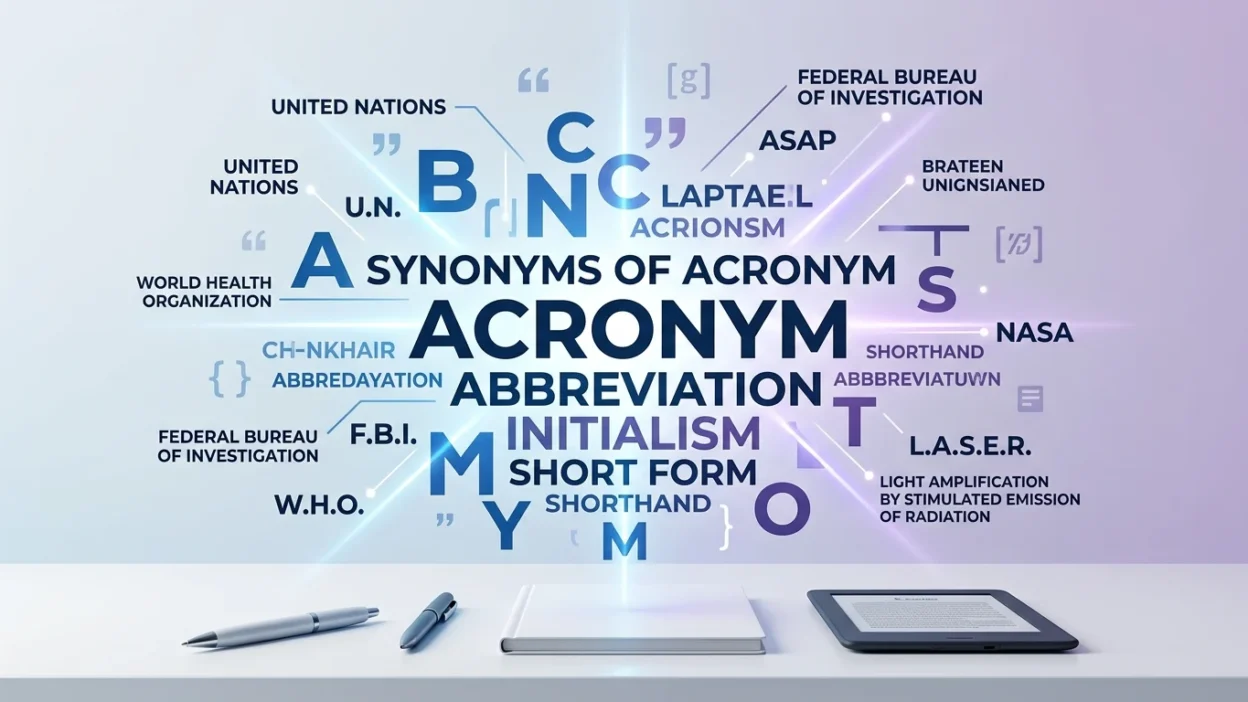
The word acronym is common in writing, school, business, and online content. It refers to a short form made from the first letters of a phrase, like NASA or FBI. People often search for synonyms of acronym because they want different ways to say the same idea in simple English.
This topic is useful for students, ESL learners, writers, and content creators. Knowing the right word helps you write clearly, avoid repetition, and choose the best term for each situation. In this guide, you will learn the meaning of acronym, see 30 useful related words and alternatives, and understand when to use each one.
What Does “Acronym” Mean?
An acronym is a word formed from the first letters of a phrase. Sometimes it is spoken as one word, like NATO. In simple English, it means a short name made from a longer name.
In daily use, people often mix up acronym, abbreviation, initialism, and short form. These words are related, but they do not always mean exactly the same thing. That is why it is helpful to learn the difference.
30 Synonyms and Related Words for Acronym
Note: Some words below are true synonyms, while others are related terms used in similar contexts. This is important because English does not have 30 exact replacements for acronym.
1. Abbreviation
Meaning: A shorter form of a word or phrase.
Example sentence: “NASA is an abbreviation used around the world.”
Best usage context: General writing, school, and everyday English.
2. Initialism
Meaning: A short form made from the first letters of words, spoken letter by letter.
Example sentence: “FBI is an initialism, not a spoken acronym.”
Best usage context: Grammar, language study, and formal explanation.
3. Short form
Meaning: A shorter version of a longer word or phrase.
Example sentence: “Email is a short form of electronic mail.”
Best usage context: Simple English and beginner friendly writing.
4. Condensed form
Meaning: A reduced or shortened version.
Example sentence: “The company name was used in condensed form on the logo.”
Best usage context: Business writing and general explanation.
5. Shortened form
Meaning: A word or phrase made shorter.
Example sentence: “UN is a shortened form of United Nations.”
Best usage context: Easy explanations and teaching materials.
6. Contracted form
Meaning: A form made smaller by removing parts.
Example sentence: “In some notes, the name appears in contracted form.”
Best usage context: Language study and grammar discussion.
7. Short name
Meaning: A brief name used instead of the full one.
Example sentence: “People often use a short name for long organisations.”
Best usage context: Informal writing and spoken English.
8. Code
Meaning: A special set of letters used to represent something.
Example sentence: “The product code is easier to remember than the full title.”
Best usage context: Technical writing, systems, and business records.
9. Symbol
Meaning: A sign or mark that stands for an idea or name.
Example sentence: “The symbol stands for the company’s mission.”
Best usage context: Academic and visual communication.
10. Sign
Meaning: Something that represents or points to something else.
Example sentence: “The letters act as a sign for the full phrase.”
Best usage context: Simple explanation and beginner learning.
11. Label
Meaning: A word or name used to identify something.
Example sentence: “The label on the file uses a short code.”
Best usage context: Organisation, packaging, and file names.
12. Tag
Meaning: A short word or marker used to identify something.
Example sentence: “The tag helps users understand the category quickly.”
Best usage context: Digital content, websites, and online systems.
13. Marker
Meaning: A sign that shows or identifies something.
Example sentence: “The letters work as a marker for the full phrase.”
Best usage context: Teaching, classification, and note taking.
14. Shorthand
Meaning: A shorter way of writing or saying something.
Example sentence: “Writers often use shorthand for common terms.”
Best usage context: Writing, note taking, and fast communication.
15. Shorthand term
Meaning: A short term used instead of the full expression.
Example sentence: “SEO is a shorthand term in digital marketing.”
Best usage context: Online writing and professional communication.
16. Contracted term
Meaning: A term made shorter for ease of use.
Example sentence: “The contracted term saves time in documents.”
Best usage context: Formal writing and language analysis.
17. Initial based word
Meaning: A word built from first letters.
Example sentence: “NATO is an initial based word used in global news.”
Best usage context: Educational explanations for students.
18. Letter code
Meaning: A code made with letters instead of numbers or symbols.
Example sentence: “The file uses a letter code to keep it simple.”
Best usage context: Systems, records, and technical notes.
19. Letter group
Meaning: A group of letters used together as one unit.
Example sentence: “This letter group stands for a longer phrase.”
Best usage context: Basic language teaching and simple descriptions.
20. Initial word
Meaning: A word formed from the first letters of other words.
Example sentence: “Some people use the term initial word loosely.”
Best usage context: Casual teaching and beginner explanations.
21. Alphabetic code
Meaning: A code made from letters of the alphabet.
Example sentence: “The company uses an alphabetic code in documents.”
Best usage context: Office work and technical systems.
22. Letter shorthand
Meaning: A short form created from letters.
Example sentence: “The report includes letter shorthand for departments.”
Best usage context: Notes, charts, and internal communication.
23. Compact name
Meaning: A name made shorter and tighter.
Example sentence: “The brand uses a compact name on packaging.”
Best usage context: Marketing, branding, and design.
24. Brief form
Meaning: A short and simple form.
Example sentence: “The brief form is easier for readers to remember.”
Best usage context: ESL writing and user friendly content.
25. Reduced form
Meaning: A form with less length or fewer parts.
Example sentence: “The reduced form appears in the glossary.”
Best usage context: Academic explanation and editing.
26. Compact version
Meaning: A shorter version of something long.
Example sentence: “This is the compact version of the company title.”
Best usage context: Product names, labels, and summaries.
27. Short version
Meaning: The shorter version of a longer phrase.
Example sentence: “Use the short version when space is limited.”
Best usage context: Social media, design, and captions.
28. Express form
Meaning: A quick form that expresses the full idea.
Example sentence: “The express form is used in fast communication.”
Best usage context: Informal writing and simple explanations.
29. Concise form
Meaning: A form that gives the idea in fewer words.
Example sentence: “The concise form is better for headings.”
Best usage context: Professional writing and editing.
30. Inscribed short form
Meaning: A shortened form written down for clarity.
Example sentence: “The document uses an inscribed short form for the department name.”
Best usage context: Rare use, language study, and detailed explanation.
Comparison Table: Which Word Should You Use?
| Word | Best for | Simple note |
| Acronym | General use | Short form made from first letters |
| Abbreviation | Everyday writing | Broad and common term |
| Initialism | Grammar and language study | Said letter by letter |
| Short form | Beginner friendly English | Very clear and simple |
| Shorthand | Fast writing | Common in notes and casual use |
How to Choose the Right Synonym
Choose the word based on your purpose and tone.
Use “abbreviation” when you want the safest general term. It works in most situations and is easy for readers to understand.
Use “initialism” when you want to be precise. This is the best choice in grammar lessons or language explanations.
Use “short form” or “shortened form” when you want simple English. These are good for students and ESL readers.
Use “shorthand” when you are talking about fast, informal writing or quick naming.
Use “concise form” or “compact version” when your content sounds more polished, professional, or editorial.
Final Thoughts
The keyword synonyms of acronym is popular because many people want a clear, simple way to describe short forms in English. The most common and useful related words are abbreviation, initialism, short form, and shorthand. These words are not always perfect replacements, but they help you write with more accuracy.

Logan Hayes is a professional editor and language researcher passionate about improving English skills. He creates informative articles that encourage confident writing, stronger vocabulary, and effective everyday communication.