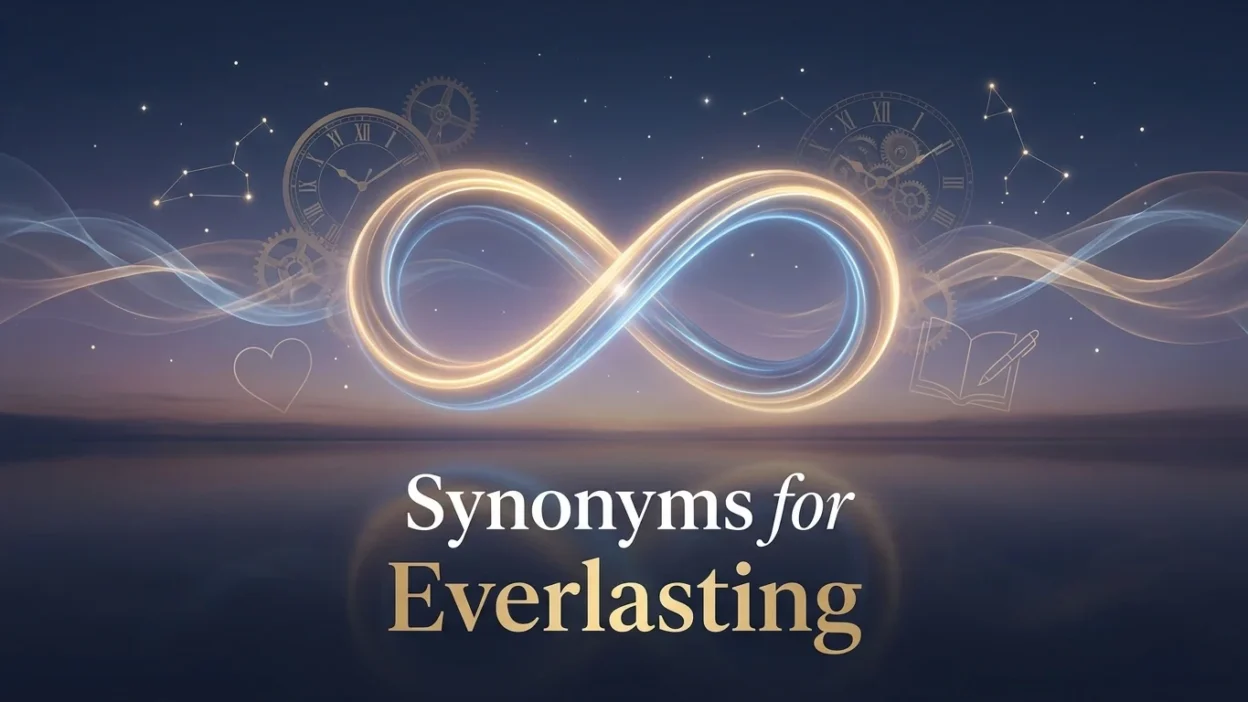
When you want to describe something that lasts forever or seems to continue without an end, “everlasting” is a strong and expressive word. It can describe love, memories, beauty, friendship, peace, life, or even something that seems to continue for a very long time.
Understanding synonyms for everlasting can help students, ESL learners, writers, and content creators make their English more varied and precise. Although many words have a similar meaning, each one can carry a slightly different tone or fit a different situation.
What Does “Everlasting” Mean?
Everlasting means lasting forever or continuing for an extremely long time without ending.
It is commonly used for things that are expected to remain for a very long time, especially abstract ideas such as love, hope, friendship, peace, or memories.
Example:
Their friendship created an everlasting bond.
Tone: Positive, emotional, formal, or poetic depending on the context.
Common uses:
- Everlasting love
- Everlasting friendship
- Everlasting peace
- Everlasting memory
- Everlasting beauty
- Everlasting hope
Below are 30 useful alternatives to help you choose the right word for your sentence.
30 Synonyms for Everlasting
1. Eternal
Meaning: Lasting forever and having no end.
Example sentence: Their love seemed eternal.
Best usage context: Use it for love, life, spiritual ideas, or things believed to exist forever.
2. Permanent
Meaning: Intended to stay the same or continue without being changed or removed.
Example sentence: The artist wanted to make a permanent mark on history.
Best usage context: Best for situations, conditions, arrangements, or physical changes.
3. Endless
Meaning: Having no apparent end.
Example sentence: The children enjoyed endless summer days.
Best usage context: Useful for time, activities, possibilities, conversations, and experiences.
4. Perpetual
Meaning: Continuing for a very long time or seemingly without stopping.
Example sentence: The machine operates in perpetual motion.
Best usage context: Common in formal, academic, and technical writing.
5. Immortal
Meaning: Unable to die or remembered forever.
Example sentence: The writer created an immortal character.
Best usage context: Use for people, characters, fame, art, or achievements that live on through memory.
6. Timeless
Meaning: Not affected by the passage of time and remaining valuable or attractive.
Example sentence: Her advice contains timeless wisdom.
Best usage context: Excellent for art, fashion, ideas, wisdom, stories, and beauty.
7. Unending
Meaning: Continuing without stopping or reaching an end.
Example sentence: They showed unending support for their team.
Best usage context: Suitable for support, problems, journeys, emotions, and ongoing situations.
8. Never ending
Meaning: Seeming to continue forever.
Example sentence: The project felt like a never ending task.
Best usage context: Good for everyday English and situations that seem to have no conclusion.
9. Infinite
Meaning: Without any limit or end.
Example sentence: The universe appears to contain infinite possibilities.
Best usage context: Common in mathematics, science, philosophy, and abstract discussions.
10. Perennial
Meaning: Continuing for a long time or returning repeatedly.
Example sentence: Trust remains a perennial concern in business.
Best usage context: Best for recurring issues, traditions, plants, or ideas that remain relevant.
11. Abiding
Meaning: Continuing for a long time and remaining strong.
Example sentence: She had an abiding respect for her teacher.
Best usage context: Often used with feelings such as respect, love, faith, and affection.
12. Durable
Meaning: Able to last for a long time without being damaged or becoming ineffective.
Example sentence: The company produces durable furniture.
Best usage context: Best for products, materials, objects, and practical things.
13. Lasting
Meaning: Continuing for a long time.
Example sentence: The experience had a lasting effect on him.
Best usage context: A natural and versatile choice for effects, relationships, memories, and impressions.
14. Long lasting
Meaning: Continuing for a particularly long period.
Example sentence: This battery provides long lasting power.
Best usage context: Very useful in everyday English, especially for products, effects, and experiences.
15. Constant
Meaning: Continuing without significant change or interruption.
Example sentence: Her constant encouragement helped me succeed.
Best usage context: Use for support, change, pressure, attention, or repeated conditions.
16. Continual
Meaning: Happening repeatedly or continuing over a period of time.
Example sentence: The team faced continual challenges.
Best usage context: Good for repeated events, difficulties, changes, or actions.
17. Continuous
Meaning: Continuing without interruption.
Example sentence: The system requires continuous monitoring.
Best usage context: Common in technical, scientific, professional, and formal writing.
18. Uninterrupted
Meaning: Continuing without being stopped or broken.
Example sentence: We enjoyed six hours of uninterrupted sleep.
Best usage context: Best when emphasizing that something continues without pauses or interruptions.
19. Perdurable
Meaning: Able to continue or survive for a very long time.
Example sentence: The poet hoped to create a perdurable legacy.
Best usage context: A formal and uncommon word suited to literary or academic writing.
20. Ageless
Meaning: Not appearing to grow old or lose its appeal over time.
Example sentence: Her simple style has an ageless quality.
Best usage context: Excellent for people, beauty, fashion, designs, and ideas.
21. Deathless
Meaning: Never dying or never being forgotten.
Example sentence: The author achieved deathless fame through her novels.
Best usage context: Mostly literary or poetic; useful for fame, love, art, and stories.
22. Evermore
Meaning: Forever or for all future time.
Example sentence: They promised to remain friends evermore.
Best usage context: Mainly poetic, literary, or emotional writing.
23. Forever
Meaning: For all time; without an end.
Example sentence: This memory will stay with me forever.
Best usage context: The most common and natural choice in everyday English.
24. Unchangeable
Meaning: Unable to be changed.
Example sentence: Their commitment remained unchangeable.
Best usage context: Use when the focus is on permanence rather than simply duration.
25. Irreversible
Meaning: Impossible to change back to an earlier condition.
Example sentence: The decision had irreversible consequences.
Best usage context: Best for decisions, changes, damage, effects, and processes that cannot be undone.
26. Enduring
Meaning: Continuing for a long time despite difficulties or changes.
Example sentence: Their enduring friendship survived many challenges.
Best usage context: Excellent for relationships, values, traditions, influence, and achievements.
27. Persistent
Meaning: Continuing firmly despite attempts to stop it.
Example sentence: Her persistent efforts eventually produced results.
Best usage context: Best for efforts, problems, behaviors, symptoms, or situations that continue.
28. Stable
Meaning: Remaining steady and unlikely to change suddenly.
Example sentence: The organization has maintained a stable presence for decades.
Best usage context: Useful for systems, conditions, relationships, situations, and organizations.
29. Everlasting
Meaning: Continuing forever or appearing to have no end.
Example sentence: They believed their friendship would be everlasting.
Best usage context: Use when you want a warm, emotional, poetic, or powerful sense of permanence.
30. Eternalized
Meaning: Made to be remembered or preserved forever.
Example sentence: The monument eternalized the hero’s contribution.
Best usage context: Useful in literary, artistic, and historical contexts.
Quick Comparison of Synonyms for Everlasting
| Synonym | Main Idea | Tone | Common Usage |
| Eternal | Forever | Formal/poetic | Love, spiritual ideas |
| Permanent | Not temporary | Neutral/formal | Changes, arrangements |
| Endless | No end | Neutral | Time, possibilities |
| Perpetual | Continues repeatedly | Formal | Processes, conditions |
| Immortal | Never forgotten/dies | Literary | People, fame, art |
| Timeless | Always valuable | Positive | Art, ideas, beauty |
| Lasting | Continues long | Neutral | Effects, relationships |
| Enduring | Survives over time | Positive/formal | Values, friendship |
| Forever | For all time | Everyday | Love, memories |
| Uninterrupted | No breaks | Formal/neutral | Sleep, service, activity |
| Ageless | Not affected by age | Positive | Beauty, style |
| Infinite | Without limits | Academic | Numbers, possibilities |
Everlasting vs. Eternal
Everlasting and eternal are very close in meaning, but their use can differ.
Everlasting often describes something that continues forever or seems to last forever.
Their friendship created an everlasting bond.
Eternal often has a stronger philosophical, spiritual, or poetic feeling.
Many religions discuss eternal life.
For everyday emotional writing, everlasting can sound warm and expressive. For philosophical or spiritual contexts, eternal is often more natural.
Everlasting vs. Endless
These words are also closely related.
Endless focuses on something having no end:
The road seemed endless.
Everlasting often suggests something that continues forever, especially something positive or meaningful:
They shared an everlasting love.
So, “endless” works well for journeys, tasks, time, or possibilities, while “everlasting” is especially effective for emotional and abstract ideas.
Everlasting vs. Permanent
Permanent means something is not temporary and is expected to remain.
She found a permanent solution to the problem.
Everlasting has a much stronger sense of forever.
Their love was everlasting.
Use permanent for practical situations and everlasting when you want emotional, poetic, or powerful language.
Everlasting vs. Timeless
Timeless does not necessarily mean something literally lasts forever. Instead, it means something remains relevant, beautiful, or valuable despite the passage of time.
The novel is a timeless classic.
You would not normally replace “timeless” with “everlasting” in this sentence because the focus is on lasting appeal, not physical duration.
How to Choose the Right Synonym
The best synonym depends on what you are describing and the tone you want.
For Love and Relationships
Choose:
- Eternal
- Everlasting
- Enduring
- Abiding
- Forever
Example:
Their enduring friendship became stronger with age.
For Formal or Academic Writing
Choose:
- Perpetual
- Continuous
- Perennial
- Permanent
- Infinite
Example:
The study examines the continuous development of language.
For Poetry and Creative Writing
Choose:
- Eternal
- Evermore
- Deathless
- Immortal
- Timeless
- Everlasting
Example:
Her memory would live evermore in his heart.
For Everyday English
Choose:
- Forever
- Lasting
- Long lasting
- Endless
- Permanent
Example:
I hope we remain friends forever.
For Art, Fashion, and Beauty
Choose:
- Timeless
- Ageless
- Immortal
- Enduring
Example:
The designer created a timeless collection.
For Things That Cannot Be Changed
Choose:
- Permanent
- Irreversible
- Unchangeable
Example:
The treatment caused an irreversible change.
Common Phrases with Everlasting Synonyms
Learning synonyms is easier when you see them in natural word combinations.
- Eternal love
- Permanent solution
- Endless possibilities
- Perpetual motion
- Immortal fame
- Timeless beauty
- Unending support
- Long lasting effect
- Enduring friendship
- Abiding respect
- Infinite possibilities
- Everlasting peace
- Ageless style
- Deathless art
- Continuous improvement
Notice that you cannot always replace one synonym with another. The surrounding words and intended meaning determine which choice sounds natural.
Why Learning Synonyms for Everlasting Matters
Knowing several alternatives helps you avoid repetition.
For example, instead of writing:
Their everlasting friendship created an everlasting memory and an everlasting connection.
You can write:
Their enduring friendship created a lasting memory and a timeless connection.
The second version sounds more natural and gives the writing greater variety.
Synonyms also help you communicate tone. “Forever” sounds simple and conversational, while “eternal” can sound philosophical or poetic. “Permanent” is practical, while “evermore” has a literary feeling.
Final Thoughts
The word everlasting describes something that lasts forever or seems to continue without an end. However, the best alternative depends on the exact meaning, context, and tone of your sentence.
For everyday English, forever, lasting, long lasting, and endless are useful choices. For formal writing, consider perpetual, continuous, permanent, or perennial. For emotional and creative writing, eternal, enduring, timeless, immortal, and evermore can add greater depth.
Learning these synonyms for everlasting will help you write with more variety, accuracy, and confidence. Instead of simply searching for a replacement word, think about what you want to express: duration, permanence, emotional depth, repetition, or timeless value. That small distinction can make your writing much stronger.
Charles Cody is a talented author recognized for engaging storytelling, memorable characters, and imaginative plots. His books inspire readers through creativity, emotional depth, and meaningful literary experiences worldwide.