
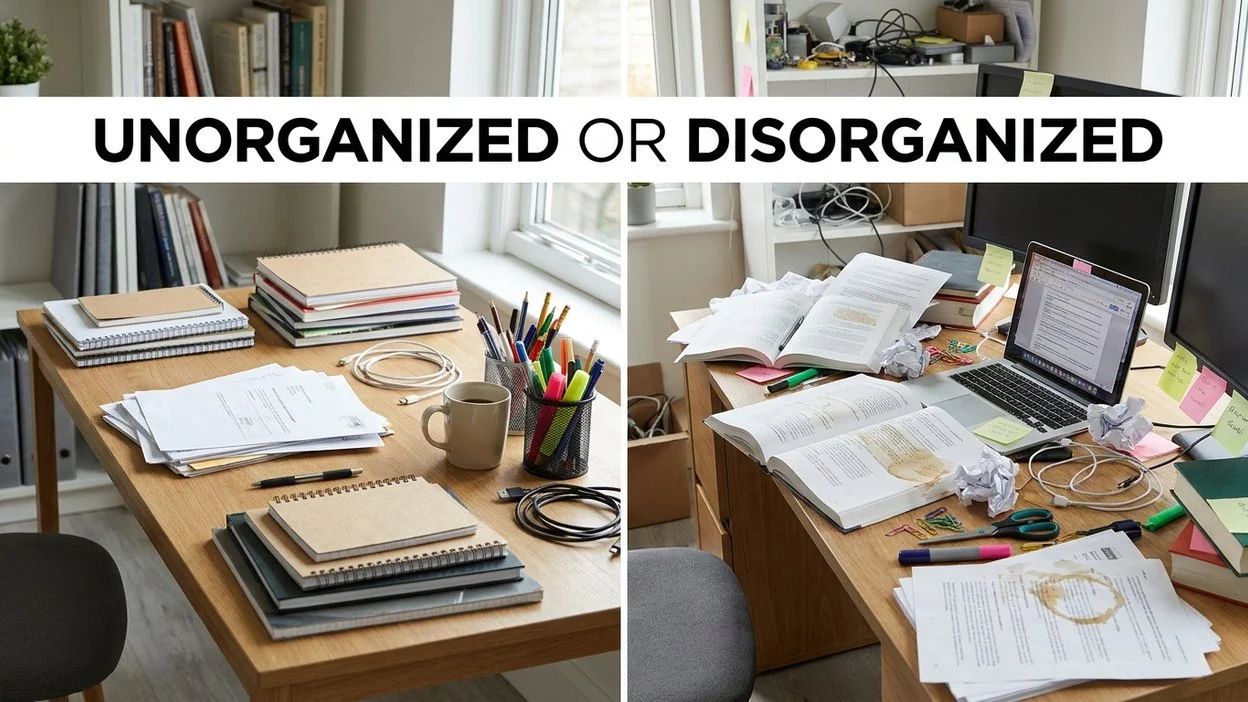
The words unorganized and disorganized are often used interchangeably because both describe a lack of organization, order, or structure. However, they have slightly different meanings. Understanding the difference can help you choose the right word when writing essays, emails, reports, or everyday conversations.
Unorganized generally describes something that has not been arranged, planned, or structured properly. Disorganized, on the other hand, often describes something messy, chaotic, confused, or poorly managed. For example, an unorganized desk may have no clear arrangement, while a disorganized desk may have papers, books, and supplies scattered everywhere. Although both words are grammatically correct, the best choice depends on what you want to communicate. Let’s explore their definitions, differences, examples, and usage so you can use each word confidently.
Quick Answer: Unorganized or Disorganized?
Both unorganized and disorganized are correct English words. Unorganized means something lacks a proper arrangement, structure, or plan. Disorganized means something is messy, chaotic, or poorly arranged. Use unorganized when something has not been organized, and use disorganized when describing disorder or confusion.
Why Do People Confuse Unorganized and Disorganized?
People confuse these words because they share the same root word: organized. Both also use negative prefixes that change the meaning of the original word.
- Un- generally means not or the opposite of something.
- Dis- can mean the opposite of something, a reversal, or a lack of something.
Since both prefixes create negative meanings, unorganized and disorganized can describe similar situations.
For example:
- An unorganized office may lack a proper filing system.
- A disorganized office may have documents scattered across desks, misplaced folders, and no clear working system.
The meanings overlap, but disorganized often suggests a stronger sense of disorder or confusion.
What Does Unorganized Mean?
Unorganized is an adjective that describes something that has not been arranged, planned, structured, or coordinated properly.
It can refer to physical objects, activities, information, people, or groups that lack an organized system.
In simple words, something unorganized does not have a proper arrangement or structure.
Examples of Unorganized in Sentences
- My notes are unorganized, so I cannot find the information I need.
- The students created an unorganized study schedule.
- We attended an unorganized event without a clear timetable.
- Her files are unorganized and need proper labeling.
- The team started an unorganized project without a detailed plan.
When Is Unorganized Appropriate?
Use unorganized when you want to emphasize the absence of a proper arrangement, system, or plan.
Common situations include:
- Documents: Unorganized files without a clear folder structure.
- Planning: An unorganized schedule without specific tasks or deadlines.
- Information: Unorganized notes that need sorting.
- Activities: An unorganized event without a clear sequence.
- Groups: An unorganized group without formal coordination.
Unorganized does not always mean extremely messy. Sometimes it simply means that something has not yet been arranged properly.
What Does Disorganized Mean?
Disorganized is an adjective that describes something lacking order, structure, or effective coordination. It often suggests confusion, messiness, or difficulty managing things properly.
In simple English, disorganized means messy, chaotic, or poorly arranged.
It can describe physical spaces, personal habits, workplaces, schedules, and even people’s behavior.
Examples of Disorganized in Sentences
- My bedroom is disorganized because clothes are scattered everywhere.
- He is disorganized and frequently forgets important appointments.
- The company has a disorganized management system.
- Her presentation was disorganized and difficult to follow.
- The classroom became disorganized after the activity.
When Is Disorganized Appropriate?
Use disorganized when you want to describe disorder, confusion, or a lack of effective management.
Common situations include:
- Rooms: A disorganized bedroom with scattered belongings.
- People: Someone who regularly forgets tasks or loses important items.
- Workplaces: A disorganized office with poor communication.
- Schedules: A disorganized timetable with conflicting activities.
- Writing: A disorganized essay with ideas presented in a confusing order.
Disorganized often communicates more than simply lacking a plan. It can suggest that things are not working together in an orderly way.
Unorganized vs Disorganized: What’s the Difference?
The main difference is the emphasis each word creates.
Unorganized focuses on the absence of proper organization, while disorganized often emphasizes disorder, confusion, or poor management.
| Feature | Unorganized | Disorganized |
|---|---|---|
| Meaning | Not properly arranged or structured | Lacking order or badly arranged |
| Main emphasis | Lack of organization | Disorder or confusion |
| Tone | Often neutral | Often more negative |
| Physical objects | Objects without a proper arrangement | Objects scattered or messy |
| People | Someone without an organized system | Someone who struggles to manage tasks |
| Planning | No clear structure or plan | Poorly coordinated plans |
| Workplace | Lacks an established system | Has confusion or ineffective management |
| Example | Unorganized notes | Disorganized paperwork |
| Common use | Arrangements and structures | Mess, confusion, and behavior |
Important: These meanings are not strict rules. Both words can describe similar situations, and the surrounding sentence determines which one sounds more natural.
When Should You Use Unorganized or Disorganized?
Choosing between these words becomes easier when you focus on what you are describing.
Use Unorganized When Something Lacks Structure
Choose unorganized when something has not been arranged or given a proper system.
Examples:
- The information is unorganized.
- We have an unorganized collection of photographs.
- The meeting was unorganized because nobody prepared an agenda.
- My research notes are unorganized.
In these examples, the main issue is the absence of a proper arrangement or structure.
Use Disorganized When Something Is Messy or Confusing
Choose disorganized when something is poorly arranged, chaotic, or difficult to manage.
Examples:
- His workspace is disorganized.
- The manager runs a disorganized department.
- My daily routine has become disorganized.
- The instructions were disorganized and confusing.
Here, the emphasis is on disorder and ineffective organization.
Can You Use Both Words in the Same Situation?
Yes. Sometimes both words are grammatically correct, but they communicate slightly different ideas.
Consider this example:
- The documents are unorganized because nobody has sorted them.
- The documents are disorganized because they are scattered across several desks.
Both sentences describe documents without proper organization. However, the first emphasizes the missing sorting process, while the second highlights the messy condition.
10+ Examples of Unorganized vs Disorganized in Sentences
Here are practical examples to help you understand how these words work in everyday English.
| Unorganized | Disorganized |
|---|---|
| My study notes are unorganized. | My study desk is disorganized. |
| The files are unorganized. | The papers are disorganized. |
| We have an unorganized schedule. | Our daily routine is disorganized. |
| The information is unorganized. | The presentation is disorganized. |
| Their project is unorganized. | Their project management is disorganized. |
| The books are unorganized. | The bookshelf is disorganized. |
| The event was unorganized. | The event became disorganized. |
| Her research material is unorganized. | Her research process is disorganized. |
| The collection is unorganized. | The storage room is disorganized. |
| The group is unorganized. | The group became disorganized during the activity. |
More Examples in Everyday Conversations
Example 1: At School
- Unorganized: My class notes are unorganized because I haven’t arranged them by subject.
- Disorganized: My study routine is disorganized because I keep missing study sessions.
Example 2: At Work
- Unorganized: The company has an unorganized filing system.
- Disorganized: The office became disorganized after several employees left.
Example 3: At Home
- Unorganized: Our family photos are unorganized.
- Disorganized: The kitchen looks disorganized after cooking.
Example 4: Personal Habits
- Unorganized: I am unorganized when it comes to planning my weekly tasks.
- Disorganized: I feel disorganized when I have too many responsibilities.
Example 5: Writing
- Unorganized: My research material is unorganized.
- Disorganized: My essay is disorganized because the ideas do not follow a logical order.
Common Mistakes When Using Unorganized and Disorganized
Although both words are correct, learners sometimes use them in ways that make sentences unclear or unnatural.
1. Thinking That Unorganized Is Incorrect
Incorrect assumption: Unorganized is not a real English word.
Correct understanding: Unorganized is a valid adjective and is widely used in English.
Example: My files are unorganized.
2. Using Disorganized Only for Physical Messes
Disorganized does not describe only messy rooms or scattered objects.
It can also describe people, plans, communication, writing, and management.
Example: The company’s communication system is disorganized.
3. Assuming Both Words Always Mean Exactly the Same Thing
The words overlap, but their emphasis can differ.
Example:
- Unorganized notes: Notes without a proper structure.
- Disorganized notes: Notes arranged in a confusing or messy way.
4. Confusing Unorganized With Unorganised
These are spelling variations of the same word.
- Unorganized: American English spelling.
- Unorganised: Common British English spelling.
The difference is spelling, not meaning.
5. Using Disorganized as a Noun
Disorganized is an adjective, not a noun.
Incorrect: His disorganized caused problems.
Correct: His disorganization caused problems.
Memory Trick: How to Remember the Difference
A simple memory trick can help you remember these words without memorizing complicated grammar rules.
Think of UN as Unarranged and DIS as Disorder.
- Unorganized = Unarranged: Something does not have a proper structure or arrangement.
- Disorganized = Disorder: Something is messy, confusing, or poorly managed.
Remember these two examples:
- Unorganized desk: The desk has not been arranged properly.
- Disorganized desk: The desk is messy, with things scattered around.
This trick is not a strict grammatical rule, but it makes the difference easier to remember.
American vs British English: Unorganized or Disorganized
Both unorganized and disorganized are accepted in American and British English. However, spelling preferences differ between the two varieties.
| American English | British English |
|---|---|
| Unorganized | Unorganised |
| Disorganized | Disorganised |
| Organized | Organised |
| Organization | Organisation |
American English generally uses -ize, while British English commonly uses -ise.
However, British English also accepts some -ize spellings, depending on the dictionary and style guide being followed.
The important thing is to remain consistent throughout your writing.
For example:
- American English: My office is disorganized.
- British English: My office is disorganised.
Both sentences are correct and communicate the same meaning.
Similar Words to Unorganized and Disorganized
Several other English words describe a lack of order, structure, or planning. Understanding their meanings can help you improve your vocabulary.
| Word | Simple Meaning | Example |
|---|---|---|
| Messy | Dirty or untidy | My room is messy. |
| Chaotic | Completely lacking order | The situation became chaotic. |
| Untidy | Not neat or properly arranged | His desk looks untidy. |
| Disorderly | Not following an organized arrangement | The crowd became disorderly. |
| Unstructured | Without a clear structure | We followed an unstructured plan. |
| Haphazard | Done without planning or order | They made a haphazard decision. |
| Confused | Difficult to understand or manage | The instructions were confused. |
| Scattered | Spread across different places | Her papers were scattered. |
These words are related, but they are not always interchangeable.
For example, messy usually describes something untidy, while chaotic suggests a greater level of disorder. Unstructured focuses more specifically on the absence of an established structure.
Final Verdict: Which Word Should You Choose?
Both unorganized and disorganized are correct English words, but they have slightly different shades of meaning.
Choose unorganized when describing something that lacks a proper arrangement, structure, or plan. Choose disorganized when describing something messy, chaotic, confusing, or poorly managed.
For example, you can describe notes as unorganized when they have not been sorted into categories. You can describe a workspace as disorganized when everything is scattered and difficult to find.
If you are unsure which word to use, consider whether you want to emphasize the absence of organization or the presence of disorder. That simple distinction will help you make the right choice.
Frequently Asked Questions
1. Is Unorganized or Disorganized Grammatically Correct?
Both words are grammatically correct. Unorganized means lacking a proper arrangement or structure, while disorganized generally describes something messy, chaotic, or poorly managed. The correct choice depends on the context.
2. Is Unorganized a Real Word?
Yes, unorganized is a standard English adjective. It describes something that has not been arranged, structured, or planned properly. It is commonly used when discussing schedules, documents, information, and personal organization.
3. Does Disorganized Mean Messy?
Yes, disorganized can mean messy, but its meaning is broader. It can describe physical spaces, confusing plans, poorly managed workplaces, and people who struggle to keep their responsibilities organized.
4. Is It Better to Say Unorganized or Disorganized Person?
Both expressions are correct. An unorganized person may lack a reliable system for planning tasks, while a disorganized person may frequently struggle with disorder, misplaced belongings, or managing responsibilities. Disorganized often sounds more natural when describing someone whose daily habits are chaotic.
5. What Is the Opposite of Unorganized and Disorganized?
The most common opposite is organized. Other alternatives include orderly, structured, systematic, neat, and well-arranged. The best opposite depends on the situation.
6. Is Unorganised British or American English?
Unorganised is a commonly used British English spelling. American English generally uses unorganized. Both forms have the same meaning, and the difference is simply spelling preference.
7. Can Unorganized and Disorganized Be Used Interchangeably?
Yes, in some situations. Both can describe things that lack proper organization. However, unorganized emphasizes the absence of a system, while disorganized often emphasizes confusion, messiness, or poor management.
Remember This
- Unorganized means lacking proper arrangement, planning, or structure.
- Disorganized means messy, chaotic, or poorly managed.
- Both words are grammatically correct.
- The two words can overlap, depending on context.
- American English generally uses -ize, while British English commonly uses -ise.
Conclusion
Understanding the difference between unorganized and disorganized is easier when you focus on their main meanings. Unorganized describes something that lacks a proper system or arrangement, while disorganized often describes something that is messy, confusing, or poorly managed. Both words are useful in everyday conversations and formal writing.
The next time you use these words, think about what you want to describe. If something simply lacks a clear structure, choose unorganized. If it is in a state of disorder or confusion, choose disorganized. With practice, you will be able to use both words naturally and confidently.

Carter Brooks writes educational content that helps readers understand word meanings, synonyms, and writing techniques. He believes simple explanations inspire lifelong learning and stronger communication skills for everyone.