
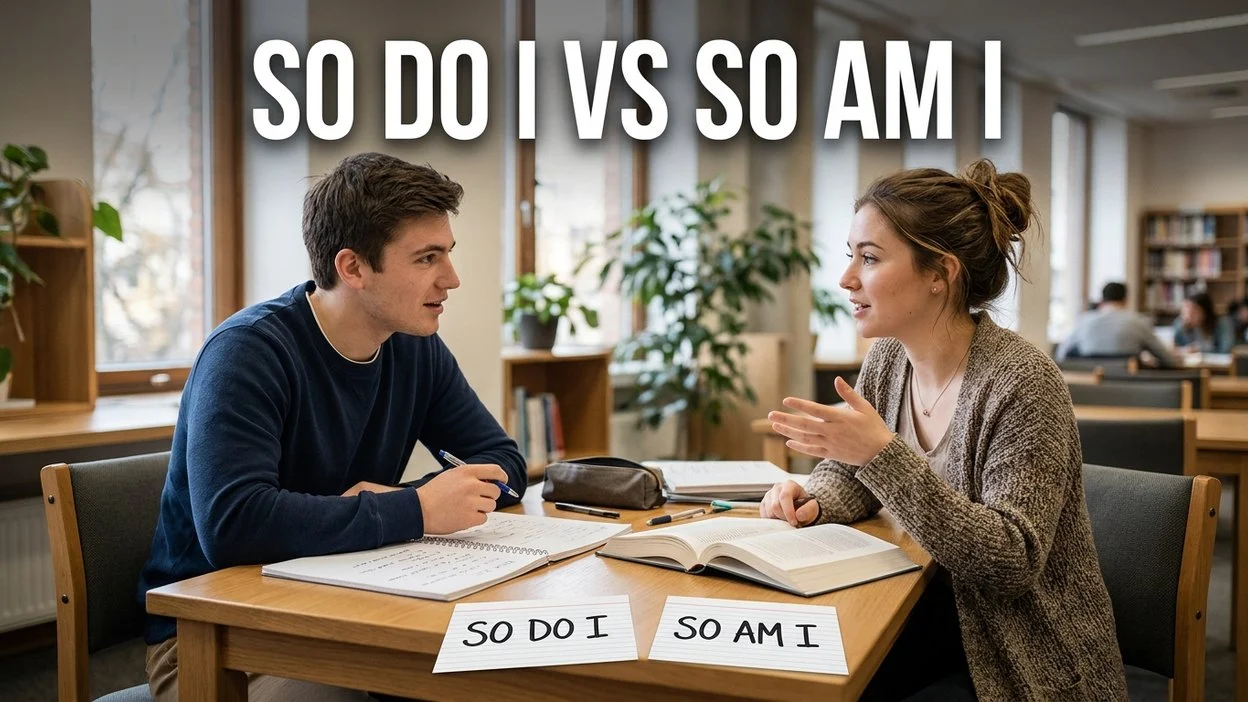
When agreeing with someone in English, you might hear both “So do I” and “So am I.” Although these expressions look similar, they are not interchangeable. Each one follows a different grammatical pattern and is used in a different situation. Understanding the difference helps you agree with people naturally and avoid common English grammar mistakes.
The main difference between “so do I” and “so am I” is the helping verb used in the original statement. Use “so do I” when agreeing with a positive sentence that uses the verb “do” or a simple present action verb. Use “so am I” when agreeing with a statement that uses the verb “am,” such as a description, identity, feeling, or present continuous action. Both expressions mean that you share the same situation or feeling as another person.
Quick Answer: So Do I vs. So Am I
“So do I” agrees with positive statements in the simple present that use “do” as the auxiliary verb, such as “I like coffee.” “So am I” agrees with statements using “am,” such as “I am tired” or “I am studying.” The correct choice depends on the verb structure of the original sentence.
Why Do People Confuse So Do I and So Am I?
People often confuse these expressions because they have the same purpose: showing agreement with another person.
For example:
- Person A: “I love music.”
- Person B: “So do I.”
But:
- Person A: “I am happy.”
- Person B: “So am I.”
Both responses communicate agreement, but their grammatical structures are different.
The confusion usually happens because English learners focus on the meaning instead of the helping verb in the original sentence.
Remember that English agreement expressions follow a specific grammatical pattern. You cannot randomly replace “do” with “am.”
First Phrase: What Does So Do I Mean?
“So do I” is an expression used to agree with a positive statement about an action, habit, preference, or general fact when the original statement uses the simple present tense with an ordinary verb.
It means “I do the same thing” or “I feel the same way.”
The grammatical structure is:
So + do + subject
Examples:
- Person A: “I like chocolate.”
- Person B: “So do I.”
- Person A: “I play football.”
- Person B: “So do I.”
- Person A: “I enjoy reading.”
- Person B: “So do I.”
In these examples, the first speaker uses an ordinary present-tense verb. The second speaker uses “do” to avoid repeating the entire sentence.
When Should You Use So Do I?
Use “so do I” when agreeing with a positive statement in the simple present that has an ordinary action or state verb.
Common situations include:
1. Talking about preferences
- “I love pizza.” — “So do I.”
- “I like traveling.” — “So do I.”
2. Talking about habits
- “I wake up early.” — “So do I.”
- “I exercise every morning.” — “So do I.”
3. Talking about everyday activities
- “I watch movies on weekends.” — “So do I.”
- “I study English every day.” — “So do I.”
4. Talking about general opinions
- “I believe education is important.” — “So do I.”
- “I think this book is interesting.” — “So do I.”
Second Phrase: What Does So Am I Mean?
“So am I” is an expression used to agree with a positive statement that uses the verb “am.”
It commonly appears when someone talks about their feelings, identity, condition, or an action happening right now.
The grammatical structure is:
So + am + subject
Examples:
- Person A: “I am tired.”
- Person B: “So am I.”
- Person A: “I am happy.”
- Person B: “So am I.”
- Person A: “I am learning English.”
- Person B: “So am I.”
In each example, the second speaker uses “am” because the first speaker uses the verb “am.”
When Should You Use So Am I?
Use “so am I” when agreeing with a positive statement that uses “I am.”
Common situations include:
1. Talking about feelings
- “I am excited.” — “So am I.”
- “I am nervous.” — “So am I.”
2. Describing your condition
- “I am hungry.” — “So am I.”
- “I am tired.” — “So am I.”
3. Describing your identity or role
- “I am a student.” — “So am I.”
- “I am a teacher.” — “So am I.”
4. Talking about ongoing activities
- “I am working right now.” — “So am I.”
- “I am watching television.” — “So am I.”
So Do I vs. So Am I: Comparison Table
| Feature | So Do I | So Am I |
|---|---|---|
| Main purpose | Showing agreement | Showing agreement |
| Helping verb | Do | Am |
| Common tense | Simple present | Present simple of “be” or present continuous |
| Used with | Ordinary present-tense verbs | The verb “am” |
| Grammar structure | So + do + subject | So + am + subject |
| Example | I like tea. So do I. | I am happy. So am I. |
| Meaning | I like it too. | I am too. |
The most important difference is the verb in the original statement. If the original speaker says “I like,” use “so do I.” If the speaker says “I am,” use “so am I.”
When Should You Use Each Expression?
Choosing between these expressions becomes easier when you identify the main verb in the original sentence.
Use So Do I for Ordinary Present-Tense Verbs
Examples:
- “I love animals.” → “So do I.”
- “I speak English.” → “So do I.”
- “I enjoy swimming.” → “So do I.”
The original statements use ordinary present-tense verbs, so “do” is the correct auxiliary for agreement.
Use So Am I With the Verb Am
Examples:
- “I am busy.” → “So am I.”
- “I am interested in science.” → “So am I.”
- “I am preparing for an exam.” → “So am I.”
The original statements use “am,” so the response must also use “am.”
What About He, She, and They?
The same agreement pattern works with other subjects, but the auxiliary verb must match the subject.
For example:
- “She likes coffee.” → “So does he.”
- “He is tired.” → “So am I.”
- “They are happy.” → “So are we.”
Notice that the subject and auxiliary can change, but the grammatical pattern remains the same.
12+ Examples of So Do I vs. So Am I
Here are practical examples to help you understand how these expressions work in everyday conversations.
| Original Statement | Correct Agreement |
|---|---|
| I like coffee. | So do I. |
| I love music. | So do I. |
| I play cricket. | So do I. |
| I enjoy reading. | So do I. |
| I speak English. | So do I. |
| I work from home. | So do I. |
| I am hungry. | So am I. |
| I am happy. | So am I. |
| I am a student. | So am I. |
| I am tired. | So am I. |
| I am learning English. | So am I. |
| I am waiting for my friend. | So am I. |
Examples in Everyday Conversations
Example 1: Talking About Food
Person A: “I love Italian food.”
Person B: “So do I.”
Example 2: Talking About Feelings
Person A: “I am really excited about the trip.”
Person B: “So am I.”
Example 3: Talking About Education
Person A: “I study English every evening.”
Person B: “So do I.”
Example 4: Talking About Work
Person A: “I am working on a new project.”
Person B: “So am I.”
Example 5: Talking About Hobbies
Person A: “I enjoy playing video games.”
Person B: “So do I.”
These examples show how the correct expression depends on the grammatical structure of the first speaker’s statement.
Common Mistakes When Using So Do I and So Am I
Even advanced English learners sometimes make mistakes with agreement expressions. Here are some common errors and their corrections.
Mistake 1: Using So Am I With an Ordinary Verb
Incorrect: “I like coffee.” — “So am I.”
Correct: “I like coffee.” — “So do I.”
Why? The original sentence uses the ordinary verb “like,” not the verb “am.”
Mistake 2: Using So Do I With the Verb Am
Incorrect: “I am tired.” — “So do I.”
Correct: “I am tired.” — “So am I.”
Why? The original statement uses “am,” so the response must use the same auxiliary verb.
Mistake 3: Forgetting the Subject
Incorrect: “So do.”
Correct: “So do I.”
Why? The complete agreement structure needs a subject after the auxiliary verb.
Mistake 4: Using These Expressions With Negative Statements
Incorrect: “I don’t like coffee.” — “So do I.”
Correct: “I don’t like coffee.” — “Neither do I.”
Why? “So do I” agrees with positive statements. “Neither do I” agrees with negative statements.
Mistake 5: Confusing the Verb With the Tense
Incorrect: “I am going to school.” — “So do I.”
Correct: “I am going to school.” — “So am I.”
Why? The original statement uses the present continuous structure with “am,” so the agreement response uses “am” too.
Memory Trick: How to Remember the Difference
You can remember the difference between “so do I” and “so am I” with one simple rule:
Follow the original helping verb.
- If the original sentence uses an ordinary simple present verb, use “so do I.”
- If the original sentence uses “am,” use “so am I.”
Think of these two examples:
- “I like tea.” → “So do I.”
- “I am thirsty.” → “So am I.”
Another easy trick is to ask yourself: Does the original sentence contain “am”?
If yes, “so am I” is usually correct when agreeing with an “I am” statement.
If not, check the actual verb and its tense before choosing “do.”
So Do I vs. So Am I in American and British English
There is no grammatical difference between American and British English when using “so do I” and “so am I.”
Both expressions are correct in both varieties of English.
| Situation | American English | British English |
|---|---|---|
| Agreeing with “I like tea.” | So do I. | So do I. |
| Agreeing with “I am tired.” | So am I. | So am I. |
| Agreeing with “I love football.” | So do I. | So do I. |
| Agreeing with “I am excited.” | So am I. | So am I. |
The grammar and meaning remain the same. You can confidently use both expressions when speaking with American or British English speakers.
Similar Expressions You Should Know
English has several other expressions for showing agreement. Learning them can make your conversations sound more natural.
1. So Have I
Use “so have I” when agreeing with a positive statement that uses “have” as an auxiliary verb, particularly in the present perfect tense.
Example:
- “I have visited London.”
- “So have I.”
2. So Can I
Use “so can I” when agreeing with a statement about ability or possibility.
Example:
- “I can swim.”
- “So can I.”
3. So Will I
Use “so will I” when agreeing with a statement about a future action.
Example:
- “I will attend the meeting.”
- “So will I.”
4. Neither Do I
Use “neither do I” to agree with a negative statement that uses “do” in the simple present.
Example:
- “I don’t like spicy food.”
- “Neither do I.”
5. Neither Am I
Use “neither am I” to agree with a negative statement that uses “am.”
Example:
- “I am not ready.”
- “Neither am I.”
These expressions follow the same general principle: choose the auxiliary verb that matches the original statement.
Final Verdict: So Do I or So Am I?
Both “so do I” and “so am I” are grammatically correct expressions used to show agreement, but they work in different situations.
Use “so do I” when agreeing with positive simple present statements that use ordinary verbs, such as “I like music” or “I enjoy reading.”
Use “so am I” when agreeing with positive statements using “am,” such as “I am tired,” “I am happy,” or “I am studying.”
The easiest way to choose correctly is to look at the verb in the original sentence. Match the auxiliary verb, and you will know which expression to use.
Frequently Asked Questions
1. Is it correct to say so do I or so am I?
Both expressions are correct, but their usage depends on the original sentence. Use “so do I” with ordinary simple present verbs, such as “I like coffee.” Use “so am I” with statements containing “am,” such as “I am happy.”
2. What is the difference between so do I and so am I?
“So do I” agrees with positive simple present statements that use ordinary verbs. “So am I” agrees with positive statements using the verb “am.” Both expressions mean that you share the same action, feeling, or situation.
3. Can I say so am I when someone says I like you?
No. The correct response is “So do I” if you mean that you like the person too. The original sentence uses the ordinary verb “like,” so “do” is the appropriate auxiliary.
4. Should I say so do I or so am I after I am tired?
You should say “So am I.” The original sentence uses “am,” so the agreement response must also use “am.” For example: “I am tired.” — “So am I.”
5. Can I use so do I in everyday conversation?
Yes. So do I” is a natural and common expression in everyday English. You can use it to agree with statements about habits, preferences, opinions, and everyday activities.
6. Is so am I used in American English?
Yes. “So am I” is grammatically correct and commonly understood in American English. It is also correct in British English. There is no difference in the basic grammatical usage.
7. What is the negative form of so do I and so am I?
The negative agreement forms are “Neither do I” and “Neither am I.” Use “neither do I” after statements such as “I don’t like coffee” and “neither am I” after statements such as “I am not ready.”
Remember This
- So do I: Use it with ordinary simple present verbs. Example: “I like tea.” — “So do I.”
- So am I: Use it with statements containing “am.” Example: “I am happy.” — “So am I.”
- Neither do I: Use it to agree with negative statements using “don’t.”
- Neither am I: Use it to agree with negative statements using “am not.”
- Always check the original sentence before choosing your agreement expression.
Conclusion
Understanding the difference between “so do I” and “so am I” is simple once you learn how auxiliary verbs work. Both expressions help you agree with another person, but you must choose the correct one according to the original sentence. Use “so do I” with ordinary simple present verbs and “so am I” with statements that use “am.”
With regular practice and attention to sentence structure, you can use these expressions confidently in conversations, classroom discussions, and everyday communication. Remember one simple rule: match the helping verb in the original statement.

Charles Cody is a talented author recognized for engaging storytelling, memorable characters, and imaginative plots. His books inspire readers through creativity, emotional depth, and meaningful literary experiences worldwide.