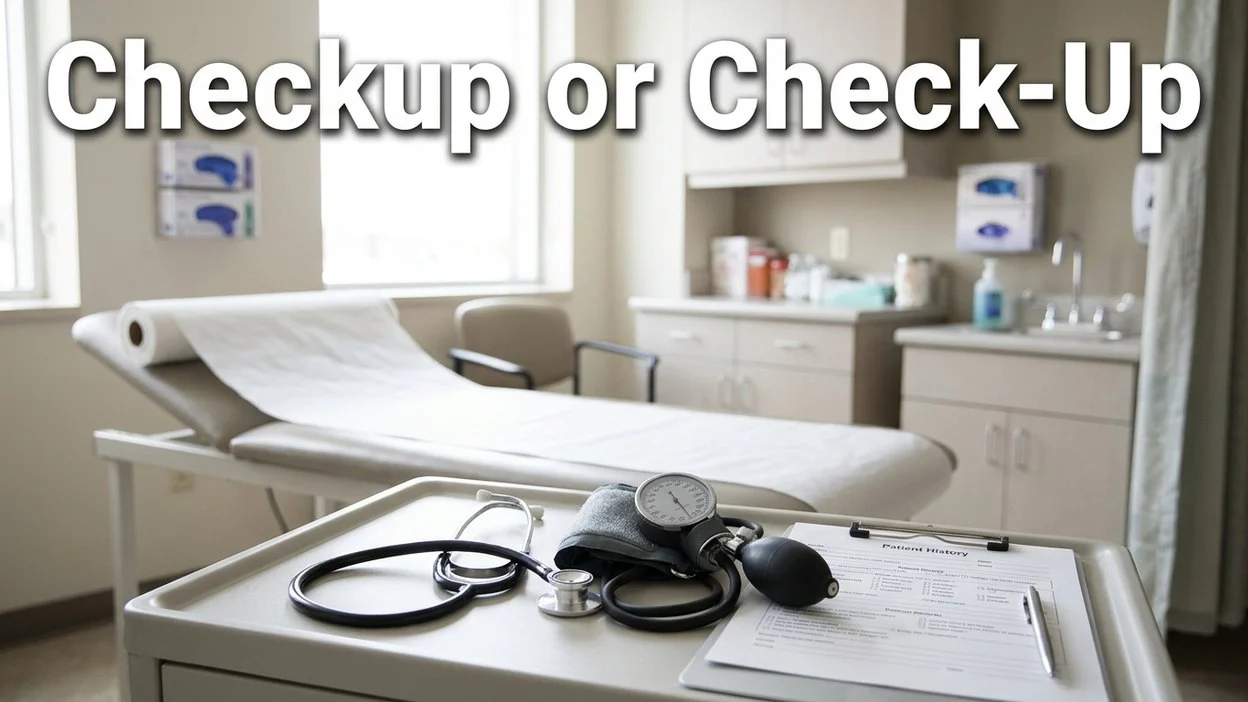
The words checkup and check-up are both used in English, but checkup is the standard American English spelling for a routine medical examination. The hyphenated form, check-up, is also accepted, especially in British English and some other varieties. Both forms can refer to a visit to a doctor to check your health.
Choosing the right spelling can be confusing because English sometimes uses hyphens to connect words that work together. In this case, the meaning usually stays the same whether you write checkup or check-up. The best choice depends on your preferred style and the audience you are writing for. If you are writing for an American audience, checkup is generally the simplest and most natural option. Learning how this word is used will help you write more confidently in emails, school assignments, medical documents, and everyday conversations.
Quick Answer
Checkup and check-up are both correct spellings of a noun meaning a routine examination, especially a medical examination. In American English, checkup is generally preferred. The hyphenated spelling, check-up, is also used, particularly in British English. Choose one spelling and use it consistently.
Why Do People Confuse Checkup and Check-Up?
People confuse checkup and check-up because they have the same basic meaning and pronunciation. The only visible difference is the hyphen.
A hyphen is a short punctuation mark used to connect words. English spelling conventions sometimes change over time, and expressions that once commonly appeared with hyphens may later become closed compounds written as a single word.
For example:
- Checkup: I have a checkup tomorrow.
- Check-up: I have a check-up tomorrow.
Both sentences communicate the same idea.
The confusion also comes from differences between dictionaries, writing styles, and regional English conventions. Some references recognize both forms, while others prefer one spelling.
The important point is that checkup and check-up are not two words with different meanings. They are spelling variants of the same noun.
First Word: Checkup
Checkup is a noun that means a routine examination to assess someone’s health, condition, or progress.
In American English, this closed spelling is the usual choice when referring to a medical appointment.
Meaning of Checkup
A checkup often involves visiting a doctor or another healthcare professional to make sure everything is going well.
Depending on the purpose, a checkup may include:
- Reviewing your medical history.
- Discussing symptoms or health concerns.
- Checking your blood pressure and other vital signs.
- Performing a physical examination.
- Recommending tests or preventive care when appropriate.
The exact procedures depend on the person’s age, health, and reason for the appointment.
Although the word is commonly associated with medicine, it can also refer to a general inspection or review.
For example, a mechanic might perform a vehicle checkup, or a business might conduct a routine checkup of its procedures.
Example Sentences With Checkup
- I have a doctor’s checkup on Friday.
- She schedules a yearly checkup to monitor her health.
- My son needs a checkup before starting school.
- The doctor recommended a routine checkup.
- He went to the clinic for a general checkup.
- I feel better after my annual checkup.
- Her checkup showed that everything was normal.
- The nurse helped me prepare for my checkup.
- Regular checkups can help identify certain health problems early.
- My car needs a checkup before our road trip.
These examples show that checkup works as a noun in both medical and general contexts.
Second Word: Check-Up
Check-up is a hyphenated noun with the same meaning as checkup. It refers to a routine examination, inspection, or assessment.
The spelling is recognizable and accepted in English, particularly in British usage and in publications that follow a style guide favoring hyphenated compounds.
Meaning of Check-Up
A check-up usually involves examining something to make sure it is working properly or that everything is satisfactory.
For example, a medical check-up helps a healthcare professional assess a person’s health. A routine equipment check-up may help identify maintenance needs.
The hyphen does not create a new meaning. It simply connects the parts of the compound noun.
Example Sentences With Check-Up
- I have a medical check-up next week.
- She went to the hospital for a routine check-up.
- The doctor advised him to arrange a check-up.
- My annual check-up is scheduled for November.
- The child had a check-up before the trip.
- He visited the clinic for a general check-up.
- Her check-up included a discussion of her symptoms.
- We booked a check-up for our elderly dog.
- The mechanic recommended a check-up before winter.
- He felt relieved after his check-up.
These sentences have the same meaning as their checkup equivalents. The main difference is spelling style, not definition.
Checkup vs. Check-Up: Comparison Table
| Feature | Checkup | Check-up |
|---|---|---|
| Word type | Noun | Noun |
| Meaning | Routine examination or assessment | Routine examination or assessment |
| Pronunciation | CHEK-up | CHEK-up |
| American English | Generally preferred | Also recognized |
| British English | Used | Commonly used |
| Hyphen | No | Yes |
| Medical use | Correct | Correct |
| General inspection | Correct | Correct |
| Meaning difference | None in ordinary use | None in ordinary use |
The key difference is the spelling convention. If you are writing for readers in the United States, checkup is usually the safest choice.
When Should You Use Checkup or Check-Up?
Choose the spelling based on your audience, writing style, and the rules of the publication you are writing for.
Use Checkup in American English
Choose checkup when writing American English, particularly for school assignments, blog posts, everyday messages, and general informational content.
Examples:
- I need to schedule a checkup.
- Her annual checkup is coming up.
- The doctor recommended a routine checkup.
This spelling is concise and widely familiar to American readers.
Use Check-Up When Your Style Guide Prefers It
Choose check-up if your British English dictionary, employer, publisher, or other style guide recommends the hyphenated form.
Examples:
- He went for a routine check-up.
- She booked a medical check-up.
- The doctor arranged a follow-up check-up.
The last example is understandable, although follow-up appointment may be more natural when referring specifically to a later visit.
Keep Your Spelling Consistent
If both spellings are acceptable in your chosen style, consistency matters more than switching between them without a reason.
For example, if you write checkup in the introduction, continue using checkup throughout the article.
Consistency makes your writing easier to read and gives it a more polished appearance.
12 Examples of Checkup and Check-Up in Sentences
Here are practical examples showing how the two spellings work in everyday English.
| Checkup | Check-Up |
|---|---|
| I have a checkup tomorrow. | I have a check-up tomorrow. |
| She needs an annual checkup. | She needs an annual check-up. |
| His checkup went well. | His check-up went well. |
| We scheduled a medical checkup. | We scheduled a medical check-up. |
| The child had a routine checkup. | The child had a routine check-up. |
| My doctor recommended a checkup. | My doctor recommended a check-up. |
Each pair expresses the same idea. You can use either form when it agrees with the spelling convention you follow.
Here are six additional examples using checkup naturally:
- At work: The company arranged a routine equipment checkup.
- For children: Her pediatrician recommended a regular checkup.
- For pets: Our dog is due for a checkup.
- For travel: I scheduled a checkup before leaving the country.
- For general health: He uses his annual checkup to discuss health concerns.
- For everyday conversation: Did you remember to book your checkup?
These examples also demonstrate that the noun can refer to examinations beyond a person’s routine doctor’s visit.
Common Mistakes to Avoid
Although the two spellings have the same basic meaning, there are a few mistakes worth avoiding.
1. Treating Checkup as a Verb
Checkup and check-up are nouns, not standard verbs.
Incorrect: The nurse will checkup the patient.
Correct: The nurse will check up on the patient.
Even more natural in a medical context: The nurse will examine the patient.
2. Confusing Checkup With Check Up
The two-word expression check up can function as a verb phrase. Its meaning depends on the sentence.
For example:
- Noun: I have a checkup tomorrow.
- Verb phrase: I need to check up on my friend.
In the second sentence, check up on means to find out how someone is doing.
3. Assuming the Hyphen Changes the Meaning
The hyphen in check-up does not give the word a different medical meaning.
Both spellings can describe a routine examination.
4. Switching Spellings Without a Reason
Using checkup in one paragraph and check-up in another may make your writing look inconsistent.
Follow your chosen dictionary or style guide.
5. Confusing a Checkup With a Follow-Up
A checkup is a routine examination or general assessment. A follow-up is a later contact or appointment to review an earlier issue, treatment, or visit.
A follow-up appointment may include a checkup, but the terms are not always interchangeable.
Memory Trick: How to Remember Checkup vs. Check-Up
Use this simple trick:
American English: checkup. British-style spelling: check-up is also common.
Remember that both forms refer to an examination, not an action.
You can also compare these sentences:
- Noun: I booked a checkup.
- Verb phrase: I will check up on my brother.
The noun names the examination. The verb phrase describes an action.
If you are unsure which spelling to use in an American school assignment or article, choose checkup. It is straightforward and widely accepted.
American vs. British English: Is There a Difference?
Yes, there is a difference in spelling preference, but not in the ordinary meaning of the word.
In American English, checkup is generally the preferred noun spelling.
In British English, check-up is a familiar and commonly used form. The closed spelling checkup is also found in English usage, so it would be inaccurate to say that only the hyphenated version is correct in Britain.
For example:
- American-style sentence: I need to schedule a checkup.
- British-style sentence: I need to schedule a check-up.
Both sentences mean that the speaker needs to arrange a routine examination.
The main lesson is to follow the convention used by your audience or publication. Neither spelling automatically makes a sentence more formal, more professional, or more medically accurate.
Similar Words You Should Know
Several English expressions are related to checkup, but they do not always mean exactly the same thing.
Check Up
Check up is a verb phrase, often used with on, meaning to find out how someone or something is doing.
Example: I called to check up on my grandmother.
Check-In
Check-in is a noun referring to the process of registering or reporting one’s arrival, such as at a hotel or airport.
Example: Hotel check-in begins at 3 p.m.
Check-Out
Check-out is a noun referring to the process of leaving a hotel or completing a purchase at a store.
Example: The hotel check-out time is 11 a.m.
Follow-Up
Follow-up is a noun or adjective referring to something done after an earlier event to review progress or address an issue.
Example: The doctor scheduled a follow-up appointment.
Examination
An examination is a formal inspection or assessment. In medicine, it may involve checking a person’s physical condition.
Example: The doctor performed a physical examination.
Physical
A physical is an informal noun for a physical examination, often performed as part of a routine health assessment.
Example: I need a physical before starting my new job.
These expressions are related, but they should be chosen according to what you actually mean.
Final Verdict: Checkup or Check-Up?
Checkup and check-up are both acceptable noun spellings for a routine examination. Neither has a different basic meaning from the other.
For American English, checkup is generally the preferred spelling. For British English or publications that follow a hyphenated style, check-up is also a suitable choice.
Remember the difference between the noun and the verb phrase: a checkup is an examination, while check up on someone means to find out how that person is doing.
When in doubt, use checkup for American readers and remain consistent throughout your writing.
Frequently Asked Questions
Is checkup one word or two?
Checkup is one word when used as a noun. The hyphenated form check-up is also accepted. The two-word expression check up is used in verb phrases, such as “check up on a friend.”
Is checkup or check-up correct in American English?
Both forms are recognized, but checkup is generally preferred in American English. It is the simplest choice for most US-based writing.
Is check-up British or American?
Check-up is particularly familiar in British English, although it is also used in American English. The closed spelling checkup is generally preferred in the United States.
Does checkup mean the same as check-up?
Yes. As nouns, both forms refer to a routine examination or assessment. The difference is spelling, not meaning.
Is checkup a noun or a verb?
Checkup is a noun. For example, “I have a checkup tomorrow.” The phrase check up can function as a verb, as in “I will check up on him.”
Should I write annual checkup or annual check-up?
Both are understandable and acceptable. For American English, annual checkup is generally the preferred form. Use annual check-up if your chosen style guide calls for the hyphen.
What is the difference between a checkup and a physical?
A checkup is a general term for a routine examination or assessment. A physical specifically refers to a physical examination, often conducted to assess overall health or meet a particular requirement. The terms can overlap, depending on the context.
Remember This
- Checkup: The generally preferred American English noun spelling.
- Check-up: An accepted hyphenated noun spelling, particularly familiar in British English.
- Check up: A verb phrase, as in “check up on someone.”
- Meaning: Checkup and check-up have the same basic meaning.
- Best practice: Follow your preferred dictionary or style guide and use one spelling consistently.
Conclusion
The choice between checkup and check-up is mainly a matter of spelling convention. Both forms describe a routine examination, especially one that helps assess a person’s health. In American English, checkup is generally the preferred noun spelling, while check-up remains a recognized alternative.
To write confidently, remember the distinction between checkup as a noun and check up as a verb phrase. Choose the spelling that fits your audience, follow the relevant style guide, and keep it consistent. With these simple rules, you can use the word naturally in schoolwork, professional writing, and everyday conversations.

Charles Cody is a talented author recognized for engaging storytelling, memorable characters, and imaginative plots. His books inspire readers through creativity, emotional depth, and meaningful literary experiences worldwide.