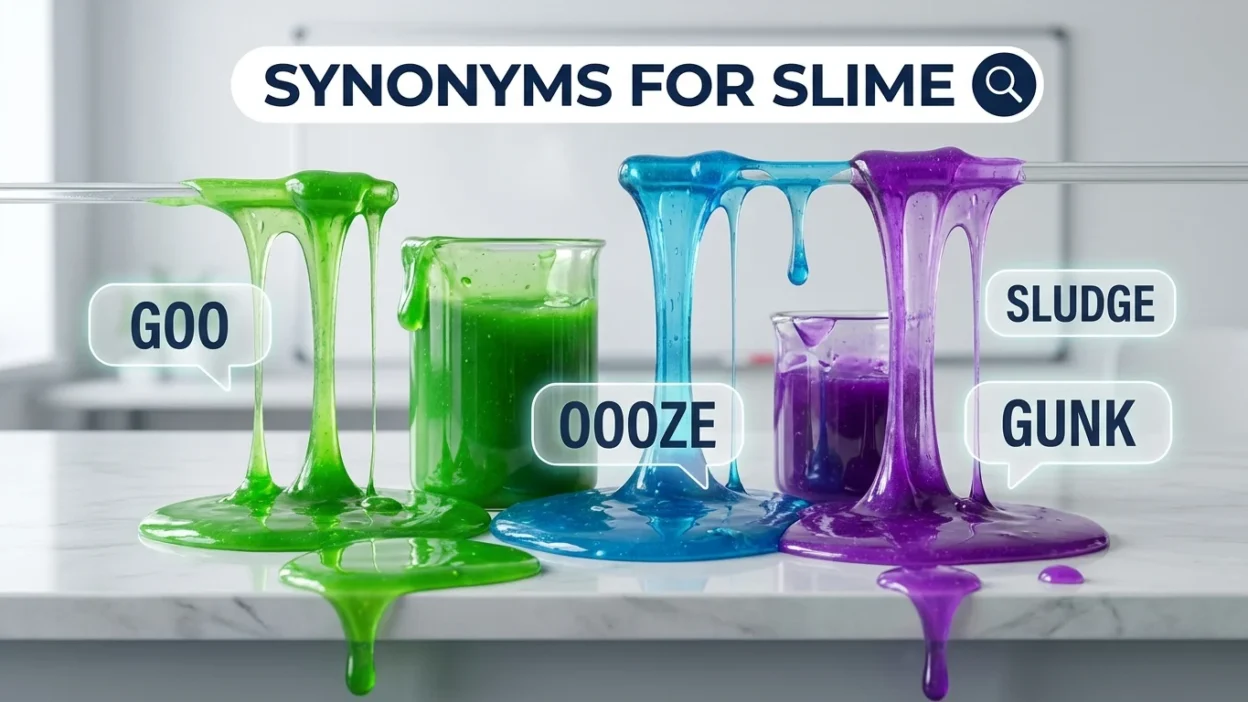
Slime is a common word used to describe a thick, wet, sticky, or slippery substance. It can refer to natural materials, dirty substances, or even colorful toy slime used by children. Depending on the situation, however, a different word may describe the substance more accurately.
Learning synonyms for slime can help students, ESL learners, writers, and content creators make their vocabulary more varied and precise. Words such as goo, sludge, ooze, muck, gel, and mucus may describe something similar to slime, but each has a slightly different meaning and usage.
In this guide, you will discover 30 useful alternatives to “slime,” along with simple meanings, example sentences, and the best context for using each word.
What Does “Slime” Mean?
Slime usually means a thick, slippery, sticky, or unpleasant substance. It may be natural, such as the slimy coating produced by some animals, or artificial, such as the stretchy material used as a children’s toy.
The word can have a neutral, playful, or negative tone, depending on the context.
For example:
- The pond was covered in green slime.
- The children played with colorful slime.
- A layer of slime covered the wet rocks.
Because “slime” can describe many different substances, choosing a more specific synonym can make your writing clearer.
30 Synonyms for Slime
1. Goo
Meaning: A thick, sticky, soft substance that is usually wet.
Example sentence: The broken toy was covered in yellow goo.
Best usage context: Use “goo” for informal, playful, or general descriptions of sticky substances.
2. Ooze
Meaning: A thick liquid that slowly flows or comes out of something.
Example sentence: Dark liquid began to ooze from the damaged pipe.
Best usage context: Best when describing a substance slowly coming out or spreading.
3. Sludge
Meaning: A thick, dirty mixture of liquid and solid material.
Example sentence: Workers removed the sludge from the bottom of the tank.
Best usage context: Common in environmental, industrial, and technical contexts.
4. Muck
Meaning: Wet, dirty, unpleasant material.
Example sentence: His boots were covered in mud and muck.
Best usage context: Informal writing and descriptions of dirty outdoor environments.
5. Gunk
Meaning: A sticky or dirty substance that is difficult to remove.
Example sentence: There was black gunk stuck around the machine.
Best usage context: Informal descriptions of unwanted sticky material.
6. Gooey Material
Meaning: A soft, sticky substance that is difficult to handle.
Example sentence: The children enjoyed making colorful gooey material.
Best usage context: Useful when describing soft and sticky substances in a general way.
7. Gel
Meaning: A soft substance with a jelly like consistency.
Example sentence: The product contains a clear gel that feels smooth.
Best usage context: Best for cosmetics, food, medicine, science, and manufactured products.
8. Jelly
Meaning: A soft, semi solid substance with a smooth or wobbly texture.
Example sentence: The strange substance felt like cold jelly.
Best usage context: Use when the slime like material has a soft, jelly like texture.
9. Mucus
Meaning: A slippery substance produced by the body to protect moist tissues.
Example sentence: Mucus helps protect the inside of the nose.
Best usage context: Medical, biological, and scientific writing.
10. Secretion
Meaning: A substance produced and released by a living organism or body part.
Example sentence: The animal produces a sticky secretion to protect its skin.
Best usage context: Formal scientific and biological writing.
11. Excretion
Meaning: Waste material released from a living organism.
Example sentence: The researcher studied the animal’s natural excretion.
Best usage context: Biology and scientific contexts involving waste products.
12. Sap
Meaning: A liquid that moves through the tissues of plants.
Example sentence: Sticky sap leaked from the damaged tree.
Best usage context: Use specifically for plant fluids rather than general slime.
13. Resin
Meaning: A sticky substance produced naturally by some plants or made synthetically.
Example sentence: Sticky resin covered the surface of the tree.
Best usage context: Botany, crafts, manufacturing, and materials science.
14. Paste
Meaning: A thick, soft substance that can be spread or squeezed.
Example sentence: The thick paste stuck to the spoon.
Best usage context: Food, art, construction, cosmetics, and everyday descriptions.
15. Pulp
Meaning: A soft, wet mass made from crushed or broken material.
Example sentence: The fruit was crushed into a wet pulp.
Best usage context: Food, plants, paper production, and natural materials.
16. Mash
Meaning: A soft mixture made by crushing or mixing ingredients.
Example sentence: The potatoes turned into a smooth mash.
Best usage context: Cooking and descriptions of crushed soft materials.
17. Slop
Meaning: A messy, watery, or semi liquid substance.
Example sentence: Muddy slop covered the floor after the storm.
Best usage context: Informal descriptions of messy liquids or mixtures.
18. Mire
Meaning: Deep, wet, muddy ground or a difficult muddy area.
Example sentence: The hikers struggled through the wet mire.
Best usage context: Nature writing, literature, and descriptions of swampy ground.
19. Marsh
Meaning: Wet, low land that is often covered with water and plants.
Example sentence: The frogs lived near the muddy marsh.
Best usage context: Geography and descriptions of wet natural environments.
20. Swamp
Meaning: A wet area of land with trees or other vegetation.
Example sentence: The explorers crossed a dark, muddy swamp.
Best usage context: Nature writing and descriptions of wet ecosystems.
21. Mucilage
Meaning: A thick, slippery substance produced by some plants and organisms.
Example sentence: The seeds release mucilage when they become wet.
Best usage context: Scientific, botanical, and technical writing.
22. Biofilm
Meaning: A thin layer of microorganisms attached to a surface.
Example sentence: A slippery biofilm formed on the wet rocks.
Best usage context: Biology, microbiology, medicine, and environmental science.
23. Scum
Meaning: An unwanted layer or substance that collects on the surface of a liquid.
Example sentence: Green scum covered the surface of the pond.
Best usage context: Dirty water, ponds, drains, and unpleasant surface buildup.
24. Film
Meaning: A thin layer covering a surface.
Example sentence: A slippery film formed over the water.
Best usage context: Scientific, technical, and neutral descriptions.
25. Coating
Meaning: A layer of material spread over or covering something.
Example sentence: A slimy coating covered the wet stones.
Best usage context: General and technical descriptions of surface layers.
26. Residue
Meaning: Material left behind after something has been used, processed, or removed.
Example sentence: Sticky residue remained on the glass.
Best usage context: Cleaning, science, manufacturing, and everyday writing.
27. Gooey Sludge
Meaning: A thick mixture that is both sticky and dirty.
Example sentence: The old drain contained a layer of gooey sludge.
Best usage context: Informal descriptions of unpleasant thick mixtures.
28. Gloop
Meaning: A thick, sticky, semi liquid substance.
Example sentence: Blue gloop spilled across the table.
Best usage context: Informal, playful, and creative writing.
29. Ooze
Meaning: A thick substance that moves slowly or gradually spreads.
Example sentence: Green ooze spread across the surface of the rock.
Best usage context: Descriptions of slow moving liquids, especially in fiction or nature writing.
30. Gooey Substance
Meaning: A soft, sticky, thick material.
Example sentence: The mysterious gooey substance covered the inside of the container.
Best usage context: General descriptions when the exact material is unknown.
Quick Comparison of Synonyms for Slime
| Synonym | Main Meaning | Tone | Best Context |
| Goo | Thick, sticky substance | Informal | Everyday descriptions |
| Ooze | Slowly flowing thick liquid | Neutral | Nature and descriptive writing |
| Sludge | Dirty thick mixture | Negative | Industrial/environmental |
| Muck | Wet, dirty material | Informal | Outdoor descriptions |
| Gunk | Sticky unwanted material | Informal | Cleaning and everyday use |
| Gel | Soft jelly like substance | Neutral | Science, cosmetics, products |
| Mucus | Body produced slippery substance | Scientific | Biology and medicine |
| Resin | Sticky plant substance | Neutral | Plants and materials |
| Paste | Thick spreadable material | Neutral | Food, art, construction |
| Scum | Unwanted surface layer | Negative | Water and pollution |
| Biofilm | Microbial surface layer | Scientific | Biology |
| Gloop | Thick sticky substance | Playful | Creative writing |
| Residue | Material left behind | Neutral | Science and cleaning |
How to Choose the Right Synonym
The best synonym depends on what the substance is, how it behaves, and the tone of your writing.
For Casual or Everyday Writing
Choose:
- Goo
- Gunk
- Muck
- Gloop
- Slop
These words sound natural in conversations, informal articles, stories, and children’s content.
For Scientific Writing
Choose:
- Mucus
- Mucilage
- Biofilm
- Secretion
- Gel
- Residue
These terms are more precise and suitable for academic or scientific contexts.
For Nature Descriptions
Choose:
- Ooze
- Sap
- Resin
- Scum
- Mire
- Marsh
- Swamp
These words work well when describing natural environments or substances.
For Industrial or Environmental Contexts
Choose:
- Sludge
- Scum
- Residue
- Biofilm
- Coating
These alternatives are useful when discussing wastewater, machinery, pollution, or environmental processes.
For Creative Writing
Choose:
- Goo
- Gloop
- Ooze
- Muck
- Sludge
These words can create strong visual and sensory descriptions.
For example, instead of writing:
The creature was covered in slime.
You could write:
The creature was covered in thick green ooze.
The second sentence gives the reader a clearer image.
Slime vs. Goo
“Slime” and “goo” are closely related, but they are not always interchangeable.
Slime often suggests something slippery, sticky, or unpleasant. It is also commonly used for colorful children’s toys.
Goo is more general and often sounds informal or playful.
- The pond was covered in slime.
- The monster left green goo behind.
Slime vs. Sludge
These words are also similar but have different uses.
Sludge usually refers to a thick mixture containing liquid and solid particles. It often has a dirty or industrial meaning.
Slime generally focuses more on a slippery or slimy texture.
For example:
- Slime: A slippery substance covered the rock.
- Sludge: Thick sludge accumulated at the bottom of the tank.
Slime vs. Mucus
“Mucus” is much more specific.
It refers to a slippery substance produced by the body. Therefore, it should not normally be used as a general replacement for slime.
- Correct: The snail left a trail of slime.
- Correct: Mucus protects the respiratory system.
Slime vs. Gel
“Gel” usually has a smoother and more controlled consistency. It is commonly used for products such as hair gel, cosmetic products, food, and scientific materials.
“Slime” often sounds more playful, messy, or unpleasant.
Why Use Synonyms for Slime?
Using different words can make your writing more precise and interesting.
Instead of repeating:
The slime covered the floor. The slime was green. The slime smelled bad.
You can write:
A layer of green sludge covered the floor. The sticky substance had a strong smell.
This version gives the reader more information while avoiding unnecessary repetition.
Synonyms are especially useful for:
- Essays
- Creative writing
- Blog posts
- Product descriptions
- Science assignments
- Vocabulary practice
- SEO content
- Stories and fiction
Frequently Asked Questions
What is the best synonym for slime?
Goo is one of the closest informal synonyms. However, sludge, ooze, gunk, gel, mucus, or gloop may be better depending on the specific substance.
What is a scientific synonym for slime?
Depending on the context, biofilm, mucus, mucilage, secretion, or gel may be appropriate scientific terms.
What is a good synonym for sticky slime?
Goo, gunk, gloop, and gooey substance are useful choices for sticky material.
What is a synonym for dirty slime?
Sludge, muck, scum, and gunk can describe dirty or unpleasant slime like substances.
Is “goo” the same as “slime”?
Not exactly. Both can describe thick, sticky substances, but “goo” is broader and usually more informal.
What is the opposite of slime?
There is no single perfect opposite. Depending on the context, words such as dryness, solid, firmness, or clean surface may provide an opposite idea.
Final Thoughts
Knowing different synonyms for slime helps you describe sticky, slippery, wet, and thick substances more accurately. While goo, gunk, gloop, and muck work well in casual writing, terms such as sludge, biofilm, mucilage, mucus, and residue are better for specific scientific or technical situations.
The key is to choose a word based on texture, source, purpose, and tone. A good synonym does more than replace “slime” it gives your reader a clearer picture of what you mean.
For students and ESL learners, learning these differences can also improve vocabulary, reading comprehension, and writing skills. The more precisely you choose your words, the stronger and more natural your English becomes.

Carter Brooks writes educational content that helps readers understand word meanings, synonyms, and writing techniques. He believes simple explanations inspire lifelong learning and stronger communication skills for everyone.