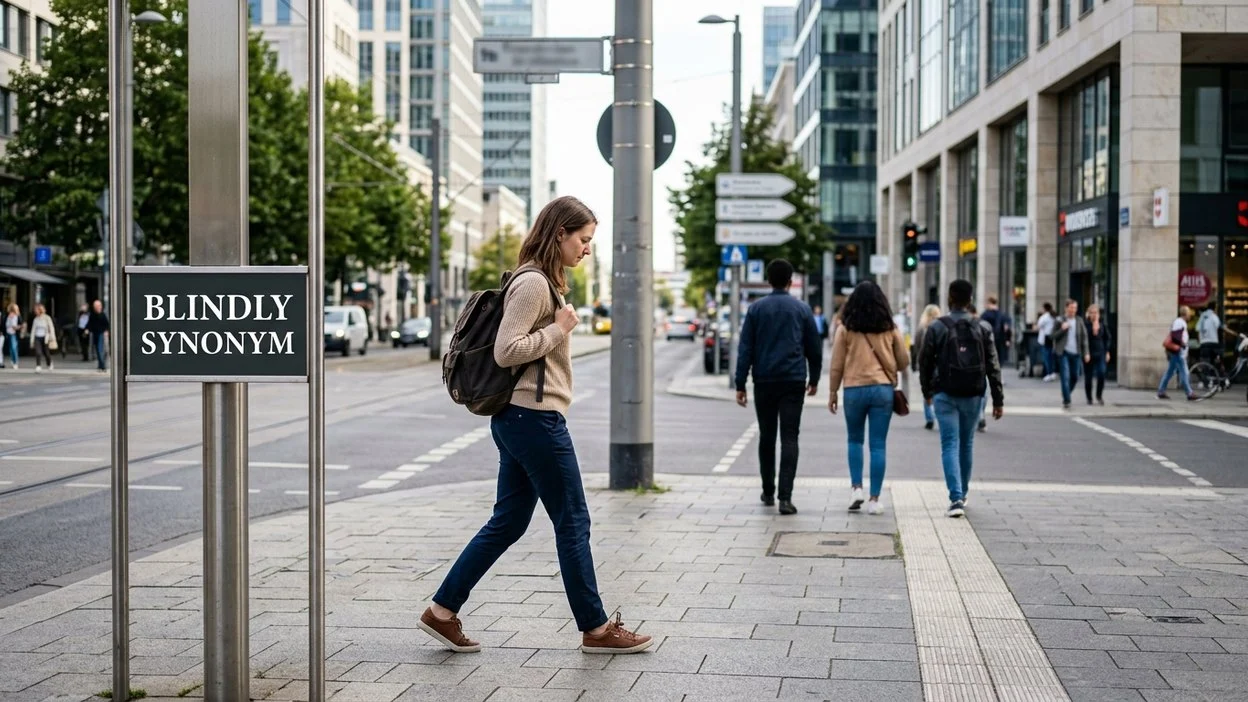
The word “blindly” is commonly used when someone does something without seeing, checking, thinking, questioning, or understanding what they are doing. Depending on the sentence, it can suggest acting without careful thought, without evidence, without guidance, or without questioning. For example, “He blindly followed the instructions” means he followed them without stopping to consider whether they were correct or suitable.
Choosing the right synonym for “blindly” depends on the exact meaning you want to express. Some alternatives sound neutral, such as automatically or unquestioningly, while others can sound critical, such as recklessly, thoughtlessly, or carelessly. This guide explains 30 useful synonyms in simple English, with examples and context notes to help students, ESL learners, writers, and content creators choose the most natural word.
Quick Answer
The best synonym for “blindly” depends on context. Common alternatives include unquestioningly, automatically, without thinking, thoughtlessly, carelessly, recklessly, unquestioned, mechanically, impulsively, and without consideration.
Example:
- “She blindly trusted him.”
- “She trusted him unquestioningly.”
What Does “Blindly” Mean?
Blindly is an adverb. It describes doing something without careful thought, observation, judgment, or questioning.
Simple Definition
Blindly = without thinking carefully or without knowing enough about something.
Examples
- He blindly followed the crowd.
- She blindly trusted the information.
- They blindly accepted the decision.
- He blindly obeyed the instructions.
The word can have slightly different meanings depending on the sentence.
For example:
“He blindly followed the instructions.”
Here, “blindly” suggests that he did not question or evaluate the instructions.
“She blindly rushed into the room.”
Here, it can suggest acting without considering the possible consequences.
30 Synonyms for “Blindly”
1. Unquestioningly
Simple meaning: Without asking questions or expressing doubt.
Example:
She unquestioningly accepted everything he said.
Best usage/context: Use it when someone accepts an idea, statement, or instruction without challenging it.
2. Thoughtlessly
Simple meaning: Without thinking about what you are doing.
Example:
He thoughtlessly repeated the rumor.
Best usage/context: Good when emphasizing a lack of consideration or reflection.
3. Carelessly
Simple meaning: Without enough attention or caution.
Example:
She carelessly shared the information online.
Best usage/context: Use it when an action shows poor attention or caution.
4. Recklessly
Simple meaning: Without thinking about danger or consequences.
Example:
He recklessly drove through the crowded street.
Best usage/context: Best for risky or dangerous actions.
5. Automatically
Simple meaning: Without consciously thinking about it.
Example:
He automatically agreed with his manager.
Best usage/context: Useful when an action happens almost as a habit or reflex.
6. Mechanically
Simple meaning: In a routine way, without much thought or feeling.
Example:
She mechanically copied the information into her notebook.
Best usage/context: Good for repetitive or routine actions.
7. Impulsively
Simple meaning: Acting suddenly without thinking first.
Example:
He impulsively bought an expensive watch.
Best usage/context: Use it when an immediate emotion leads to an action.
8. Unthinkingly
Simple meaning: Without considering what you are doing.
Example:
He unthinkingly repeated the same mistake.
Best usage/context: Useful when someone acts without conscious consideration.
9. Uncritically
Simple meaning: Without examining whether something is true or reasonable.
Example:
She uncritically accepted the article’s claims.
Best usage/context: Excellent for writing about opinions, information, arguments, or beliefs.
10. Inconsiderately
Simple meaning: Without thinking about other people’s feelings or needs.
Example:
He inconsiderately interrupted the conversation.
Best usage/context: Use it when the main issue is a lack of consideration for others.
11. Carelessly
Simple meaning: Without sufficient attention.
Example:
He carelessly signed the document.
Best usage/context: Suitable when an action results from poor attention.
12. Naively
Simple meaning: Without enough experience or understanding.
Example:
She naively believed that everyone was honest.
Best usage/context: Best when someone’s lack of experience affects their judgment.
13. Innocently
Simple meaning: Without harmful intentions or awareness of a problem.
Example:
The child innocently repeated what he had heard.
Best usage/context: Use it when the person does not understand that something could be wrong.
14. Unwittingly
Simple meaning: Without knowing or intending it.
Example:
He unwittingly revealed the secret.
Best usage/context: Best when something happens without the person’s awareness or intention.
15. Unknowingly
Simple meaning: Without knowing something.
Example:
She unknowingly entered the wrong room.
Best usage/context: Use it when a person lacks important information.
16. Without Thinking
Simple meaning: Without stopping to consider an action.
Example:
He answered without thinking.
Best usage/context: A natural everyday alternative to “blindly.”
17. Without Question
Simple meaning: Without doubt or disagreement.
Example:
They followed the leader without question.
Best usage/context: Useful when emphasizing complete acceptance or obedience.
18. Without Consideration
Simple meaning: Without careful thought about something.
Example:
He made the decision without consideration of the risks.
Best usage/context: More formal and suitable for academic or professional writing.
19. Without Judgment
Simple meaning: Without carefully evaluating a situation.
Example:
She accepted the proposal without judgment.
Best usage/context: Useful when discussing decision-making.
20. Unreservedly
Simple meaning: Completely and without hesitation.
Example:
He unreservedly supported the proposal.
Best usage/context: Use it when describing complete support or acceptance.
21. Automatically
Simple meaning: As a natural or habitual response.
Example:
She automatically reached for her phone.
Best usage/context: Best for habitual, reflexive, or routine actions.
22. Reflexively
Simple meaning: As an immediate response, often without conscious thought.
Example:
He reflexively defended his friend.
Best usage/context: Useful in formal writing when an action happens almost instantly.
23. Instinctively
Simple meaning: Naturally, without conscious reasoning.
Example:
She instinctively moved away from the noise.
Best usage/context: Best when the action comes from instinct rather than deliberate thought.
24. Impetuously
Simple meaning: Suddenly and without careful thought.
Example:
He impetuously rejected the offer.
Best usage/context: A more formal word for impulsive behavior.
25. Rashly
Simple meaning: Without carefully considering the results.
Example:
She rashly quit her job.
Best usage/context: Good for decisions that are made too quickly.
26. Haphazardly
Simple meaning: In a random or poorly planned way.
Example:
The files were arranged haphazardly.
Best usage/context: Use it for disorganized actions rather than unquestioning belief.
27. Randomly
Simple meaning: Without a particular plan or reason.
Example:
He randomly chose a name from the list.
Best usage/context: Suitable when there is no clear method or selection process.
28. Unmindfully
Simple meaning: Without paying attention or being aware.
Example:
He unmindfully walked past the sign.
Best usage/context: More formal and less common; useful when describing a lack of awareness.
29. Passively
Simple meaning: Without taking an active role or questioning what happens.
Example:
The employees passively accepted the changes.
Best usage/context: Good when someone simply accepts events instead of responding actively.
30. Submissively
Simple meaning: In a way that shows willingness to obey another person.
Example:
He submissively followed the manager’s instructions.
Best usage/context: Use it when obedience or lack of resistance is the main idea.
Comparison Table: Synonyms for “Blindly”
| Synonym | Main Idea | Tone | Common Context |
| Unquestioningly | No questions | Neutral | Beliefs, instructions |
| Thoughtlessly | No thought | Negative | Everyday actions |
| Carelessly | Poor attention | Negative | Mistakes, actions |
| Recklessly | No concern for danger | Strong/negative | Risky behavior |
| Automatically | Habitual response | Neutral | Routine actions |
| Mechanically | Routine action | Neutral | Repetitive tasks |
| Impulsively | Sudden decision | Neutral/negative | Choices |
| Unthinkingly | No conscious thought | Negative | Behavior |
| Uncritically | No evaluation | Neutral/negative | Information |
| Naively | Lack of experience | Neutral/negative | Beliefs |
| Unwittingly | Without knowing | Neutral | Accidental actions |
| Unknowingly | Without awareness | Neutral | Mistakes |
| Reflexively | Immediate response | Neutral | Reactions |
| Instinctively | Natural response | Neutral | Reactions |
| Rashly | Poorly considered | Negative | Decisions |
| Haphazardly | Random/disorganized | Negative | Processes |
| Passively | No active response | Neutral | Acceptance |
| Submissively | Willing obedience | Negative/neutral | Authority |
How to Choose the Right Synonym for “Blindly”
Not every synonym works in every sentence. The best choice depends on tone, meaning, and intent.
For a Neutral Tone
Choose:
- Automatically
- Mechanically
- Instinctively
- Reflexively
- Unknowingly
Example:
“He automatically opened the door.”
These words do not necessarily criticize the person.
For Lack of Thought
Choose:
- Thoughtlessly
- Unthinkingly
- Without thinking
- Rashly
- Impetuously
Example:
“He thoughtlessly repeated the comment.”
These choices highlight poor or absent consideration.
For Lack of Questioning
Choose:
- Unquestioningly
- Without question
- Uncritically
- Passively
Example:
“They unquestioningly accepted the instructions.”
These are especially useful when discussing beliefs, authority, or information.
For Risky Behavior
Choose:
- Recklessly
- Rashly
- Impulsively
- Carelessly
Example:
“He recklessly ignored the warning.”
These words suggest that the action could have harmful consequences.
For Lack of Knowledge
Choose:
- Unknowingly
- Unwittingly
- Naively
- Innocently
Example:
“She unknowingly shared incorrect information.”
Here, the focus is on what the person did not know, rather than whether they failed to think.
“Blindely” vs. Similar Words
Blindily vs. Unquestioningly
Unquestioningly specifically emphasizes accepting or obeying something without asking questions.
- He blindly followed the crowd.
- He unquestioningly followed his teacher’s instructions.
Blindly vs. Recklessly
Blindly does not always involve danger.
Recklessly specifically suggests ignoring risk or consequences.
- She blindly accepted the advice.
- He recklessly ignored the warning.
Blindly vs. Automatically
Blindly can imply poor judgment.
Automatically often describes a habitual or unconscious response without criticism.
- He blindly agreed with them.
- She automatically checked her phone.
Blindly vs. Unknowingly
Blindly can mean acting without careful judgment.
Unknowingly specifically means doing something without knowing it.
- He blindly trusted the claim.
- He unknowingly used incorrect information.
Common Usage Mistakes
1. Using “recklessly” for every situation
“Recklessly” means that someone ignores danger or consequences. It is not a perfect synonym for every use of “blindly.”
Better:
“He blindly accepted the advice.”
Not necessarily:
“He recklessly accepted the advice.”
The second sentence gives the action a stronger sense of risk.
2. Confusing “unknowingly” with “blindly”
“Unknowingly” means without knowing.
“Blindly” can mean without thinking, checking, or questioning.
These ideas overlap, but they are not identical.
3. Using “randomly” when obedience is meant
“Randomly” describes something done without a particular plan or selection method. It does not necessarily mean that someone accepted or followed something without questioning it.
4. Choosing a synonym that changes the tone
Words such as recklessly, rashly, and thoughtlessly can sound critical.
If you want a neutral tone, consider automatically, unknowingly, instinctively, or mechanically, depending on the context.
5. Repeating “blindly” when a more precise word works
Using the same word repeatedly can make writing less precise.
Instead of:
“He blindly followed the advice and blindly accepted the decision.”
You could write:
“He unquestioningly followed the advice and automatically accepted the decision.”
The second version gives each action a more specific meaning.
Frequently Asked Questions
What is the closest synonym for “blindly”?
Unquestioningly is often one of the closest choices when “blindly” means accepting or following something without doubt or questioning.
What is a simple word for “blindly”?
Depending on the sentence, simple alternatives include without thinking, automatically, carelessly, and without question.
Is “blindly” positive or negative?
It is often neutral to negative because it can suggest a lack of careful thought or questioning. However, the exact tone depends on the sentence.
Can “blindly” mean “without knowing”?
Sometimes. In certain contexts, “blindly” suggests acting without enough knowledge, but unknowingly or unwittingly is more precise when lack of knowledge is the main idea.
What is the synonym of “blindly” in academic writing?
Depending on the meaning, academic writing may use uncritically, unquestioningly, without consideration, or without sufficient evaluation.
What is the opposite of “blindly”?
Possible opposites include carefully, thoughtfully, critically, deliberately, consciously, and cautiously.
Is “automatically” the same as “blindly”?
Not always. “Automatically” usually describes something done habitually or without conscious thought, while “blindly” can also suggest following, accepting, or acting without proper judgment.
Which synonym should I use for “blindly followed”?
Unquestioningly followed is often a natural choice when someone obeys or follows something without questioning it.
Conclusion
The word “blindly” can describe several related ideas, including acting without thinking, accepting something without questioning it, behaving without enough knowledge, or ignoring possible consequences. That is why the best synonym depends on the exact meaning of your sentence.
For acceptance without questioning, try unquestioningly or uncritically. For lack of thought, use thoughtlessly or unthinkingly. For risk-taking, recklessly or rashly may fit better. For lack of awareness, consider unknowingly or unwittingly. When you choose a synonym based on the specific meaning you want to communicate, your writing becomes clearer, more natural, and more precise.

Carter Brooks writes educational content that helps readers understand word meanings, synonyms, and writing techniques. He believes simple explanations inspire lifelong learning and stronger communication skills for everyone.