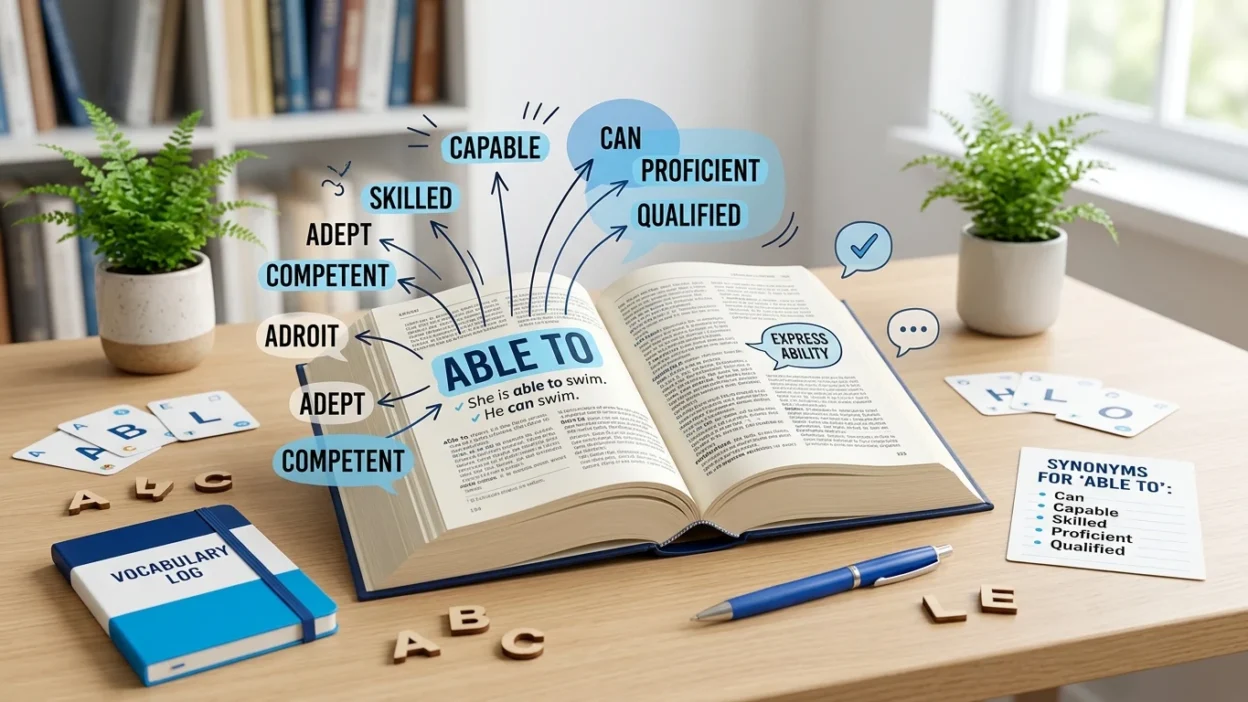
Finding the right able to synonyms can make your English more natural, precise, and interesting. The phrase “able to” is very common because it describes having the skill, opportunity, strength, or possibility to do something.
For students and ESL learners, learning alternatives to “able to” is useful because the best replacement depends on the situation. For example, “can,” “capable of,” “competent,” and “in a position to” do not always have exactly the same meaning or tone.
This guide explains 30 useful able to synonyms in simple English. Each word or phrase includes its meaning, an example sentence, and the best situation for using it.
What Does “Able To” Mean?
Able to means having the skill, ability, opportunity, or capacity to do something.
For example:
She is able to solve difficult problems.
This means she has the skill or ability to solve difficult problems.
The phrase can describe physical ability, mental ability, skills, opportunities, or circumstances.
Tone and Usage of “Able To”
“Able to” is neutral and widely used. It works well in everyday conversation, academic writing, professional communication, and formal writing.
However, repeating “able to” too often can make your writing sound repetitive. Using suitable alternatives can give your sentences more variety and precision.
30 Able to Synonyms
1. Can
Meaning: Has the ability or opportunity to do something.
Example sentence:
She can speak three languages.
Best usage context:
Everyday English, conversations, and simple writing.
2. Capable of
Meaning: Having the ability or potential to do something.
Example sentence:
He is capable of handling difficult situations.
Best usage context:
Formal, professional, and academic writing.
3. Competent
Meaning: Having enough skill or knowledge to do something successfully.
Example sentence:
She is a competent manager who understands her team.
Best usage context:
Professional, workplace, and formal contexts.
4. Skilled
Meaning: Having a high level of ability in a particular activity.
Example sentence:
He is skilled at repairing computers.
Best usage context:
Jobs, professions, practical abilities, and hobbies.
5. Proficient
Meaning: Very good at doing something because of training or experience.
Example sentence:
Maria is proficient in using spreadsheet software.
Best usage context:
Academic, professional, technical, and résumé writing.
6. Qualified
Meaning: Having the necessary training, education, or experience to do something.
Example sentence:
She is qualified to teach English.
Best usage context:
Jobs, careers, education, licenses, and professional situations.
7. Equipped to
Meaning: Having the tools, knowledge, skills, or resources needed to do something.
Example sentence:
The team is equipped to deal with unexpected challenges.
Best usage context:
Professional, technical, academic, and organizational writing.
8. In a Position to
Meaning: Having the circumstances or opportunity needed to do something.
Example sentence:
We are now in a position to make a final decision.
Best usage context:
Business, formal communication, and professional writing.
9. In a Capacity to
Meaning: Having the ability or role necessary to perform an action.
Example sentence:
She is working in a capacity to support the research team.
Best usage context:
Formal and professional contexts.
10. Have the Ability to
Meaning: Have the power, skill, or capacity to do something.
Example sentence:
Modern computers have the ability to process large amounts of data.
Best usage context:
Academic, technical, and explanatory writing.
11. Have the Capacity to
Meaning: Have enough power, space, resources, or ability to do something.
Example sentence:
The organization has the capacity to support thousands of students.
Best usage context:
Academic, business, technical, and formal writing.
12. Have What It Takes to
Meaning: Have the qualities, skills, or determination needed to succeed.
Example sentence:
She has what it takes to become an excellent leader.
Best usage context:
Motivational, conversational, and informal writing.
13. Manage to
Meaning: Successfully do something, often despite difficulty.
Example sentence:
He managed to finish the project before the deadline.
Best usage context:
Situations involving effort, difficulty, or unexpected success.
14. Succeed in
Meaning: Successfully accomplish something.
Example sentence:
The researchers succeeded in finding a practical solution.
Best usage context:
Academic, professional, and formal writing.
15. Accomplish
Meaning: Successfully complete or achieve something.
Example sentence:
The team accomplished its main goal.
Best usage context:
Professional, academic, achievement-focused, and formal contexts.
16. Achieve
Meaning: Successfully reach a goal or desired result.
Example sentence:
She achieved excellent results through consistent effort.
Best usage context:
Goals, education, careers, business, and personal success.
17. Perform
Meaning: Successfully carry out an action, task, or activity.
Example sentence:
The machine can perform several complex operations.
Best usage context:
Technical, professional, academic, and workplace contexts.
18. Handle
Meaning: Have enough skill or ability to deal with something.
Example sentence:
He can handle pressure very well.
Best usage context:
Workplace, personal situations, responsibilities, and challenges.
19. Deal With
Meaning: Have the ability or opportunity to manage a problem or situation.
Example sentence:
The support team is able to deal with customer complaints quickly.
Best usage context:
Problems, challenges, customer service, and everyday situations.
20. Cope With
Meaning: Manage a difficult situation successfully.
Example sentence:
She learned how to cope with stressful situations.
Best usage context:
Difficult experiences, pressure, challenges, and emotional situations.
21. Accommodate
Meaning: Have enough space, resources, or flexibility to accept or support something.
Example sentence:
The hotel can accommodate up to 200 guests.
Best usage context:
Hotels, organizations, facilities, schedules, and formal writing.
22. Sustain
Meaning: Continue or maintain something over a period of time.
Example sentence:
The company has enough resources to sustain its growth.
Best usage context:
Business, economics, environment, academic writing, and long-term situations.
23. Endure
Meaning: Have the strength to experience or survive something difficult.
Example sentence:
The building was strong enough to endure severe weather.
Best usage context:
Hardship, difficult conditions, physical strength, and formal writing.
24. Withstand
Meaning: Have enough strength to resist or survive something harmful or difficult.
Example sentence:
This material can withstand extreme temperatures.
Best usage context:
Science, engineering, construction, weather, and technical writing.
25. Adapt
Meaning: Change successfully to deal with new conditions.
Example sentence:
Good employees can adapt to changing work environments.
Best usage context:
Work, education, technology, nature, and changing situations.
26. Function
Meaning: Work or operate successfully.
Example sentence:
The device is able to function without an external power source.
Best usage context:
Technology, machines, systems, biology, and technical writing.
27. Operate
Meaning: Have the ability to control, use, or make something work.
Example sentence:
Only trained employees are allowed to operate the equipment.
Best usage context:
Machines, equipment, businesses, systems, and technical contexts.
28. Exercise the Ability to
Meaning: Use a particular ability or power.
Example sentence:
Students should exercise the ability to think critically.
Best usage context:
Academic, formal, educational, and professional writing.
29. Be Competent to
Meaning: Have enough skill or knowledge to perform a particular task.
Example sentence:
The technician is competent to inspect the equipment.
Best usage context:
Professional, technical, legal, and formal contexts.
30. Be in a Position to
Meaning: Have the circumstances, authority, resources, or opportunity to do something.
Example sentence:
After receiving the funding, the organization was in a position to expand.
Best usage context:
Business, finance, management, and formal communication.
Able to Synonyms Comparison Table
| Synonym | Main Meaning | Tone | Best Context |
| Can | General ability | Neutral | Everyday English |
| Capable of | Ability or potential | Formal | Academic/professional |
| Competent | Sufficient skill | Formal | Work |
| Skilled | Strong practical ability | Neutral | Jobs and hobbies |
| Proficient | High level of skill | Formal | Academic/work |
| Qualified | Proper training or credentials | Formal | Careers |
| Equipped to | Has needed resources | Formal | Business/technical |
| In a position to | Has opportunity or circumstances | Formal | Business |
| Manage to | Succeed despite difficulty | Neutral | Everyday/formal |
| Succeed in | Successfully accomplish | Formal | Academic/work |
| Achieve | Reach a goal | Neutral | Goals and success |
| Handle | Manage something | Neutral | Work/challenges |
| Cope with | Manage difficulty | Neutral | Difficult situations |
| Adapt | Adjust successfully | Neutral | Change |
| Withstand | Resist or survive | Formal | Technical/physical |
How to Choose the Right Synonym for “Able To”
The best able to synonym depends on what kind of ability you want to describe.
For Everyday English
Use:
- Can
- Manage to
- Handle
- Have what it takes to
Example:
Simple:
I can finish this today.
More expressive:
I managed to finish this today.
“Can” simply describes ability, while “managed to” suggests that the task was difficult.
For Academic Writing
Use:
- Capable of
- Proficient
- Have the ability to
- Have the capacity to
- Succeed in
- Exercise the ability to
Example:
Basic:
Students are able to analyze complex information.
Academic:
Students are capable of analyzing complex information.
The second sentence sounds more formal and academic.
For Professional Writing
Use:
- Competent
- Qualified
- Equipped to
- In a position to
- Capable of
- Proficient
Example:
Basic:
The company is able to provide technical support.
Professional:
The company is equipped to provide technical support.
The second version emphasizes that the company has the necessary resources and preparation.
For Skills and Expertise
Use:
- Skilled
- Proficient
- Competent
- Qualified
- Capable of
Example:
She is proficient in digital marketing.
This is more specific than simply saying:
She is able to do digital marketing.
For Difficult Situations
Use:
- Manage to
- Handle
- Cope with
- Endure
- Withstand
- Adapt
Example:
Despite the pressure, he managed to complete the assignment.
“Managed to” works particularly well when something required effort.
For Goals and Success
Use:
- Achieve
- Accomplish
- Succeed in
- Have what it takes to
Example:
She has what it takes to achieve her career goals.
These expressions focus more on success and results than simple ability.
Able To vs. Can
One of the most common questions is whether “can” and “able to” mean the same thing.
In many situations, they do.
Can:
I can swim.
Able to:
I am able to swim.
Both sentences describe the ability to swim. However, “can” is usually more natural in everyday English.
“Able to” can be useful when you need a different grammatical structure or want to emphasize ability.
For example:
She was able to complete the task.
This can emphasize that she successfully completed a particular task, especially after facing difficulty.
Able To vs. Capable Of
“Capable of” usually emphasizes a person’s or thing’s ability or potential.
Able to:
The machine is able to process large files.
Capable of:
The machine is capable of processing large files.
Both are correct, but “capable of” often sounds more formal and emphasizes capacity or potential.
Remember the grammar difference:
Able to + verb
She is able to solve the problem.
Capable of + -ing
She is capable of solving the problem.
Able To vs. Skilled
These words are related but not identical.
Able to means someone can do something.
Skilled means someone has developed a good level of ability through practice or experience.
For example:
He is able to repair computers.
This only tells us that he can repair computers.
He is skilled at repairing computers.
This suggests that he is good at it.
Able To vs. Qualified
“Qualified” is more specific than “able to.”
Someone may be able to perform a task without being officially qualified to do it.
For example:
She is able to teach the class.
This means she has the ability to teach it.
She is qualified to teach the class.
This suggests that she has the required education, training, certification, or credentials.
Common Sentence Patterns
Learning sentence patterns can help you use alternatives to “able to” correctly.
Can + Base Verb
He can drive.
Be Able To + Base Verb
He is able to drive.
Be Capable Of + -ing
He is capable of driving long distances.
Be Skilled At + -ing
He is skilled at driving in difficult conditions.
Be Proficient In + Noun/-ing
She is proficient in using design software.
Manage To + Base Verb
They managed to complete the project.
Succeed In + -ing
They succeeded in completing the project.
Be Qualified To + Base Verb
He is qualified to operate the equipment.
Why Use Synonyms for “Able To”?
Using different expressions can make your writing clearer and more natural.
1. Avoid Repetition
Repeating “able to” many times can make a paragraph sound mechanical.
Instead of:
The students are able to research topics. They are able to analyze sources. They are able to present their findings.
You could write:
The students can research topics, analyze sources, and present their findings.
2. Show More Precise Meaning
Different synonyms highlight different aspects of ability.
“Skilled” emphasizes expertise.
“Qualified” emphasizes credentials.
“Capable” emphasizes ability or potential.
“Manage to” emphasizes successful effort.
“Equipped to” emphasizes available resources.
3. Improve Academic Writing
Academic writing often benefits from precise vocabulary.
Instead of repeatedly using “able to,” writers can use terms such as “capable of,” “proficient in,” “have the capacity to,” or “succeed in,” when appropriate.
4. Make Professional Writing Stronger
In business writing, phrases such as “equipped to,” “in a position to,” and “qualified to” can communicate specific meanings more clearly.
Common Mistakes When Using Able To Synonyms
Mistake 1: Using “Capable Of” With the Wrong Verb Form
Incorrect:
She is capable to solve the problem.
Correct:
She is capable of solving the problem.
Use capable of + -ing.
Mistake 2: Using “Proficient” Without the Correct Preposition
Incorrect:
He is proficient at computer software.
Better:
He is proficient in using computer software.
“Proficient in” is the common structure.
Mistake 3: Confusing “Qualified” With “Skilled”
Being skilled and being qualified are not always the same.
A person can be highly skilled but not officially qualified.
“Qualified” often relates to formal training, education, certification, or requirements.
Mistake 4: Using Formal Synonyms in Casual Conversations
You normally do not need complicated vocabulary when “can” sounds natural.
Instead of:
I am capable of helping you.
In everyday conversation, you can simply say:
I can help you.
Choose vocabulary according to the situation.
Quick Guide: Which Able to Synonym Should You Use?
If you mean general ability, use can.
If you mean potential or capacity, use capable of.
If you mean good practical ability, use skilled.
If you mean high-level knowledge or skill, use proficient.
If you mean formal training or credentials, use qualified.
If you mean success despite difficulty, use manage to.
If you mean successful completion, use succeed in or accomplish.
If you mean reaching a goal, use achieve.
If you mean having the necessary resources, use equipped to.
If you mean having the opportunity or circumstances, use in a position to.
If you mean managing a problem, use handle or cope with.
If you mean resisting difficult conditions, use withstand or endure.
Frequently Asked Questions About Able to Synonyms
What is the best synonym for “able to”?
The most common synonym is can. However, the best choice depends on the meaning. “Capable of,” “skilled,” “qualified,” and “manage to” are better in specific contexts.
What is a formal synonym for “able to”?
Some formal alternatives include capable of, proficient in, equipped to, have the capacity to, and in a position to.
Is “can” the same as “able to”?
In many sentences, yes. Both can describe ability. “Can” is usually more natural and concise, while “able to” can provide flexibility in sentence structure and emphasis.
What is a synonym for “able to” in academic writing?
Useful academic alternatives include capable of, proficient in, have the capacity to, succeed in, and have the ability to.
What is a synonym for “able to” in professional writing?
Depending on the context, you can use qualified, competent, equipped to, capable of, or in a position to.
What is a synonym for “able to” meaning successful?
Manage to, succeed in, accomplish, and achieve can work when the meaning focuses on successfully completing something.
Final Thoughts on Able to Synonyms
Learning different able to synonyms helps you express ability with greater accuracy and variety. While “can” is usually the simplest choice, other alternatives can communicate more specific ideas.
Use capable of for ability or potential, skilled and proficient for expertise, qualified for formal credentials, and equipped to when resources or preparation are important. For difficult achievements, manage to is often a natural choice.
The key is not to replace “able to” with a difficult word every time. Good writing uses the simplest word that communicates the exact meaning. By understanding the differences between these 30 alternatives, you can make your English more natural, flexible, and precise.

Carter Brooks writes educational content that helps readers understand word meanings, synonyms, and writing techniques. He believes simple explanations inspire lifelong learning and stronger communication skills for everyone.