
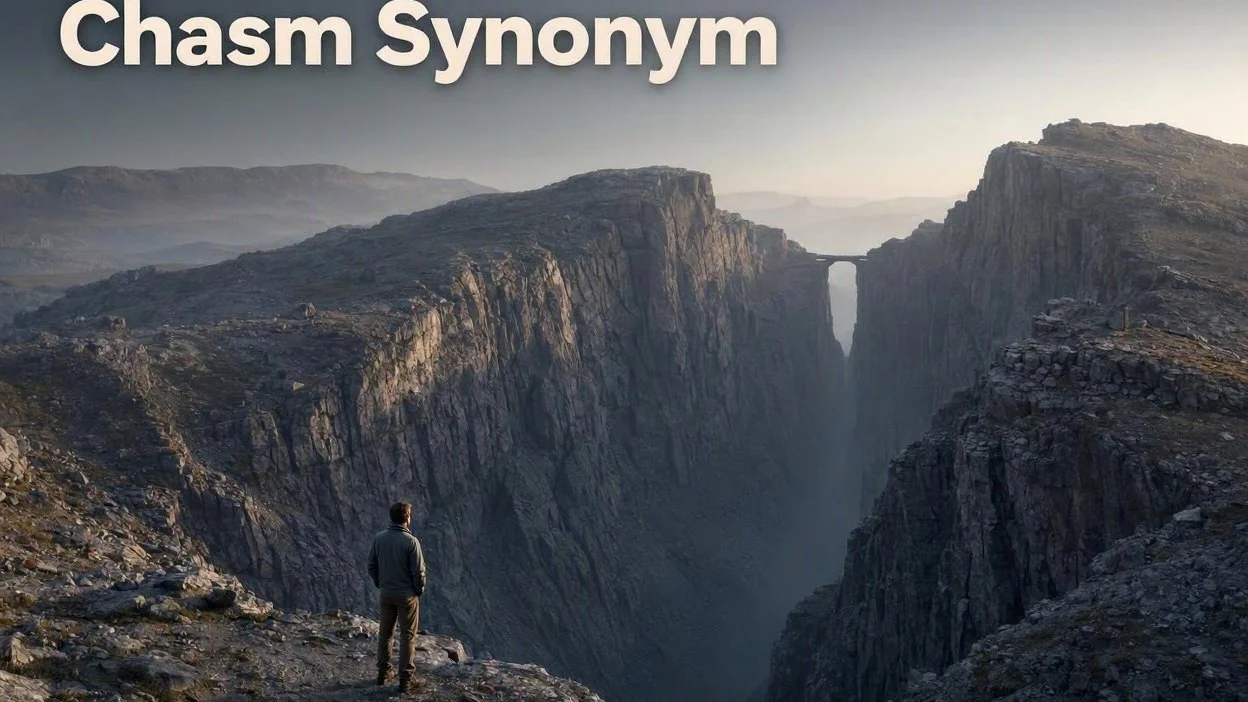
Finding the right word for a deep gap can be harder than it seems. You might be describing a physical opening, a serious disagreement, or the distance between two people’s beliefs. The word chasm can express all these ideas, but another word may fit your sentence better. Useful synonyms for chasm include gap, gulf, divide, abyss, and rift. Each has a slightly different meaning and emotional tone. This guide explains 30 alternatives in simple English, with examples to help you choose a word that sounds natural in essays, emails, stories, and everyday writing.
Quick Answer
Chasm means a very deep opening or a wide separation between things, people, or ideas.
The five most useful synonyms are:
- Gap: an empty space or difference.
- Gulf: a large difference that separates people or ideas.
- Divide: a separation between groups or opinions.
- Abyss: a very deep space or a frightening sense of emptiness.
- Rift: a serious disagreement or broken relationship.
Quick tip: Use gap for a general difference, gulf for a major separation, and rift for conflict.
What Does Chasm Mean?
A chasm is a deep opening in the ground or a large difference between two things. The word often suggests that the separation is difficult to cross or overcome.
For example, a deep crack in a mountain can be a physical chasm. A major difference between two generations can be a figurative chasm.
What Part of Speech Is Chasm?
Chasm is a noun. Its plural form is chasms.
- The hikers stopped before the chasm.
- A chasm had grown between the two friends.
- The report revealed a chasm between expectations and reality.
Is Chasm Formal or Informal?
Chasm is common in formal writing, journalism, literature, and thoughtful conversation. It can sound dramatic because it often suggests a deep or serious separation.
In casual conversation, gap may sound simpler. In an essay about political disagreement, divide or gulf may be more precise.
What Is the Difference Between Chasm, Gap, and Gulf?
These words overlap, but they are not always interchangeable.
- Chasm suggests a deep or difficult-to-cross separation.
- Gap is broader and can describe a small or large space or difference.
- Gulf often describes a major difference in opinions, experiences, or beliefs.
Consider this example: “There is a gap between the two chairs” describes physical space. “There is a chasm between their beliefs” suggests a much deeper disagreement.
30 Synonyms for Chasm With Meanings and Examples
The best synonym depends on what you want to describe. Some words focus on physical space, while others highlight disagreement, distance, or missing information.
Deep Spaces and Physical Openings
Use these words when describing a hole, crack, valley, or deep opening in a landscape or surface.
1. Abyss
- Word: Abyss
- Simple meaning: A very deep or seemingly bottomless space.
- Example sentence: The explorers stared into the dark abyss beneath the narrow bridge.
- Best usage/context: Use it for dramatic descriptions of deep spaces or a frightening feeling of emptiness.
2. Crevasse
- Word: Crevasse
- Simple meaning: A deep crack in a glacier or mass of ice.
- Example sentence: The climbing team marked the crevasse before moving across the glacier.
- Best usage/context: Best for glaciers, icy landscapes, and outdoor adventure writing. It is more specific than chasm.
3. Fissure
- Word: Fissure
- Simple meaning: A long, narrow crack in a surface.
- Example sentence: A new fissure appeared in the dry ground after the earthquake.
- Best usage/context: Use it in scientific, geological, or descriptive writing about cracks.
4. Gorge
- Word: Gorge
- Simple meaning: A deep, narrow valley with steep sides.
- Example sentence: The river wound through a rocky gorge below the village.
- Best usage/context: Best for natural landscapes shaped by rivers or erosion.
5. Ravine
- Word: Ravine
- Simple meaning: A deep, narrow valley or hollow in the land.
- Example sentence: The hikers followed the trail along the edge of a wooded ravine.
- Best usage/context: Use it when describing terrain. A ravine is a landform, not simply any deep crack.
6. Cleft
- Word: Cleft
- Simple meaning: A split or opening in something.
- Example sentence: A thin stream flowed through a cleft in the rocky hillside.
- Best usage/context: Useful in literary descriptions or when a surface has a clear split.
These words can make a landscape feel vivid. For disagreements and relationships, however, a different group will work better.
Differences, Divisions, and Separation
These synonyms are useful when a chasm represents distance between people, communities, beliefs, or experiences.
7. Gap
- Word: Gap
- Simple meaning: An empty space or a difference between things.
- Example sentence: The teacher noticed a gap between the students’ knowledge and the exam requirements.
- Best usage/context: Use it for general differences, missing information, physical spaces, or unequal levels of skill.
8. Gulf
- Word: Gulf
- Simple meaning: A wide or serious separation between people or ideas.
- Example sentence: A gulf separated the two teams’ views on how to solve the problem.
- Best usage/context: Best for major differences in opinion, values, experience, or understanding.
9. Divide
- Word: Divide
- Simple meaning: A separation between groups or opposing sides.
- Example sentence: The new policy exposed a divide between younger and older employees.
- Best usage/context: Use it in discussions of politics, society, generations, or competing opinions.
10. Rift
- Word: Rift
- Simple meaning: A serious disagreement or break in a relationship.
- Example sentence: The argument created a rift between the business partners.
- Best usage/context: Best for personal conflict, family disputes, workplace tension, or political disagreements.
11. Chink
- Word: Chink
- Simple meaning: A small crack or narrow opening.
- Example sentence: A chink in the wall let a thin line of sunlight into the room.
- Best usage/context: Use it only for a narrow opening or small crack. It is not a good general synonym for a major chasm, and the word has other potentially offensive meanings in some contexts.
12. Partition
- Word: Partition
- Simple meaning: A division that separates one area or group from another.
- Example sentence: A glass partition separated the meeting room from the reception area.
- Best usage/context: Suitable for physical barriers, organized divisions, and historical or political contexts.
13. Barrier
- Word: Barrier
- Simple meaning: Something that blocks movement, contact, or progress.
- Example sentence: A language barrier made it difficult for the visitors to ask for help.
- Best usage/context: Use it when the separation prevents communication, access, or progress.
14. Separation
- Word: Separation
- Simple meaning: The state of being apart.
- Example sentence: Years of separation made it difficult for the old friends to reconnect.
- Best usage/context: A neutral choice for physical distance, relationships, or things kept apart.
15. Schism
- Word: Schism
- Simple meaning: A deep split within a group, especially over beliefs.
- Example sentence: The debate led to a schism within the organization.
- Best usage/context: Best for religious, political, ideological, or organizational divisions.
Emotional Distance and Conflict
Choose these words when the chasm involves hurt feelings, mistrust, disagreement, or a loss of connection.
16. Estrangement
- Word: Estrangement
- Simple meaning: A state in which people have become distant or unfriendly.
- Example sentence: Years of silence deepened the estrangement between the siblings.
- Best usage/context: Use it for long-lasting emotional distance, especially between family members or former friends.
17. Discord
- Word: Discord
- Simple meaning: Disagreement or a lack of harmony.
- Example sentence: Discord among the committee members delayed the final decision.
- Best usage/context: Suitable for formal writing about conflict within a group.
18. Disconnection
- Word: Disconnection
- Simple meaning: A lack of connection or shared understanding.
- Example sentence: The manager sensed a disconnection between the team’s goals and its daily work.
- Best usage/context: Use it when people or ideas seem unrelated or emotionally distant.
19. Alienation
- Word: Alienation
- Simple meaning: A feeling of being isolated or excluded.
- Example sentence: The employee’s exclusion from key meetings led to a sense of alienation.
- Best usage/context: Best for social, emotional, or workplace situations involving isolation.
20. Antagonism
- Word: Antagonism
- Simple meaning: Strong hostility or opposition.
- Example sentence: Years of competition created antagonism between the rival groups.
- Best usage/context: Use it when a separation includes active hostility, not merely a difference of opinion.
21. Fracture
- Word: Fracture
- Simple meaning: A break or split in something that was once whole.
- Example sentence: The scandal caused a fracture in the party’s public support.
- Best usage/context: Useful for describing damage to relationships, unity, institutions, or trust.
22. Breach
- Word: Breach
- Simple meaning: A break in trust, an agreement, or a rule.
- Example sentence: Sharing the private messages created a breach of trust between the colleagues.
- Best usage/context: Best for broken trust, security, agreements, or duties. It does not simply mean any difference.
Missing Knowledge, Distance, and Figurative Gaps
These words help describe what separates what people know, expect, understand, or experience.
23. Disparity
- Word: Disparity
- Simple meaning: A noticeable difference or inequality.
- Example sentence: The study highlighted a disparity between the resources available to the two schools.
- Best usage/context: Use it in formal writing about unequal outcomes, opportunities, income, or resources.
24. Discrepancy
- Word: Discrepancy
- Simple meaning: A difference between details that should match.
- Example sentence: The accountant found a discrepancy between the invoice and the payment record.
- Best usage/context: Best for reports, records, figures, and conflicting pieces of information.
25. Distance
- Word: Distance
- Simple meaning: The space or separation between people or things.
- Example sentence: Their different priorities created distance between the longtime friends.
- Best usage/context: Use it for literal space or emotional separation when you want a softer word than chasm.
26. Void
- Word: Void
- Simple meaning: An empty space or a sense that something important is missing.
- Example sentence: After the community center closed, it left a void in the neighborhood.
- Best usage/context: Best for missing support, an empty space, or a strong feeling of loss.
27. Shortfall
- Word: Shortfall
- Simple meaning: The amount by which something falls below what is needed.
- Example sentence: The project faced a funding shortfall just before its launch.
- Best usage/context: Use it for money, supplies, targets, staffing, or other unmet needs. It is not interchangeable with every meaning of chasm.
28. Disjunction
- Word: Disjunction
- Simple meaning: A lack of connection or agreement between two things.
- Example sentence: There was a clear disjunction between the company’s public message and its actions.
- Best usage/context: Suitable for academic or formal analysis of ideas, plans, and reality.
29. gulf of understanding
- Word: Gulf of understanding
- Simple meaning: A major difference in how people understand something.
- Example sentence: A gulf of understanding separated the software developers from the people using the product.
- Best usage/context: Use this phrase when the main problem is that two sides do not understand each other. It is a phrase rather than a single-word synonym.
30. gulf between
- Word: Gulf between
- Simple meaning: A large difference separating two people, groups, or conditions.
- Example sentence: The gulf between the city’s wealthy districts and its neglected neighborhoods remained clear.
- Best usage/context: Use it to emphasize a strong contrast between two sides. This is a common phrase built around gulf, rather than a separate synonym.
Chasm Synonyms: Comparison Table
Use this table to compare the tone and strength of the most useful alternatives.
| Word | Tone | Intensity | Best for |
| Gap | Neutral | Low to medium | General differences or missing information |
| Gulf | Serious | High | Deep differences in beliefs or experience |
| Divide | Neutral to serious | Medium to high | Social, political, or generational splits |
| Abyss | Dramatic | Very high | Deep physical spaces or emotional emptiness |
| Rift | Negative | High | Damaged relationships or serious conflict |
| Fissure | Descriptive | Medium | Cracks in rock or figurative divisions |
| Barrier | Practical | Medium | Obstacles to access or communication |
| Schism | Formal | High | Major splits within groups |
| Disparity | Formal | Medium to high | Inequality between people or groups |
| Discrepancy | Analytical | Low to medium | Mismatched facts, figures, or records |
| Estrangement | Emotional | High | Long-term distance between people |
| Void | Emotional or dramatic | High | An absence or a sense of loss |
How to Choose the Right Chasm Synonym
The easiest way to choose a synonym is to ask yourself three questions: What is the tone? What kind of separation do I mean? What should the reader feel or understand?
Choose by Tone
For simple, everyday writing: Choose gap, distance, or separation.
- Simple: “There is a gap in our knowledge.”
- More dramatic: “A chasm separates what we know from what we still need to learn.”
For formal or academic writing: Choose disparity, discrepancy, or schism when the meaning fits.
- “The report identified a disparity in access to education.”
- “The figures revealed a discrepancy in the final accounts.”
For emotional or dramatic writing: Choose rift, estrangement, or abyss.
- “Their argument caused a rift in the family.”
- “She felt as if an abyss separated her from the people around her.”
Choose by Meaning
Match the word to the type of separation you are describing.
- Physical opening: abyss, fissure, crevasse, or gorge.
- Difference in beliefs: gulf, divide, or disjunction.
- Broken relationship: rift, estrangement, or fracture.
- Unequal outcomes: disparity.
- Mismatched details: discrepancy.
- Something missing: void or gap.
For example, an employee writing a report should use discrepancy for conflicting numbers, not rift. A blogger describing a family disagreement may prefer rift because it conveys emotional tension.
Choose by Intent
Think about the effect you want your sentence to have.
- To sound neutral: “There is a gap between the two plans.”
- To show a serious difference: “A gulf separates their views.”
- To highlight conflict: “The disagreement created a rift.”
- To emphasize inequality: “The disparity between the two regions is clear.”
- To create a vivid image: “A dark abyss stretched below the cliff.”
A helpful rule is to match the strength of the word to the size of the separation. A small difference rarely needs a dramatic word like abyss.
Common Mistakes When Using Chasm Synonyms
Even words with similar meanings cannot always replace one another. These examples show how to avoid common errors.
1. Using “Chasm” for Every Small Difference
Wrong: There is a chasm between the colors of these two shirts.
Correct: There is a slight difference between the colors of these two shirts.
Why: Chasm usually suggests a deep, major, or striking separation. Difference is more natural for a small contrast.
2. Confusing “Discrepancy” With “Disagreement”
Wrong: The two friends had a discrepancy about where to eat.
Correct: The two friends disagreed about where to eat.
Why: A discrepancy is usually a mismatch between facts, records, or details. For opposing opinions, use disagreement or difference of opinion.
3. Using “Rift” for a Neutral Physical Space
Wrong: A rift separated the two chairs in the meeting room.
Correct: A gap separated the two chairs in the meeting room.
Why: Rift often suggests conflict or a break in a relationship. Gap is the natural word for an ordinary space between objects.
4. Using “Disparity” When You Mean a Crack
Wrong: The worker found a disparity in the concrete wall.
Correct: The worker found a crack in the concrete wall.
Why: Disparity describes a difference or inequality, not a physical crack. Use crack, fissure, or split for damage to a surface.
5. Using “Abyss” for a Minor Problem
Wrong: I faced an abyss when I forgot one answer on the quiz.
Correct: I faced a problem when I forgot one answer on the quiz.
Why: Abyss is a dramatic word. It works for deep spaces or powerful feelings, but it usually exaggerates a small, ordinary problem.
6. Choosing the Wrong Preposition With “Chasm”
Wrong: A chasm separated between the two communities.
Correct: A chasm separated the two communities.
Also correct: There was a chasm between the two communities.
Why: Use separated the two communities without between, or use the structure a chasm between the two communities. Avoid combining both patterns.
Frequently Asked Questions About Chasm Synonyms
1. What is the closest synonym for chasm?
Gap is a common, general synonym for chasm, but it is usually less dramatic. If you mean a major difference between people or beliefs, gulf may be closer. If you mean a serious break in a relationship, rift is often more accurate.
2. What is another word for a deep chasm?
Abyss is a strong alternative when you mean a very deep or seemingly bottomless space. For a crack in ice, use crevasse. For a narrow crack in rock or another surface, fissure may be more precise. Choose according to the physical feature you are describing.
3. What is a synonym for chasm in a relationship?
Rift is often the best choice when a disagreement has damaged a relationship. Estrangement describes a state of emotional distance, while disconnection suggests a lack of closeness or understanding. For example, “Their argument created a rift” sounds natural and clearly suggests conflict.
4. What is the difference between a chasm and a divide?
A chasm often suggests a deep or difficult-to-cross separation. A divide can be any separation between groups, opinions, or sides. For example, a political divide may describe opposing views, while a political chasm suggests a particularly deep difference that may be hard to overcome.
5. Can I use chasm in academic writing?
Yes. Chasm can work well in academic writing when you want to emphasize a major separation between ideas, groups, or outcomes. However, words such as disparity, difference, and discrepancy may be more precise in research or reports, depending on what you are describing.
6. What is the opposite of chasm?
There is no single opposite that fits every use. For a physical opening, connection or continuity may express the opposite idea. For a divide between people, unity, agreement, or closeness may work. Choose the opposite based on whether the original meaning is physical, social, or emotional.
7. Is “gulf” stronger than “gap”?
Often, yes, when both words describe a difference between people or ideas. A gap can be small or large, while a gulf commonly suggests a wide and serious separation. Still, context matters: a physical gap can be dangerous, and a gulf can be used figuratively without implying conflict.
Conclusion
The best synonym for chasm depends on the kind of separation you want to describe. Use gap for a general difference, gulf for a major divide, rift for damaged relationships, and abyss for a deep or dramatic space.
You already know more than you may think. Try replacing chasm in one sentence you have written today, then check whether your new word matches the meaning and tone. That small step can make your writing clearer and more natural.

Ethan Cross is a language enthusiast and content writer who creates practical vocabulary guides. He enjoys helping readers improve communication through clear explanations, engaging examples, and easy-to-understand educational resources.