Have you ever wondered whether to use polite or courteous when describing someone’s behavior? These two English words are closely related because both describe respectful and considerate ways of treating other people. However, they are not always interchangeable. Understanding the difference can help you choose the right word in conversations, emails, school assignments, and professional situations.
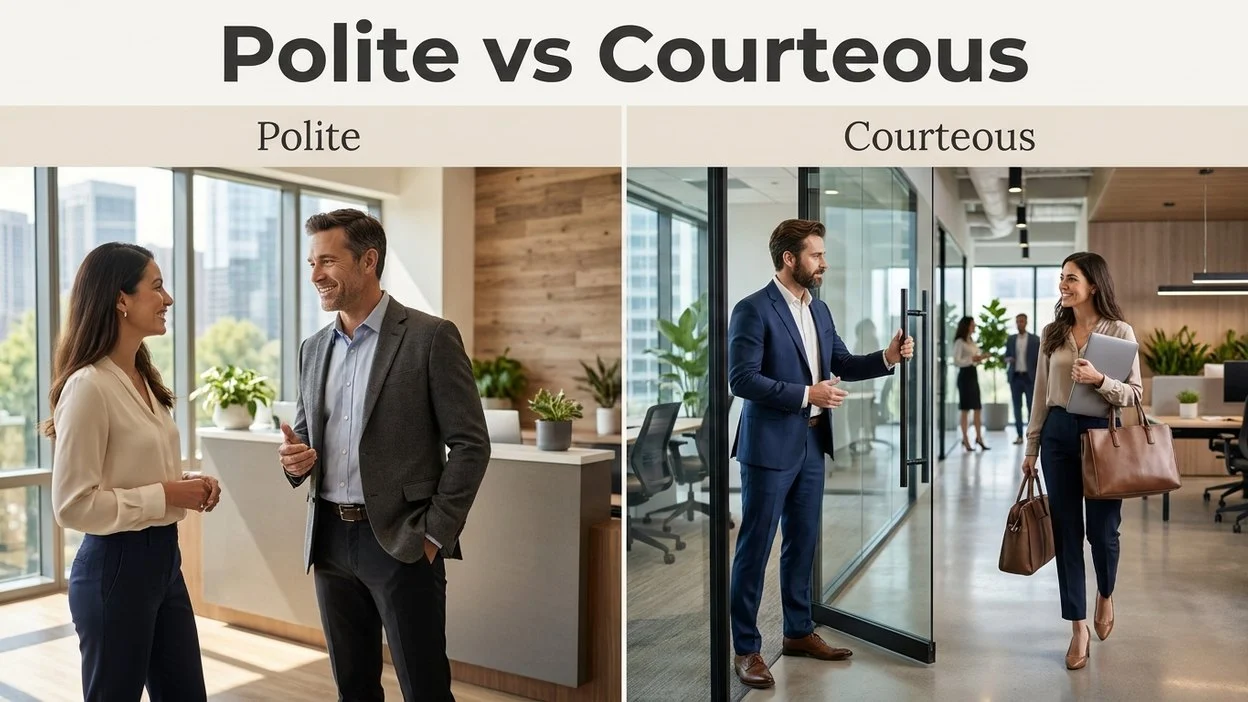
The main difference between polite and courteous is that polite describes behavior that follows accepted social manners and shows respect, while courteous emphasizes actively showing consideration, kindness, and respect toward others. For example, saying “please” and “thank you” is polite, while holding a door open for someone carrying heavy bags is courteous. Both words describe good manners, but each highlights a slightly different aspect of respectful behavior.
Quick Answer: Polite vs Courteous
Polite means showing good manners and following social expectations, such as saying “please,” “thank you,” and “excuse me.” Courteous means showing consideration, respect, and thoughtfulness toward other people through your actions. Both words describe respectful behavior, but courteous often emphasizes active consideration for others.
Why Do People Confuse Polite and Courteous?
People often confuse these words because they share similar meanings and are used in many of the same situations.
For example:
- She was polite to the guests.
- She was courteous to the guests.
Both sentences are grammatically correct and describe respectful behavior. However, the emphasis can be slightly different.
When someone is polite, they generally behave according to accepted rules of good manners. They may use respectful language, avoid interrupting, and greet people appropriately.
When someone is courteous, they show consideration for another person’s comfort, feelings, or needs. Their behavior often involves thoughtful actions rather than simply following social rules.
Here are the main distinctions:
- Polite: Focuses on good manners, respectful language, and appropriate social behavior.
- Courteous: Focuses on thoughtfulness, consideration, and respectful treatment of others.
- Both: Can describe someone who behaves respectfully and treats people well.
The difference is not absolute. A person can be both polite and courteous at the same time.
What Does Polite Mean?
Polite is an adjective that describes someone who behaves respectfully and follows accepted standards of good manners.
A polite person understands how to communicate appropriately in different situations. They use respectful words, listen when others speak, and avoid behavior that might offend or embarrass someone.
Politeness is especially important in everyday conversations, workplaces, schools, and social gatherings.
Examples of Polite
- Please close the window.
- Thank you for helping me.
- Excuse me, could you tell me the time?
- He was polite to his teacher.
- She always speaks politely to customers.
In these examples, politeness involves using respectful language and following common social expectations.
Characteristics of a Polite Person
A polite person often:
- Says please and thank you.
- Greets people respectfully.
- Avoids interrupting others.
- Uses appropriate language.
- Listens when someone is speaking.
- Apologizes when necessary.
- Respects personal boundaries.
When Is Polite Used?
The word polite is commonly used when discussing manners, communication, and social behavior.
For example:
- Everyday conversations: “Please give me a moment.”
- Professional communication: “Thank you for your quick response.”
- School environments: “The students were polite to their teachers.”
- Social situations: “It is polite to greet your guests when they arrive.”
Politeness helps people communicate respectfully and maintain positive relationships.
What Does Courteous Mean?
Courteous is an adjective that describes someone who shows respect, kindness, and consideration toward other people.
A courteous person thinks about how their behavior affects others. They make an effort to be helpful, considerate, and respectful, even when they are busy or dealing with difficult situations.
For example, offering your seat to an elderly passenger on a crowded bus is courteous because you are considering another person’s comfort.
Examples of Courteous
- The receptionist was courteous to every visitor.
- He offered his seat to an elderly woman.
- The driver was courteous and allowed pedestrians to cross.
- She gave a courteous response to the customer.
- The staff treated everyone in a courteous manner.
These examples show that courteous behavior often involves thoughtful actions and consideration for other people.
Characteristics of a Courteous Person
A courteous person often:
- Offers help when someone needs it.
- Respects other people’s time.
- Holds doors open for others.
- Gives people their full attention.
- Considers other people’s feelings.
- Avoids unnecessary inconvenience.
- Treats strangers with kindness.
When Is Courteous Used?
The word courteous is often used in situations where consideration and respectful treatment are important.
For example:
- Customer service: “The employee was courteous throughout the conversation.”
- Public behavior: “The driver was courteous to other road users.”
- Professional settings: “Please remain courteous during the meeting.”
- Everyday kindness: “She was courteous enough to help her neighbor.”
Courteous behavior helps create a comfortable and respectful environment for everyone.
Polite vs Courteous: Comparison Table
Although both words describe good behavior, they have slightly different focuses.
| Feature | Polite | Courteous |
|---|---|---|
| Meaning | Showing good manners | Showing consideration and respect |
| Main focus | Social etiquette | Thoughtfulness toward others |
| Behavior | Respectful language and manners | Considerate words and actions |
| Common example | Saying “please” | Offering someone your seat |
| Tone | Respectful and well-mannered | Respectful and considerate |
| Usage | Everyday conversations | Social and professional situations |
| Part of speech | Adjective | Adjective |
| Adverb form | Politely | Courteously |
| Opposite | Impolite or rude | Discourteous or inconsiderate |
The easiest way to remember: Polite behavior follows good manners, while courteous behavior demonstrates consideration for other people.
When Should You Use Polite vs Courteous?
Choosing between these words depends on what you want to communicate.
Use Polite When Talking About Good Manners
Choose polite when describing respectful language, social etiquette, or appropriate behavior.
Examples:
- It is polite to say thank you after receiving a gift.
- Please be polite when speaking to your classmates.
- He wrote a polite email to his manager.
- The children were polite during dinner.
In these situations, the focus is on manners and respectful communication.
Use Courteous When Talking About Consideration
Choose courteous when describing thoughtful behavior that shows concern for another person’s comfort or needs.
Examples:
- The hotel staff were courteous to the guests.
- She was courteous enough to wait for everyone before starting.
- The driver showed courteous behavior toward pedestrians.
- He gave his colleague a courteous reply.
Here, the emphasis is on consideration and respectful treatment.
Can You Use Both Words in the Same Sentence?
Yes! Both words can appear together when you want to emphasize good manners and thoughtful behavior.
For example:
“She was polite in her conversation and courteous in her actions.”
This sentence suggests that she used respectful language and also considered other people’s needs.
15 Examples of Polite vs Courteous in Sentences
Learning through examples is one of the easiest ways to understand the difference between these words.
Examples Using Polite
- It is always polite to say thank you when someone helps you.
- My brother is polite to everyone he meets.
- The student gave a polite answer to the teacher.
- She sent a polite message asking for more information.
- Please be polite when speaking to older people.
- He politely declined the invitation.
- The receptionist greeted every visitor with a polite smile.
- It would be polite to introduce yourself before joining the conversation.
Examples Using Courteous
- The hotel employee was courteous to every guest.
- He was courteous enough to hold the door open for me.
- The driver showed courteous behavior on the busy road.
- She gave a courteous response even though she disagreed.
- The company is known for its courteous customer service.
- Please be courteous to other people waiting in line.
- The neighbors were courteous and helped us carry our furniture.
Examples Using Both Words
- A polite person uses respectful language, while a courteous person also considers other people’s comfort.
- The receptionist was both polite and courteous throughout the meeting.
- Good customer service requires polite communication and courteous treatment.
Common Mistakes When Using Polite and Courteous
Even though these words have similar meanings, learners sometimes use them incorrectly.
Here are some mistakes to avoid.
1. Assuming Both Words Have Exactly the Same Meaning
Although they are similar, they emphasize different aspects of behavior.
Incorrect understanding: Polite and courteous always mean precisely the same thing.
Better understanding: Polite emphasizes manners, while courteous emphasizes consideration.
2. Using Courteous When You Mean Simply Well-Mannered
For example:
“She is a polite student who always says please.”
This is a natural sentence because it focuses on good manners.
You could also say “She is a courteous student,” but that would place more emphasis on her considerate behavior.
3. Confusing Adjectives and Adverbs
Both words have adverb forms.
- Polite → Politely
- Courteous → Courteously
Correct examples:
- She spoke politely to her teacher.
- He courteously offered his assistance.
Avoid using “polite” or “courteous” when an adverb is needed to describe how someone performs an action.
4. Thinking Courteous Is Only Used in Formal Situations
Courteous is common in professional and formal communication, but it can also describe everyday actions.
For example:
“He was courteous enough to let me go first.”
This is a natural example of courteous behavior in an ordinary situation.
5. Thinking Politeness Always Means Genuine Kindness
Someone can follow social manners without genuinely caring about another person’s feelings.
For example, a person might say “please” and “thank you” but still refuse to consider how their actions affect others.
This is why courtesy often carries a stronger emphasis on consideration.
Memory Trick: How to Remember Polite vs Courteous
Here is a simple way to remember the difference:
Polite = Proper Manners
Think about words such as:
- Please
- Thank you
- Excuse me
- Sorry
These expressions demonstrate politeness.
Courteous = Consider Other People
Think about actions such as:
- Holding a door open.
- Offering someone your seat.
- Helping someone carry their bags.
- Respecting another person’s time.
These actions demonstrate courtesy.
Easy Memory Sentence
“Be polite with your words and courteous with your actions.”
This sentence is a simple reminder that both qualities are important in everyday life.
Polite vs Courteous in American and British English
Both polite and courteous are standard English words used in American and British English.
Their spelling and basic meanings remain the same in both varieties.
| Usage | American English | British English |
|---|---|---|
| Polite | Common | Common |
| Courteous | Common | Common |
| Politely | Common | Common |
| Courteously | Common | Common |
| Meaning | Respectful manners | Respectful manners |
There is no important spelling difference between American and British English for these words.
Both varieties use polite for good manners and courteous for considerate, respectful behavior.
Similar Words Related to Polite and Courteous
Several English words have meanings similar to polite and courteous. However, each has its own shade of meaning.
| Word | Meaning | Example |
|---|---|---|
| Respectful | Showing respect for others | He was respectful toward his teacher. |
| Civil | Showing basic politeness | They remained civil during the discussion. |
| Well-mannered | Having good manners | The children were well-mannered. |
| Considerate | Thinking about other people’s needs | She is considerate of others. |
| Gracious | Showing kindness and good manners | He gave a gracious response. |
| Tactful | Communicating without upsetting others unnecessarily | She handled the situation tactfully. |
| Thoughtful | Showing care and attention | That was a thoughtful gesture. |
| Diplomatic | Handling sensitive situations carefully | He gave a diplomatic answer. |
What Is the Opposite of Polite?
The most common opposite of polite is impolite.
Other related opposites include:
- Rude
- Disrespectful
- Ill-mannered
- Uncivil
Example: “It is impolite to interrupt someone while they are speaking.”
What Is the Opposite of Courteous?
The opposite of courteous is discourteous.
Other related words include:
- Inconsiderate
- Rude
- Thoughtless
- Disrespectful
Example: “It was discourteous to ignore the other guests.”
Final Verdict: Is Polite or Courteous the Better Word?
Neither word is better in every situation. The right choice depends on the meaning you want to express.
Use polite when you are talking about good manners, respectful language, and appropriate social behavior. For example, saying “please” when asking for something is polite.
Use courteous when you want to emphasize thoughtfulness, consideration, and respect for other people’s needs. For example, offering your seat to someone who needs it is courteous.
Both words describe positive behavior and can often be used in similar situations. However, understanding their subtle difference will help you communicate more naturally and accurately.
Frequently Asked Questions (FAQs)
1. Are Polite and Courteous the Same Thing?
Polite and courteous have similar meanings, but they are not exactly the same. Polite emphasizes good manners and respectful communication, while courteous emphasizes consideration and thoughtfulness toward others. Both words describe respectful behavior.
2. Is Courteous More Formal Than Polite?
Courteous can sound slightly more formal or professional than polite in some situations. However, both words are appropriate in everyday and professional English. The difference depends more on context than on formality.
3. Can a Person Be Polite but Not Courteous?
Yes. Someone can use respectful language and follow social rules without showing much consideration for other people’s needs. For example, a person might say “please” and “thank you” but refuse to help someone who needs assistance.
4. What Is Another Word for Polite and Courteous?
Words such as respectful, considerate, well-mannered, civil, and gracious are related to both terms. The best alternative depends on the context and the specific quality you want to describe.
5. Is It Correct to Say Both Polite and Courteous?
Yes. Both adjectives can be used together to emphasize different aspects of respectful behavior.
Example: “The hotel staff were polite and courteous to all their guests.”
6. What Is the Adverb of Polite and Courteous?
The adverb forms are:
- Polite → Politely
- Courteous → Courteously
Examples:
- She politely asked for directions.
- He courteously offered to help.
7. Which Is Better for Professional Communication: Polite or Courteous?
Both are suitable for professional communication. Use polite when discussing respectful language and courteous when emphasizing thoughtful treatment of colleagues, customers, or clients.
Remember This
- Polite means showing good manners and using respectful language.
- Courteous means showing consideration and respect for other people’s needs.
- Saying “please” and “thank you” is polite.
- Holding a door open for someone is courteous.
- Both words are adjectives.
- Both words are commonly used in American and British English.
- A person can be both polite and courteous.
Conclusion
Understanding the difference between polite and courteous makes your English clearer and more natural. Although both words describe respectful behavior, polite focuses more on good manners, while courteous highlights consideration and thoughtfulness. Knowing when to use each word helps you communicate appropriately in everyday conversations, school, and professional environments.
The easiest way to remember the difference is to think of politeness as following good manners and courtesy as considering other people. Both qualities are important for building positive relationships and creating a respectful environment. When possible, aim to be both polite and courteous in your words and actions.

Mason Blake specializes in educational writing, focusing on vocabulary, grammar, and language improvement. His articles simplify complex topics, making learning enjoyable for students, writers, and English learners everywhere.