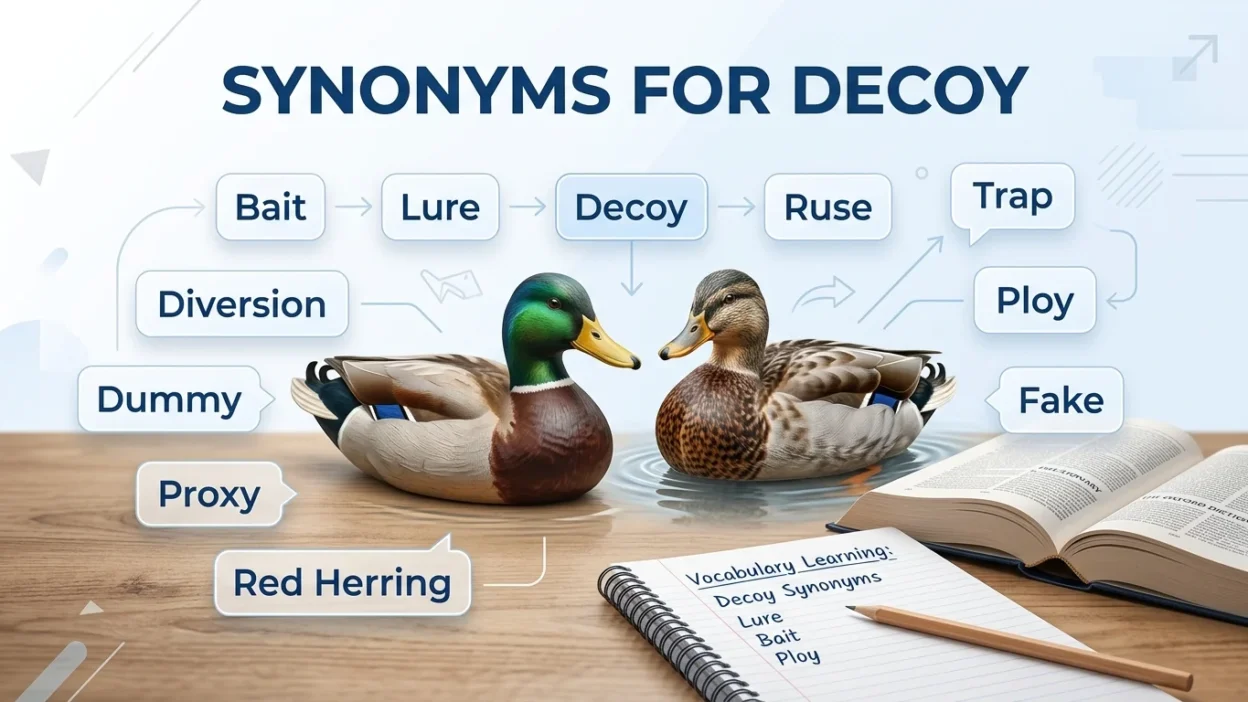
The phrase “synonyms for decoy” is useful for anyone who wants to speak and write more clearly. A decoy is something used to trick, distract, attract, or mislead someone. It can be a person, object, animal, plan, or message that hides the real target or purpose.
This topic matters because the word decoy appears in many kinds of writing, including stories, news, games, security, hunting, and business. If you know different synonyms, you can choose the best word for your meaning. That helps you sound more natural, more precise, and more confident.
In simple English, a decoy is something that looks real but is meant to pull attention away from the truth or the main target. Sometimes it is used to protect someone. Sometimes it is used to trick someone. The best word depends on the tone and situation.
What Does “Decoy” Mean?
A decoy is a fake or distracting thing that helps hide the real thing.
For example:
- A decoy bird may attract other birds.
- A decoy plan may distract attention from the real plan.
- A decoy person may help protect a valuable target.
So when people search for synonyms for decoy, they often want words that show:
- tricking
- distracting
- hiding
- replacing
- attracting
- misleading
30 Synonyms for Decoy
1. Bait
Meaning: Something used to attract or trap someone or something.
Example sentence: The fisherman used bait to catch the fish.
Best usage context: Fishing, traps, marketing, and simple everyday writing.
2. Lure
Meaning: Something that attracts people or animals.
Example sentence: The shiny object was a lure for birds.
Best usage context: Nature, hunting, advertising, and general use.
3. Trap
Meaning: A device or plan used to catch or trick someone.
Example sentence: The hunter set a trap in the forest.
Best usage context: Physical capture, danger, and trick situations.
4. Snare
Meaning: A hidden trap used to catch animals or people.
Example sentence: The rabbit walked into a snare.
Best usage context: Hunting, storytelling, and older or formal writing.
5. Dummy
Meaning: A fake object made to look real.
Example sentence: The army used a dummy tank to confuse enemies.
Best usage context: Military, training, and fake object situations.
6. Replica
Meaning: A copy of the real thing.
Example sentence: The museum displayed a replica of the statue.
Best usage context: Copies, models, displays, and educational use.
7. Imitation
Meaning: Something made to look like the real thing.
Example sentence: The shop sold imitation jewelry.
Best usage context: Products, fashion, and fake versions of items.
8. Fake
Meaning: Not real; made to deceive.
Example sentence: He wore a fake beard to hide his face.
Best usage context: Simple writing, informal speech, and direct meaning.
9. Sham
Meaning: Something that is false or not genuine.
Example sentence: The meeting was a sham and solved nothing.
Best usage context: Formal criticism, honesty, and serious writing.
10. Hoax
Meaning: A trick meant to make people believe something false.
Example sentence: The rumor turned out to be a hoax.
Best usage context: News, jokes, scams, and false claims.
11. Ruse
Meaning: A clever trick or plan used to deceive.
Example sentence: The escape was planned as a ruse.
Best usage context: Stories, strategy, and formal or literary writing.
12. Feint
Meaning: A fake move meant to mislead.
Example sentence: The boxer made a feint and then struck quickly.
Best usage context: Sports, combat, and strategy writing.
13. Misdirection
Meaning: The act of guiding attention away from the real thing.
Example sentence: The magician used misdirection to hide the trick.
Best usage context: Magic, performance, security, and planning.
14. Diversion
Meaning: Something that takes attention away from the main target.
Example sentence: The loud noise was a diversion for the escape.
Best usage context: Strategy, security, and simple explanation of distraction.
15. Distraction
Meaning: Something that pulls attention away from what matters.
Example sentence: The bright lights were a distraction.
Best usage context: Everyday English, school, work, and general use.
16. Red Herring
Meaning: A clue or idea that misleads people away from the truth.
Example sentence: The detective realized it was a red herring.
Best usage context: Mystery stories, analysis, and discussions.
17. Stand in
Meaning: A person or thing used instead of the real one.
Example sentence: The actor used a stand in for the scene.
Best usage context: Film, theater, work, and substitute roles.
18. Substitute
Meaning: A replacement for something else.
Example sentence: Salt was used as a substitute for seasoning.
Best usage context: General replacement, school, sports, and daily life.
19. Proxy
Meaning: Someone or something acting for another person.
Example sentence: The proxy attended the meeting in her place.
Best usage context: Business, law, politics, and formal situations.
20. Surrogate
Meaning: A replacement that acts in place of the original.
Example sentence: The company used a surrogate speaker for the event.
Best usage context: Formal writing, legal use, and official settings.
21. Double
Meaning: A person who looks like another person.
Example sentence: The actor used a body double in the action scene.
Best usage context: Film, security, and disguise situations.
22. Plant
Meaning: Something or someone placed secretly to trick others.
Example sentence: The spy was a plant inside the group.
Best usage context: Spy stories, secret plans, and investigative writing.
23. Cover
Meaning: Protection or hiding that hides the real purpose.
Example sentence: The story was used as cover for the escape.
Best usage context: Secret plans, military writing, and disguise.
24. Cover Story
Meaning: A fake explanation used to hide the truth.
Example sentence: He gave a cover story for being late.
Best usage context: Secrets, travel, police stories, and informal speech.
25. Mask
Meaning: Something that hides the real face or truth.
Example sentence: The joke was a mask for his anger.
Best usage context: Emotional expression, disguise, and symbolic writing.
26. Veil
Meaning: Something that hides or covers the truth.
Example sentence: The report placed a veil over the real problem.
Best usage context: Formal writing, symbolic meaning, and mystery.
27. Bogey
Meaning: A scare object or false threat used to frighten or distract.
Example sentence: The legend of the bogey kept children away.
Best usage context: Folklore, old stories, and warning language.
28. Phantom
Meaning: Something that seems real but is not.
Example sentence: The team chased a phantom target.
Best usage context: Mystery, fiction, and abstract writing.
29. Ploy
Meaning: A smart trick used to gain an advantage.
Example sentence: His apology was just a ploy to win trust.
Best usage context: Strategy, business, politics, and argument writing.
30. Artifice
Meaning: A clever but often dishonest trick.
Example sentence: The speech was full of artifice.
Best usage context: Formal, literary, and critical writing.
Comparison Guide: Which Word Should You Use?
| Word | Best For | Tone |
| Bait | Attracting or trapping | Simple |
| Lure | Drawing attention | Natural |
| Trap | Catching or tricking | Direct |
| Dummy | Fake object | Clear |
| Replica | Exact copy | Neutral |
| Hoax | False event or story | Strong |
| Ruse | Clever trick | Formal |
| Feint | Fake move in action | Strategic |
| Diversion | Pulling attention away | Neutral |
| Red Herring | Misleading clue | Literary |
| Stand in | Replacement person | Everyday |
| Proxy | Acting for another | Formal |
| Cover Story | Fake explanation | Informal |
| Ploy | Smart trick | Slightly negative |
How to Choose the Right Synonym
Choosing the right synonym depends on your purpose, tone, and situation.
Use simple words for easy writing
Use words like bait, fake, trap, lure, and distraction when you want clear, easy English. These are best for students, beginners, and everyday writing.
Use formal words for serious writing
Use words like proxy, surrogate, artifice, sham, and ruse in formal essays, articles, or professional writing. These words sound more advanced and precise.
Use story words for creative writing
Use words like red herring, phantom, bogey, ploy, and feint in fiction, mystery, or suspense writing. These words add drama and tension.
Use replacement words when one thing stands for another
Use stand in, substitute, proxy, and double when the idea is not about tricking, but about replacing something or someone.
Quick Summary of the Best Synonyms
If you want the easiest options, start with:
- bait
- lure
- trap
- dummy
- distraction
- fake
If you want more formal or advanced words, try:
- ruse
- proxy
- surrogate
- artifice
- red herring
Conclusion
The phrase synonyms for decoy includes many useful words, and each one has a slightly different meaning. Some words focus on tricking, some on attracting, and others on replacing or hiding. That is why it is important to understand the context before choosing a synonym.
For simple English, words like bait, lure, fake, trap, and distraction are easy and useful. For more advanced writing, words like ruse, proxy, red herring, and artifice can make your writing stronger and more precise.
When you understand these differences, you can write better, speak more clearly, and choose the best word for any situation.

Charles Cody is a talented author recognized for engaging storytelling, memorable characters, and imaginative plots. His books inspire readers through creativity, emotional depth, and meaningful literary experiences worldwide.