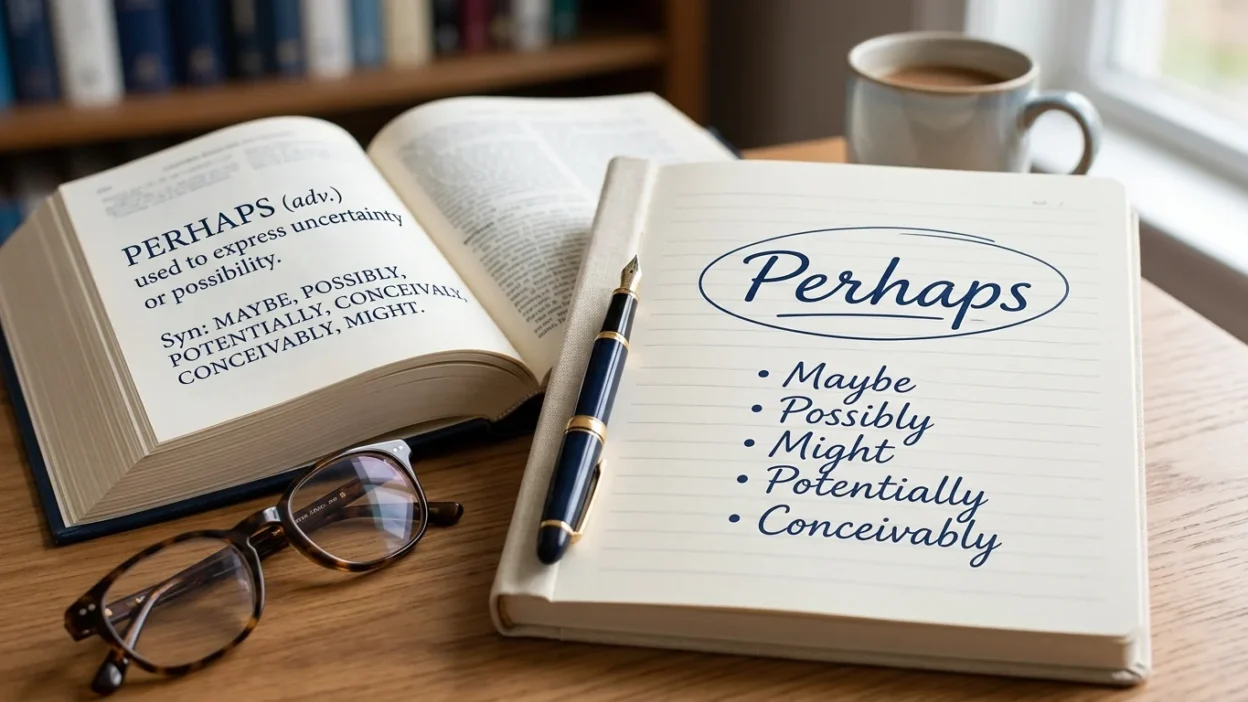
If you are looking for synonyms of perhaps, you may want different ways to express uncertainty, possibility, or a suggestion. The word “perhaps” is common in English, but using alternatives can make your writing more natural, varied, and precise.
Understanding these alternatives is especially useful for students, ESL learners, writers, and content creators. Some synonyms sound formal, while others are casual and conversational. Choosing the right one depends on the situation and the level of certainty you want to express.
What Does “Perhaps” Mean?
Perhaps means maybe or possibly. We use it when something is possible but not certain.
For example:
Perhaps we will visit the museum tomorrow.
This means that visiting the museum is possible, but the speaker is not completely sure.
“Perhaps” can also make a suggestion sound polite or less direct:
Perhaps you should check your answer again.
The tone is usually neutral, polite, and slightly formal. In everyday conversation, “maybe” is often more common.
30 Synonyms of Perhaps
1. Maybe
Meaning: Something may happen or may be true, but you are not certain.
Example sentence: Maybe I will call you later.
Best usage context: Very common in everyday conversation and informal writing.
2. Possibly
Meaning: Something could happen or could be true.
Example sentence: She could possibly arrive before noon.
Best usage context: Neutral to formal writing when discussing possibilities.
3. Possibly So
Meaning: It may be true or correct.
Example sentence: Is he the new manager? Possibly so.
Best usage context: Conversations and responses where you want to show uncertainty.
4. Conceivably
Meaning: Something is possible, even if it is not very likely.
Example sentence: Conceivably, the project could finish ahead of schedule.
Best usage context: Formal, academic, or analytical writing.
5. It May Be
Meaning: There is a possibility that something is true or will happen.
Example sentence: It may be difficult to complete the task today.
Best usage context: Formal and neutral writing.
6. It Might Be
Meaning: Something could be true or possible.
Example sentence: It might be the right solution.
Best usage context: Everyday speech and general writing.
7. Could Be
Meaning: Something is possible but uncertain.
Example sentence: That could be the reason for the delay.
Best usage context: Casual and neutral communication.
8. Might
Meaning: There is a possibility that something will happen or is true.
Example sentence: We might go to the beach this weekend.
Best usage context: Everyday English and informal writing.
9. It Is Possible
Meaning: Something can happen or may be true.
Example sentence: It is possible that prices will increase next year.
Best usage context: Formal, academic, and professional writing.
10. Potentially
Meaning: Something could happen or develop under certain conditions.
Example sentence: This idea could potentially save the company money.
Best usage context: Business, academic, technical, and professional writing.
11. In All Likelihood
Meaning: Something is probably true or likely to happen.
Example sentence: In all likelihood, the meeting will end early.
Best usage context: Formal writing when the possibility is fairly strong.
12. In Some Cases
Meaning: Something may happen or apply in certain situations.
Example sentence: In some cases, this method may produce better results.
Best usage context: Academic, technical, and explanatory writing.
13. At Times
Meaning: Sometimes or on certain occasions.
Example sentence: At times, the process can be difficult.
Best usage context: General writing when referring to occasional situations rather than a single uncertain event.
14. On the Off Chance
Meaning: Because something is possible, although unlikely.
Example sentence: Take an umbrella on the off chance that it rains.
Best usage context: Informal and conversational English.
15. By Any Chance
Meaning: Used when asking whether something might be true or possible.
Example sentence: By any chance, do you know where Sarah is?
Best usage context: Polite questions and casual conversation.
16. For All I Know
Meaning: Something may be true because you do not have enough information to know.
Example sentence: For all I know, they may have already left.
Best usage context: Informal conversation.
17. For All We Know
Meaning: Something is possible because there is not enough information to rule it out.
Example sentence: For all we know, the train could already be here.
Best usage context: Conversation and informal writing.
18. As It May Be
Meaning: Something may be the case or may apply.
Example sentence: The problem, as it may be, requires further investigation.
Best usage context: Formal or literary contexts; less common in everyday English.
19. Perhaps So
Meaning: Used to agree that something may be true without confirming it.
Example sentence: “Maybe he forgot.” “Perhaps so.”
Best usage context: Polite conversations and slightly formal responses.
20. Maybe So
Meaning: Something might be true.
Example sentence: “Do you think she knows?” “Maybe so.”
Best usage context: Informal conversation.
21. It Could Be
Meaning: Something is one possible explanation or answer.
Example sentence: It could be that the weather caused the delay.
Best usage context: Everyday and analytical conversations.
22. There Is a Chance
Meaning: Something has some possibility of happening.
Example sentence: There is a chance that we will win.
Best usage context: General conversation, business, and informative writing.
23. There Is a Possibility
Meaning: Something might happen or be true.
Example sentence: There is a possibility that the event will be postponed.
Best usage context: Formal, academic, and professional writing.
24. It Is Likely
Meaning: Something probably will happen or is probably true.
Example sentence: It is likely that demand will increase.
Best usage context: Formal and professional writing when certainty is relatively high.
25. In Some Possibility
Meaning: Intended to express that something could potentially happen.
Example sentence: The plan could, in some possibility, work.
Best usage context: Rare and unnatural in standard English. Prefer “possibly” or “there is a possibility.”
26. Potentially
Meaning: Something has the ability or possibility to happen.
Example sentence: The new strategy could potentially improve productivity.
Best usage context: Professional, academic, and technical contexts.
27. Perhaps Not
Meaning: Something may not be true or may not happen.
Example sentence: Perhaps not everyone will agree with the decision.
Best usage context: Neutral and polite English.
28. Maybe Not
Meaning: Something might not be true or might not happen.
Example sentence: Maybe not everyone understood the instructions.
Best usage context: Casual conversation and informal writing.
29. Who Knows?
Meaning: Used to say that something is uncertain or impossible to know.
Example sentence: Who knows? Maybe they will change their plans.
Best usage context: Informal and conversational English.
30. For All We Can Tell
Meaning: Based on the information available, something remains possible.
Example sentence: For all we can tell, the problem may have started yesterday.
Best usage context: Analytical or explanatory writing and careful conversation.
Comparison Table: Synonyms of Perhaps
| Synonym | Tone | Certainty | Best Use |
| Maybe | Casual | Low | Everyday conversation |
| Possibly | Neutral/Formal | Low | General and formal writing |
| Might | Neutral | Low | Everyday English |
| Could be | Neutral | Low | Conversation and explanations |
| Conceivably | Formal | Low | Academic writing |
| Potentially | Formal | Medium/Low | Professional writing |
| It is possible | Formal | Low | Academic writing |
| There is a chance | Neutral | Medium | General communication |
| It is likely | Formal | Higher | Professional writing |
| By any chance | Casual/Polite | Low | Questions |
| Who knows? | Casual | Very uncertain | Conversation |
| In all likelihood | Formal | High | Formal analysis |
Perhaps vs. Maybe
“Perhaps” and “maybe” are among the closest alternatives.
Perhaps often sounds a little more polished or formal:
Perhaps we should wait.
Maybe sounds more natural in casual conversation:
Maybe we should wait.
Both communicate uncertainty, but the choice depends on the situation.
Perhaps vs. Possibly
“Possibly” is another close synonym, but it can sound more analytical or formal.
Perhaps she is busy.
She is possibly busy.
The first sentence sounds more natural in ordinary conversation. The second can sound more cautious or formal.
Perhaps vs. Might
“Might” is a modal verb rather than a direct adverbial synonym.
Perhaps he will come tomorrow.
He might come tomorrow.
Both express possibility. “Might” often fits naturally into sentences where you are describing a possible future action.
Perhaps vs. Probably
These words should not always be treated as exact synonyms.
Perhaps means something is possible.
Probably means something is more likely than not.
Compare:
Perhaps it will rain.
This means rain is possible.
It will probably rain.
This suggests that rain is fairly likely.
Understanding this difference helps you express the correct level of certainty.
How to Choose the Right Synonym
The best synonym depends on your tone, audience, and level of certainty.
For Casual Conversation
Use:
- Maybe
- Might
- Could be
- Maybe so
- Who knows?
- By any chance
These options sound natural when speaking with friends, classmates, or colleagues.
For Formal Writing
Use:
- Possibly
- Conceivably
- It is possible
- There is a possibility
- Potentially
- In all likelihood
These choices work well in academic papers, professional documents, reports, and formal discussions.
For Academic Writing
Academic writing often benefits from careful language that does not make unsupported claims.
Good choices include:
- Possibly
- Potentially
- Conceivably
- It is possible that
- There is a possibility that
- It is likely that
For example:
This difference may potentially affect the final results.
However, avoid using too many uncertainty words in one sentence.
For Polite Suggestions
“Perhaps” itself works very well when making suggestions politely.
For example:
Perhaps you could review the report once more.
You can also use:
Maybe you could review the report once more.
The first sounds slightly more polished, while the second is more conversational.
When You Want Stronger Possibility
If you believe something is more likely, use expressions such as:
- It is likely
- In all likelihood
- There is a good chance
For example:
In all likelihood, the company will announce the results tomorrow.
This communicates stronger confidence than “perhaps.”
Common Mistakes When Using Synonyms of Perhaps
Using Formal Words in Casual Situations
Words like conceivably can sound unnatural in simple conversations.
Instead of:
Conceivably, we could go for dinner tonight.
Maybe we could go for dinner tonight.
Treating “Probably” as Exactly the Same
“Probably” suggests greater confidence than “perhaps.”
If you are only saying something is possible, “perhaps,” “maybe,” or “possibly” is usually better.
Using Awkward Expressions
Some phrases may technically communicate possibility but are not natural modern English. For example, “in some possibility” is uncommon and should generally be avoided.
Use:
There is a possibility that…
or:
It is possible that…
instead.
Ignoring the Audience
A vocabulary choice should match your reader.
A blog post for beginners may benefit from maybe and possibly, while an academic paper may use potentially, conceivably, or it is possible that.
Why Learning Synonyms of Perhaps Matters
Learning different ways to express possibility can make your English more flexible.
Instead of repeating “perhaps” in every paragraph, you can choose words that communicate slightly different tones and levels of certainty.
For ESL learners, these distinctions are particularly valuable because English often uses different expressions depending on whether the situation is casual, professional, academic, polite, or highly uncertain.
For writers and content creators, varied vocabulary also makes sentences smoother and more engaging without relying on unnecessary complicated words.
Quick Guide
If you need a simple alternative to perhaps, use maybe.
If you need a formal alternative, use possibly.
If you want to describe potential, use potentially.
If you want to show a stronger possibility, use it is likely.
If you are making a polite suggestion, perhaps itself is often an excellent choice.
If you are asking a casual question, by any chance can sound natural.
If you want to emphasize uncertainty, who knows? works well in informal conversation.
Final Thoughts
The best synonyms of perhaps are not always interchangeable. Words such as maybe, possibly, might, potentially, conceivably, and it is possible all express possibility, but they differ in tone, structure, and level of formality.
For everyday English, maybe is usually the easiest choice. For formal or academic writing, possibly, potentially, conceivably, and there is a possibility can be more appropriate. When you want to express stronger confidence, phrases such as it is likely or in all likelihood are better.
The key is to choose the synonym that matches your meaning, audience, and level of certainty. Learning these distinctions will help you write more naturally, communicate more precisely, and build a stronger English vocabulary.

Mason Blake specializes in educational writing, focusing on vocabulary, grammar, and language improvement. His articles simplify complex topics, making learning enjoyable for students, writers, and English learners everywhere.