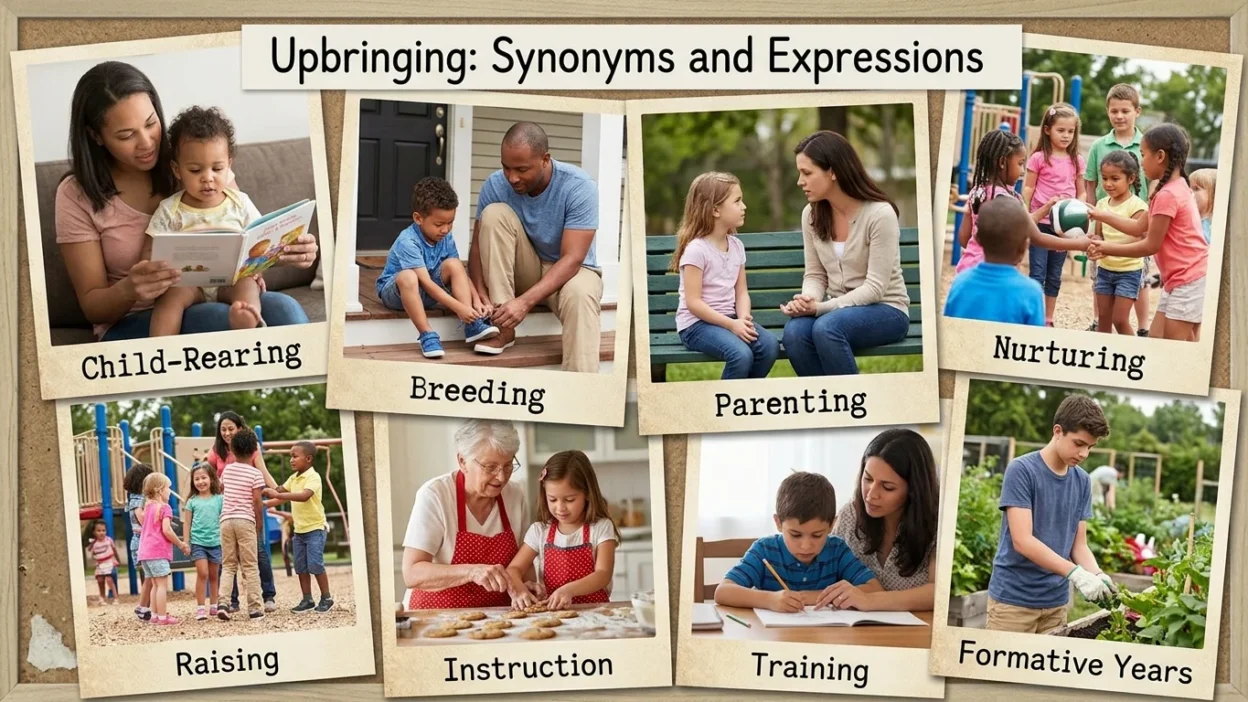
The word upbringing describes the way a person is raised during childhood, especially the influence of parents, family, education, values, rules, and surroundings. It can explain why someone develops certain habits, beliefs, manners, or attitudes.
Knowing different synonyms for upbringing can make your writing more precise and interesting. Instead of repeating “upbringing,” you can choose words such as childhood, rearing, nurture, or family environment, depending on what you want to describe.
For students, ESL learners, writers, and content creators, understanding these alternatives is useful because each word has a slightly different meaning and tone. Some focus on parenting, while others describe childhood experiences, education, or the environment in which someone grows up.
What Does Upbringing Mean?
Upbringing means the way a person is cared for, taught, guided, and influenced while growing up.
It usually includes:
- Parenting and family guidance
- Rules and discipline
- Education and learning
- Cultural and social values
- Childhood experiences
- Home environment
- Moral and social development
Example:
“Her strict upbringing taught her to be responsible and disciplined.”
The tone of upbringing is usually neutral. It can be used to describe positive, negative, strict, traditional, supportive, or unusual childhood experiences.
30 Synonyms for Upbringing
Below are 30 useful alternatives. Some are direct synonyms, while others are close alternatives that work better in specific contexts.
1. Rearing
Meaning: The process of caring for and raising a child until they become mature.
Example sentence:
“Child rearing requires patience, time, and understanding.”
Best usage context: Parenting, childcare, and formal writing.
2. Childhood
Meaning: The period of a person’s life when they are a child.
Example sentence:
“Her childhood was filled with happy memories.”
Best usage context: General discussions about someone’s early life.
3. Nurture
Meaning: The care, support, and encouragement that help a child develop.
Example sentence:
“Children need love and nurture to develop confidence.”
Best usage context: Emotional development and supportive parenting.
4. Parenting
Meaning: The activity of raising and caring for children.
Example sentence:
“Good parenting can help children develop strong social skills.”
Best usage context: Modern, everyday, and educational writing.
5. Child rearing
Meaning: The process of raising and teaching children.
Example sentence:
“Different cultures have different approaches to child rearing.”
Best usage context: Academic, family, and sociological discussions.
6. Education
Meaning: The process of teaching and developing a person’s knowledge, skills, and behavior.
Example sentence:
“His education at home strongly influenced his future career.”
Best usage context: When upbringing is mainly connected to learning and teaching.
7. Training
Meaning: The process of teaching someone how to behave or perform in a particular way.
Example sentence:
“Her early training taught her to respect others.”
Best usage context: Discipline, skills, behavior, and structured development.
8. Guidance
Meaning: Help or advice that directs a person toward appropriate behavior or decisions.
Example sentence:
“His parents provided valuable guidance during his teenage years.”
Best usage context: Supportive parenting and personal development.
9. Socialization
Meaning: The process through which children learn how to behave and interact within society.
Example sentence:
“Family plays an important role in early socialization.”
Best usage context: Psychology, sociology, education, and academic writing.
10. Conditioning
Meaning: The process through which repeated experiences or influences shape someone’s behavior or responses.
Example sentence:
“His strict childhood conditioning affected how he responded to authority.”
Best usage context: Psychology or situations involving strong behavioral influence.
11. Formation
Meaning: The process through which a person’s character, ideas, or personality develops.
Example sentence:
“Family experiences played an important role in the formation of her character.”
Best usage context: Character, personality, beliefs, and intellectual development.
12. Development
Meaning: The gradual process of growing and becoming more mature.
Example sentence:
“A supportive home can influence a child’s emotional development.”
Best usage context: Academic, educational, and psychological contexts.
13. Childhood Environment
Meaning: The physical, emotional, and social surroundings in which a child grows up.
Example sentence:
“A peaceful childhood environment helped him become confident.”
Best usage context: Psychology, education, and social discussions.
14. Family Environment
Meaning: The atmosphere, relationships, habits, and conditions within a family.
Example sentence:
“Her family environment encouraged curiosity and independence.”
Best usage context: Family relationships and personal development.
15. Home Life
Meaning: A person’s experiences and relationships within their home.
Example sentence:
“His difficult home life influenced his behavior at school.”
Best usage context: Informal writing and discussions about family experiences.
16. Family Background
Meaning: The family, circumstances, traditions, and experiences that a person comes from.
Example sentence:
“Her family background shaped many of her values.”
Best usage context: Personal history, culture, education, and social identity.
17. Childhood Experiences
Meaning: Events and situations that a person experiences while growing up.
Example sentence:
“Childhood experiences can have a lasting effect on personality.”
Best usage context: Psychology, personal stories, and reflective writing.
18. Early Life
Meaning: The early period of a person’s life, especially childhood and adolescence.
Example sentence:
“His early life was strongly influenced by his grandparents.”
Best usage context: Biographies and general descriptions of someone’s past.
19. Formative Years
Meaning: The early years when a person’s character, beliefs, and personality are developing.
Example sentence:
“She spent her formative years in a small coastal town.”
Best usage context: Formal writing, biographies, and personal development.
20. Childhood Background
Meaning: The circumstances, family situation, and experiences connected with someone’s childhood.
Example sentence:
“His childhood background helps explain his strong work ethic.”
Best usage context: Biographies, personal profiles, and explanations of behavior.
21. Family Upbringing
Meaning: The way a person’s family raised and influenced them.
Example sentence:
“Her family upbringing taught her to value honesty.”
Best usage context: When you specifically want to emphasize family influence.
22. Parental Guidance
Meaning: Advice, direction, and support provided by parents.
Example sentence:
“Children often benefit from parental guidance when making important decisions.”
Best usage context: Parenting, education, and child development.
23. Home Education
Meaning: Education provided to a child at home rather than mainly through a traditional school.
Example sentence:
“His home education gave him the freedom to study at his own pace.”
Best usage context: Homeschooling and educational discussions.
24. Care
Meaning: Protection, attention, and support given to another person.
Example sentence:
“The care she received during childhood made her feel secure.”
Best usage context: Emotional support and childcare.
25. Instruction
Meaning: Teaching or information given to help someone learn how to act or do something.
Example sentence:
“Early instruction helped the children understand the importance of good manners.”
Best usage context: Teaching, rules, manners, and formal contexts.
26. Mentoring
Meaning: Guidance and support provided by a more experienced person.
Example sentence:
“His grandfather’s mentoring had a major influence on his career.”
Best usage context: Personal development, education, and guidance beyond ordinary parenting.
27. Cultural Influence
Meaning: The effect that a person’s culture has on their beliefs, behavior, values, and traditions.
Example sentence:
“Her cultural influence was clearly visible in the way she celebrated holidays.”
Best usage context: Culture, traditions, identity, and sociology.
28. Moral Education
Meaning: Teaching people about values, ethics, responsibility, and right and wrong.
Example sentence:
“Moral education was an important part of his childhood.”
Best usage context: Ethics, values, schools, and family teaching.
29. Character Formation
Meaning: The process through which a person’s moral qualities, habits, and personality develop.
Example sentence:
“Family relationships are important in character formation.”
Best usage context: Formal, educational, philosophical, and psychological writing.
30. Early Conditioning
Meaning: The influence of repeated experiences and teachings during childhood that shape later behavior.
Example sentence:
“Early conditioning can affect how people respond to unfamiliar situations.”
Best usage context: Psychology and discussions about long term behavioral influence.
Quick Comparison of Synonyms for Upbringing
| Synonym | Main Focus | Tone | Example Use |
| Rearing | Raising children | Formal | Child rearing |
| Childhood | Time of life | Neutral | Happy childhood |
| Nurture | Care and support | Warm | Emotional nurture |
| Parenting | Raising children | Modern | Effective parenting |
| Child rearing | Raising and teaching | Formal | Child rearing practices |
| Education | Learning and teaching | Neutral/Formal | Early education |
| Guidance | Advice and direction | Positive | Parental guidance |
| Socialization | Learning social behavior | Academic | Childhood socialization |
| Family environment | Home atmosphere | Neutral | Supportive family environment |
| Home life | Daily family experience | Informal | Difficult home life |
| Family background | Family history | Neutral | Different family background |
| Formative years | Character development | Formal | During his formative years |
| Early life | Childhood period | Neutral | Her early life |
| Childhood experiences | Events while growing up | Neutral | Difficult childhood experiences |
| Moral education | Values and ethics | Formal | Moral education at home |
How to Choose the Right Synonym
Choosing the right alternative depends on what part of upbringing you want to emphasize.
When You Mean Raising a Child
Use:
- Rearing
- Parenting
- Child rearing
- Care
These words are best when discussing the practical process of raising children.
Example:
“Modern parenting requires patience and flexibility.”
When You Mean Childhood Experiences
Use:
- Childhood
- Early life
- Childhood experiences
- Formative years
These choices work well when talking about events and experiences from someone’s younger years.
Example:
“His formative years influenced his approach to leadership.”
When You Mean Family Influence
Use:
- Family environment
- Home life
- Family background
- Family upbringing
These expressions are useful when the family setting is the main reason for someone’s behavior or personality.
Example:
“Her family environment encouraged her to become independent.”
When You Mean Teaching and Learning
Use:
- Education
- Instruction
- Training
- Moral education
These words are better when upbringing involves teaching knowledge, skills, rules, manners, or values.
Example:
“His parents believed that moral education should begin early.”
When You Mean Social or Psychological Influence
Use:
- Socialization
- Conditioning
- Early conditioning
- Character formation
- Development
These terms are particularly useful in academic, psychological, and sociological writing.
Example:
“Early socialization can influence how children communicate with others.”
When You Mean Positive Support
Use:
- Nurture
- Guidance
- Care
- Mentoring
These words emphasize encouragement, protection, emotional support, and positive influence.
Example:
“Children thrive when they receive consistent care and guidance.”
Positive and Negative Alternatives
The word upbringing itself is neutral. The surrounding adjective or alternative can show whether the experience was positive or negative.
Positive Examples
- Supportive upbringing
- Loving upbringing
- Caring environment
- Positive childhood
- Nurturing home
- Strong parental guidance
- Healthy family environment
Example:
“She had a nurturing childhood that encouraged creativity.”
Negative Examples
- Strict upbringing
- Difficult childhood
- Troubled home life
- Harsh rearing
- Unstable family environment
- Negative childhood experiences
- Difficult formative years
Example:
“He experienced a difficult childhood but became a successful adult.”
Upbringing vs. Childhood
These words are related but not identical.
Childhood refers mainly to the period when someone is a child.
Upbringing refers to how that person was raised during that period.
Compare:
“She had a happy childhood.”
This tells us that her childhood was enjoyable.
“She had a supportive upbringing.”
This tells us that the way she was raised was supportive.
Therefore, childhood focuses on the time of life, while upbringing focuses more on the influence of parents, family, education, and environment.
Upbringing vs. Parenting
Parenting describes the actions and responsibilities involved in raising children.
Upbringing describes the overall influence and result of those experiences on a person.
For example:
“Good parenting can contribute to a positive upbringing.”
This sentence shows that parenting is one part of a person’s upbringing.
Upbringing vs. Rearing
Rearing is one of the closest formal alternatives to upbringing.
However, rearing often emphasizes the practical process of raising a child, while upbringing can include broader influences such as culture, education, family values, and social environment.
Example:
“Child rearing can be challenging.”
“His upbringing shaped his personality.”
Both are correct, but they emphasize different ideas.
Common Phrases With Upbringing
Learning common phrases can help ESL learners use the word naturally.
Good upbringing
Describes a positive and well guided childhood.
Example:
“His good upbringing taught him to treat everyone with respect.”
Strict upbringing
Describes childhood with many rules and strong discipline.
Example:
“She had a strict upbringing but appreciated the values she learned.”
Traditional upbringing
Describes a childhood strongly influenced by traditional values and customs.
Example:
“He had a traditional upbringing in a close knit family.”
Difficult upbringing
Describes childhood involving serious challenges or hardships.
Example:
“Despite his difficult upbringing, he remained optimistic.”
Supportive upbringing
Describes childhood with encouragement, care, and emotional support.
Example:
“A supportive upbringing can help children build confidence.”
Why Using Synonyms for Upbringing Improves Your Writing
Using the same word repeatedly can make an article or essay sound monotonous. However, replacing every occurrence with a synonym is not always a good idea.
The better approach is to select a word based on your exact meaning.
For example, instead of writing:
“Her upbringing influenced her values. Her upbringing also affected her confidence. Her upbringing shaped her personality.”
You could write:
“Her family environment influenced her values. Her childhood experiences also affected her confidence. Those formative years shaped her personality.”
The second version gives the reader more information while avoiding unnecessary repetition.
Final Takeaways
There are many useful synonyms for upbringing, but they are not all interchangeable in every sentence.
Use rearing or parenting when you mean the process of raising a child. Choose childhood or early life when you are talking about a period of someone’s life. Use family environment or home life when the family setting matters most.
For academic writing, terms such as socialization, conditioning, character formation, and development can provide greater precision. For warm and positive writing, nurture, care, and guidance are often better choices.
The most important rule is simple: choose the synonym that matches your intended meaning, tone, and context. This will make your English more natural, precise, and engaging.

Ethan Cross is a language enthusiast and content writer who creates practical vocabulary guides. He enjoys helping readers improve communication through clear explanations, engaging examples, and easy-to-understand educational resources.