
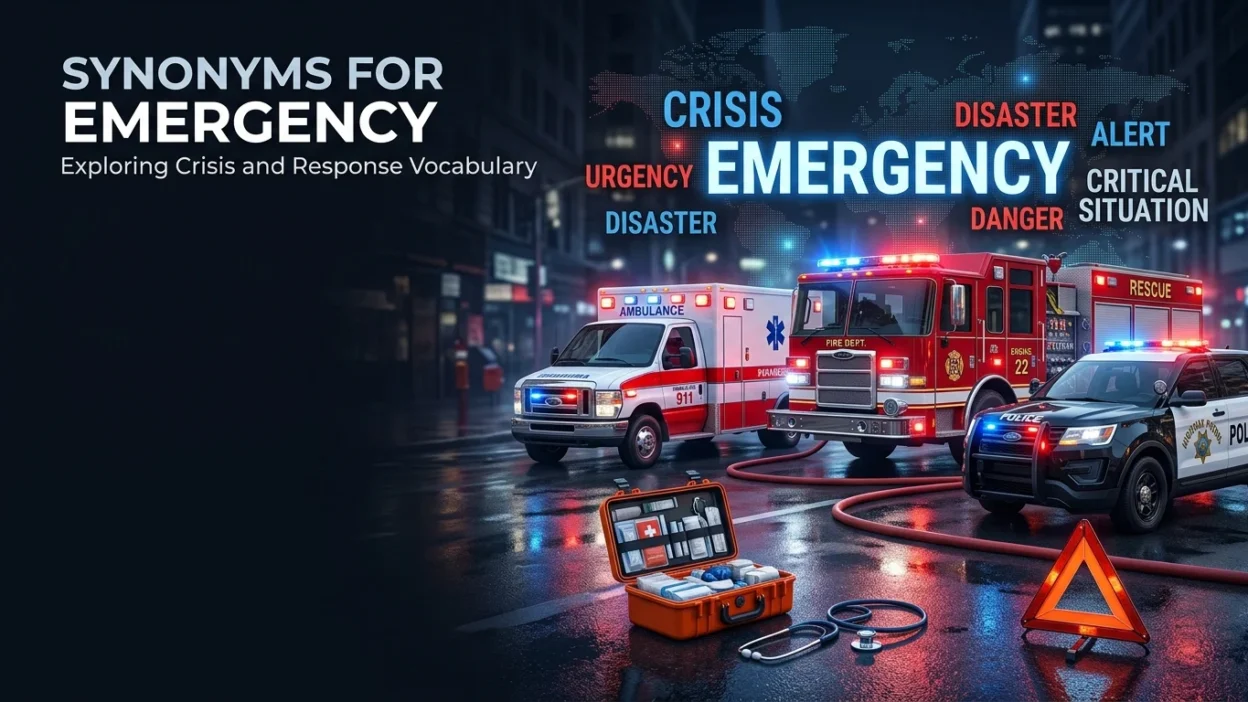
When people search for synonyms for emergency, they usually want words that mean a sudden, serious, and urgent situation. In daily life, an emergency can be something medical, a safety problem, a natural disaster, or any event that needs immediate action.
Learning different words for emergency is useful for students, ESL learners, writers, and content creators. It helps you speak and write more clearly, choose the right tone, and avoid repeating the same word again and again.
This guide gives you 30 beginner friendly synonyms and related words for emergency in simple English. You will also see examples, usage notes, a comparison table, and a short guide on how to choose the best word.
What Does “Emergency” Mean in Simple English?
An emergency is a sudden situation that is dangerous, serious, or needs fast action. It often means something unexpected has happened, and people must respond quickly.
For example, a fire, a medical problem, or an accident can all be emergencies. In writing, the word can sound formal, neutral, or serious depending on the sentence. That is why choosing the right synonym matters.
Some words are best for medical situations, some are better for formal writing, and some are used in everyday conversation. The right choice depends on your tone and context.
30 Synonyms for Emergency
1. Crisis
Meaning: A very serious and difficult situation.
Example sentence: The company faced a financial crisis after the storm.
Best usage context: Formal writing, news, business, and serious problems.
2. Urgent situation
Meaning: A situation that needs quick action.
Example sentence: The doctor said it was an urgent situation.
Best usage context: Daily speech, work, and health related cases.
3. Critical situation
Meaning: A very serious situation that may become worse fast.
Example sentence: The rescue team arrived during a critical situation.
Best usage context: Medical, safety, and official writing.
4. Disaster
Meaning: A very bad event that causes damage or harm.
Example sentence: The flood became a major disaster for the village.
Best usage context: Natural events, accidents, and large scale problems.
5. Catastrophe
Meaning: A huge and terrible disaster.
Example sentence: The plane crash was a national catastrophe.
Best usage context: Formal writing, reports, and strong dramatic language.
6. Calamity
Meaning: A serious event that causes great suffering.
Example sentence: The earthquake was a calamity for the whole region.
Best usage context: Formal, literary, and emotional writing.
7. Predicament
Meaning: A difficult situation that is hard to solve.
Example sentence: She was in a difficult predicament after missing the bus.
Best usage context: Everyday writing when the problem is serious but not always dangerous.
8. Trouble
Meaning: A problem or difficult situation.
Example sentence: He got into trouble when the car broke down.
Best usage context: Casual speech and simple writing.
9. Distress
Meaning: A state of worry, pain, or serious difficulty.
Example sentence: The passengers were in distress after the accident.
Best usage context: Medical, emotional, and formal contexts.
10. Danger
Meaning: A situation where harm may happen.
Example sentence: The warning sign showed danger ahead.
Best usage context: General use, safety signs, and simple communication.
11. Threat
Meaning: Something that may cause harm or danger.
Example sentence: The storm was a threat to nearby towns.
Best usage context: Security, safety, and formal reports.
12. Incident
Meaning: An event, often serious or unusual.
Example sentence: The school reported a security incident.
Best usage context: News, reports, police, and formal records.
13. Accident
Meaning: An unexpected event that causes damage or injury.
Example sentence: There was a car accident on the highway.
Best usage context: Traffic, injuries, and everyday situations.
14. Breakdown
Meaning: A failure of a machine, system, or process.
Example sentence: The elevator breakdown caused panic.
Best usage context: Machines, systems, and transport.
15. Meltdown
Meaning: A sudden failure, loss of control, or strong emotional reaction.
Example sentence: The power system had a meltdown during the storm.
Best usage context: Technology, emotional situations, and informal writing.
16. Alarm
Meaning: A warning that something dangerous may happen.
Example sentence: The fire alarm warned everyone to leave.
Best usage context: Safety, schools, buildings, and warning systems.
17. Alert
Meaning: A warning message about danger or risk.
Example sentence: The weather alert said to stay indoors.
Best usage context: News, technology, safety, and public warnings.
18. Warning
Meaning: A notice that danger or harm may happen.
Example sentence: The warning helped people avoid the unsafe road.
Best usage context: Signs, instructions, and safety messages.
19. Hazard
Meaning: Something that can cause harm or danger.
Example sentence: Wet floors are a hazard in public places.
Best usage context: Workplace safety, health, and official guidance.
20. Peril
Meaning: Serious danger.
Example sentence: The hikers were in peril during the snowstorm.
Best usage context: Formal, dramatic, and literary writing.
21. Endangerment
Meaning: A state of being in danger.
Example sentence: The child’s endangerment was reported to the authorities.
Best usage context: Legal, official, and formal writing.
22. Hardship
Meaning: A difficult or painful experience.
Example sentence: The family went through hardship after the fire.
Best usage context: Human stories, social issues, and emotional writing.
23. Emergency case
Meaning: A case that needs immediate help.
Example sentence: The hospital treated it as an emergency case.
Best usage context: Medical and service related settings.
24. Urgency
Meaning: The need to act quickly.
Example sentence: She spoke with urgency in her voice.
Best usage context: Writing, business, and fast moving situations.
25. Immediate need
Meaning: Something that must be done right now.
Example sentence: Food and water became an immediate need after the storm.
Best usage context: Practical writing, relief work, and planning.
26. Sudden problem
Meaning: A problem that appears without warning.
Example sentence: The meeting stopped because of a sudden problem.
Best usage context: Simple English and beginner friendly writing.
27. Fast response situation
Meaning: A situation that needs a quick answer or action.
Example sentence: The rescue team handled it as a fast response situation.
Best usage context: Workplace, safety, and service contexts.
28. Rescue situation
Meaning: A situation where people need help to stay safe.
Example sentence: The hikers were taken to safety in a rescue situation.
Best usage context: Natural disasters, accidents, and emergency services.
29. Life threatening situation
Meaning: A situation that could cause death.
Example sentence: The patient was in a life threatening situation.
Best usage context: Hospitals, doctors, and serious safety writing.
30. Urgent matter
Meaning: Something important that needs attention now.
Example sentence: Please call me about this urgent matter.
Best usage context: Email, work, business, and formal communication.
Comparison Table: Which Word Should You Use?
| Word | Best For | Tone |
| Crisis | Serious public or business problems | Formal |
| Disaster | Big harmful events | Strong and serious |
| Urgent situation | Fast action needed | Clear and simple |
| Accident | Unexpected injury or damage | Neutral |
| Distress | Pain, fear, or serious trouble | Formal |
| Alarm | Warning of danger | Safety focused |
| Hazard | Unsafe condition | Formal |
| Peril | Serious danger | Literary/formal |
| Breakdown | Machine or system failure | Practical |
| Life threatening situation | Medical danger | Very serious |
How to Choose the Right Synonym
Choosing the right synonym depends on what happened and how serious it is.
Use crisis, catastrophe, or calamity when the situation is very serious and you want a formal tone.
Use urgent situation, urgent matter, or immediate need when you want simple English and fast action is important.
Use accident, incident, or breakdown when the problem is more specific and not always life threatening.
Use danger, threat, hazard, or peril when you want to show risk or unsafe conditions.
Use distress, hardship, or predicament when the focus is on suffering, difficulty, or emotional strain.
Easy Guide by Tone
Formal tone: crisis, catastrophe, calamity, peril, distress
Simple everyday tone: trouble, urgent situation, sudden problem, accident
Safety and warning tone: alarm, alert, warning, hazard, threat
Medical or life and death tone: critical situation, life threatening situation, emergency case
Final Thoughts
The word emergency has many useful synonyms, but each one works best in a different situation. Some words sound formal, some sound simple, and some are better for medical, safety, or business writing.
If you want to improve your English vocabulary, learning these words will help you write better sentences and understand meaning more clearly. The best choice is always the one that matches your context, tone, and level of seriousness.
In short, use the synonym that fits the situation best, not just the one that sounds strongest. That is how your writing becomes clearer, smarter, and more natural.

Logan Hayes is a professional editor and language researcher passionate about improving English skills. He creates informative articles that encourage confident writing, stronger vocabulary, and effective everyday communication.